Trucking industry's greatest concern: Fuel prices
Key takeaways
- ATRI's Top Industry Issues Survey has a new top concern: Fuel prices.
- Lawsuit abuse reform, CSA, and driver hiring challenges remain critical issues.
- Rising insurance costs and regulatory emissions standards continue to challenge carriers.
CHARLOTTE, North Carolina—The brutal for-hire market recession may finally be receding. Now, economic concerns are overshadowed by skyrocketing diesel prices.
The American Transportation Research Institute's (ATRI's) 22nd annual Top Industry Issues Survey was released today at the American Trucking Associations (ATA) Management Conference & Exhibition (MCE). The industry's main barometer for market challenges shows that the fuel crisis is hurting carriers and wiping out rate gains.
“Just as we started to see some positive signs in the freight economy, the cost of diesel topped $6.50 per gallon,” Ben Banks, president of carrier TCW, said. “With operating costs continuing to climb overall, this spike in fuel costs is particularly painful for small to midsize fleets. ATRI’s annual analysis is so essential for trucking to not only quantify the issues, but, more importantly to understand what we can collectively do as an industry to address each.”
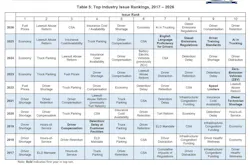
The survey's overall top industry issues this year were:
- Fuel prices
- Lawsuit abuse reform
- Compliance, Safety, Accountability (CSA)
- Insurance cost/availability
- Driver shortage
- Economy
- Artificial intelligence
- Diesel emissions regulations
- Driver compensation
- Driver retention
Who answered the ATRI survey?
Truck drivers’ top concerns
Professional drivers’ responses were quite different from the overall survey results:
- Fuel prices
- Truck parking
- Driver compensation
- Autonomous trucks
- English language proficiency for drivers
- Artificial intelligence (AI) in trucking
- Detention/delay at customer facilities
- Broker issues
- Diesel emissions regulations
- Hours-of-service (HOS)
The areas where drivers agreed most with overall results were fuel prices, driver compensation, and diesel emissions regulations.
This year’s Top Industry Issues Survey collected over 3,000 responses between August 24 and October 2. Most respondents were motor carrier executives and personnel (48.5%), and about a quarter of respondents were truck drivers (25.8%).
ATRI asked participants to rank their top three industry issues and then used a weighted point system to make the final list. The full report also includes respondents' priorities for research and advocacy under each issue.
1. Fuel prices
Fuel prices surged 17 spots from 2025's survey to rank as the highest industry issue. The Iran War started this year, leading to the largest global fuel supply crisis in decades.
According to the latest data from AAA, fuel prices are up 73% year over year. With one of the greatest for-hire operating costs exploding in a few months, it is no surprise that the price of fuel became the top industry concern in 2026.
The last times fuel ranked as the industry’s top issue were 2022, 2008, and 2005. This year’s survey was the first time that truck drivers also ranked fuel prices as their top concern.
2. Lawsuit abuse reform
Lawsuits consistently ranked among the industry’s top 10 concerns for the last six surveys.
Nuclear verdicts continue to incapacitate carriers and disturb their peers. Third-party litigation funding allows global investors to influence legal practices with little to no transparency. A recent ATRI study found that the highest verdicts and settlements have outpaced inflation in recent years. Even for successful defenses, the financial burden of constant litigation is another challenge for carrier operations.
Sidebar: Carrier executives top concerns
While motor carrier executives made up the majority of respondents, executives’ top industry issues ranked a little differently than in the survey’s overall top 10:
- Lawsuit abuse reform
- Fuel prices
- Driver shortage
- Insurance cost/availability
- CSA
- Driver retention
- Economy
- Diesel emissions regulations
- Driver compensation
- Driver distraction
The only top executive concern that did not make the overall top 10 was driver distraction, which was replaced by artificial intelligence.
3. Compliance, Safety, Accountability (CSA) program
The Federal Motor Carrier Safety Administration’s (FMCSA's) Compliance, Safety, Accountability program includes both Safety Measurement System (SMS) scoring and Safety Fitness Determinations.
Major concerns over CSA include geographic enforcement disparities and a slow DataQs appeal process, which can mischaracterize a fleet’s true safety profile. Plaintiffs invoke the results of Safety Fitness Determinations to sway juries toward nuclear verdicts, as seen in a recent major C.H. Robinson case.
Carriers’ concern for CSA remained one of the top 10 industry issues for 10 of the last 11 annual ATRI surveys, absent only from 2023’s report. This year was the first time CSA ranked among the top 5 since 2020.
4. Insurance cost/availability
Somewhat influenced by the rising costs of nuclear verdicts, the cost of insurance premiums in 2025 increased 3.9% year over year, according to ATRI’s latest Analysis of the Operational Costs of Trucking.
This survey marks the third year in a row that insurance cost/availability ranked among the top 5 industry concerns.
5. Driver shortage
After dropping out of the top 10 in 2025’s survey, the problem of driver availability rose once again to the top five industry issues this year. The driver shortage ranked as a top 10 issue for all but one year since 2016.
Retirements, competition with other employers, improving load-to-truck ratios, and FMCSA’s crackdown all contributed to the resurgence of trucking labor tightness.
6. Economy
Overall freight demand is still rather chilled: Housing starts have hardly moved, and the average consumer’s financial strength has consistently deteriorated over the last two decades. However, freight rates recovered since the last quarter of 2025 because for-hire capacity declined.
The economy was the industry’s top issue for the last three years. Carriers finally earned their much-needed break from a long, brutal market recession. Whether those for-hire rate increases will outpace 2026 operational costs, however, remains to be seen.
7. Artificial intelligence in trucking
Artificial intelligence (AI) ranked as a concern much more among drivers than among carrier executives. AI made its debut in the 2025 Top Issues survey.
Respondents’ concern for AI center on job elimination and AI-enabled fraud.
8. Diesel emissions regulations
Emissions regulations ranked among the top 10 for a second year in a row. The U.S. Environmental Protection Agency’s (EPA's) NOx rule for 2027 engines still has major revisions in the works—EPA submitted a proposed rule in July but has not yet published its final rule.
Engine manufacturers each have different strategies on how they will approach next year’s regulations. All the 2027 engines will likely incur some cost increases, and manufacturers’ strategies could still change depending on EPA’s final rule.
Truck parking not so urgent for executives
For the first time since 2012 (14 years!), truck parking fell out of the top 10 issues, ranking 11th among all survey respondents. However, among truck drivers, parking still ranked as the second-most-important concern.
9. Driver compensation
Driver compensation ranked among the top 10 every year since its debut in 2019. Ranking ninth in 2026 is the lowest this issue has placed in those seven years.
Both drivers and executives ranked compensation among their top 10 issues, though drivers ranked the issue slightly higher.
Driver compensation is directly related to the challenges carriers face in hiring and retention. ATRI’s latest operational costs studies found that driver wages did not keep up with inflation in 2024 or 2025 (though driver wages grew dramatically in 2021, 2022, and 2023). Several carriers have publicly announced pay raises for drivers to attract more talent in 2026.
10. Driver retention
Driver retention disappeared from the top 10 in 2024 and 2025—but made its comeback this year.
Directly tied to driver compensation and the driver shortage, carrier executives continue looking for ways to keep their top talent in an industry with very high turnover. ATRI’s latest operational costs study found that for-hire driver turnover in 2025 averaged 44.2%.


About the Author
 Jeremy Wolfe
Editor
Editor Jeremy Wolfe joined the FleetOwner team in February 2024. He graduated from the University of Wisconsin-Stevens Point with majors in English and Philosophy. He previously served as Editor for Endeavor Business Media's Water Group publications.
Related
 truck diesel fuel concern
 Man fueling diesel truck podcast thumbnail

