Desperate trucking times call for (mostly) business as usual
Not long ago, though relatively speaking, a lifetime ago, hearing the phrase “the new normal” 100 times a day would be quite unusual. Back then, the biggest concerns for a trucking fleet were to make deliveries on time, as safely and efficiently as possible.
Now, because of COVID-19, fleets great and small must rethink every aspect of operations, from who can enter the building to how to interact with employees.
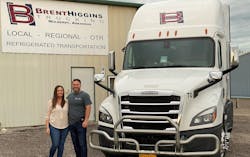
Take Brent Higgins Trucking for example. Company president, Brent, who with his wife Connie (the vice president), owns the Mulberry, Ark.-based refrigerated hauler and has large poultry providers as customers, hasn’t seen things change that much. America will always need protein, after all. Mileage increased by 4%. In March, it was just south of flat, with a 1.5% dip.
But even for them, even the simplest routines will have complications going forward.
In the first half of March 2020, right before the mass spread of COVID-19 and the total disruption of normalcy in America’s way of life, Brent qualified two new drivers before officially hiring them with a road test. And like usual, he was right next to them in the Class 8 truck passenger seat.
Connie noted that the internal test is not a federally mandated rule and that telematics can inform management of dangerous driving habits such as hard braking and speeding, but it helps lower the fleet’s insurance premiums. More importantly, the interactions with the potential new hires provides the family-run business a level of comfort and peace of mind.
“We can see their behavior without being in the truck with them, we just like to do the road test to build a relationship from day one,” Brent said. “I like to make sure they don’t make me dig my toenails into the floorboards going around a curve.”
Going forward, Brent wonders if these tests will have to be done solely relying on dash cams of streaming video from a smart device. He even mentioned a physical barrier between the cab seats for tests, though a Plexiglas wall seems to add more safety questions than it answers.
The two new drivers passed the test and joined the small fleet of about two dozen Freightliner Cascadias. The good news is that they have been “exceptional,” Connie said.
The bad news is that the Higgins don’t really know what the future holds. Will the country reopen responsibly? Will the economy come back? Will there be a Spanish Flu-style resurgence of COVID-19? Or do we all just need to take more Vitamin D?
Until those questions are answered, the big one is how to stay profitable. In early May, the national refrigerated rate was 12% lower than in March, dropping 26 cents to $1.93 per mile. That’s the lowest since 2017.
“It’s almost like we’re in 2015 again, where things slowed up,” Brent said. “A bunch, not all, have smelt the blood in the water. People needed trucks to stock the shelves, now that that has blown over, some are really getting crazy [with the rates] they are offering for freight.”
For now, Higgins has to figure out how to endure getting paid less to do the same job with most costs, less costly fuel being an exception, remaining the same.
The Higgins’ strategy is to adhere to the “old normal” as much as possible.
For starters, even though the Federal Motor Carrier Safety Administration’s (FMCSA) hours of service regulations have been relaxed for essential goods, such as food, Higgins Trucking follows the pre-COVID-19 rules.
“We still have to make sure [our drivers] are rested — it is our duty,” Connie asserted. "In the event of an accident, we are still at fault, regardless of what the FMCSA says is OK.”
Brent noted that the hardships of today may not be remembered as vividly down the road.
“In 18 months from now, is anyone on a jury going to remember what it’s like not to have milk or toilet paper on the shelf? Are they really going to be sympathetic to us?” he asked.
Of course, drivers are given bleach mix, hand sanitizer and masks for the road, and maintenance technicians sanitize the trucks when they come into the shop. Everyone is told to safe distance, Connie said.
What hasn’t changed is how the drivers are treated. Raises have also remained the same.
“They do their job, so there’s no reason for them not to receive what they earned,” Connie said. “And if they don’t receive it, they would go somewhere else.”
They would face an unfriendly job market. According to April BLS data, the truck transportation sector lost a total of 88,300 jobs. But Higgins Trucking must prepare as much for the business as usual as they have for the ongoing pandemic.
Losing good drivers now could add extra expenses in the future.
“Retention also saves money,” Connie said. “It takes a significant amount of money to qualify and train new hires.”
On average in the trucking industry, this could range from a few to several thousand dollars.
For one of their drivers, Tim Hutchins, keeping things relatively unchanged has been invaluable. He said his bosses have remained calm and ensured them the business will be OK.
That has been key to overall safety, said Hutchins, who has been with Higgins Trucking for four years and has been driving for more than 20 years overall.
“If you're excited and all worked up, you're not going to be an efficient employee,” he said. “And they want to make sure that we do the best job possible out here.”
He said the Higgins, who have a son and daughter working for them, treat every driver “like family.”
They keep drivers apprised of any changes and are upfront about the need to accept runs they may not like and the importance of teamwork.
“It’s the best company I ever worked for,” said Hutchins, who has worked for about a dozen trucking companies. He estimates he has 12 years left until retirement.
“This is going to be my last job ever,” he said.
About the Author

John Hitch
Editor
John Hitch is the editor-in-chief of Fleet Maintenance, providing maintenance management and technicians with the the latest information on the tools and strategies to keep their fleets' commercial vehicles moving. He is based out of Cleveland, Ohio, and was previously senior editor for FleetOwner. He previously wrote about manufacturing and advanced technology for IndustryWeek and New Equipment Digest.