Does hydrogen have a place in trucking's future?
Key takeaways
- Hydrogen offers benefits like higher payload capacity and potential energy independence, making it attractive for certain trucking fleets.
- Major barriers include high costs, limited infrastructure, and regulatory uncertainties, which slow widespread adoption.
- Location and customer willingness to pay premiums significantly influence hydrogen fleet deployment decisions.
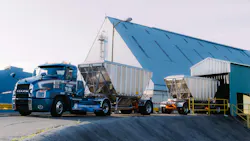
Is hydrogen fuel for the trucking industry still a thing?
The answer depends on who you ask. Some will shake their heads. “It’s too expensive.” “There’s no infrastructure.” Others are using hydrogen-powered trucks in their operations today.
But perhaps the best assessment when determining whether hydrogen is the fuel that could or the fuel that never will depends on who’s using it and where they operate.
Who wants a hydrogen-operated fleet?
Hydrogen is expensive, and the infrastructure to transport it from one fleet depot to the next hardly exists. So why do fleets consider it as a fuel source? In many cases, companies are looking for solutions that reduce their overall carbon footprint.
While battery-electric vehicles (BEVs) have received most of the hype around alternative energy for fleets, those that find BEVs lacking—in terms of weight and range restrictions as well as the energy to power them—see hydrogen as a better solution.
“I think the biggest thing is the payload preservation; as we look at battery electric, the weight is very concerning, and when you're paid by the pound, every pound is revenue,” Tyler Flynn, VP of procurement at Savage Companies, said during a panel on hydrogen operations at ACT Expo in May. “There's a lot of great [BEV] technologies out there, but we've determined that hydrogen, [although] not quite a drop-in [fuel], it's much closer to diesel operation than other options.”
Another reason a company might consider hydrogen fuel is for energy independence. Marty Tufte, corporate fleet director for Waste Management (WM), said that energy costs from utilities are unstable, which is a negative aspect of running a BEV fleet. Yet, with Middle East conflicts again causing fuel price increases, the cost of diesel is also too unpredictable.
“You can't have your business affected by the Strait of Hormuz,” Tufte said. “It makes it too volatile. … It's very difficult to catch those events when costs rise and you can't recover.”
And while hydrogen still has a long way to go in development and implementation before it becomes a more widely adopted fuel source, fleets like WM and Savage Companies are hoping to help pave the way.
“If you don't push the edge of the envelope, you're never going to get there,” Tufte said of hydrogen fuel adoption. He compared hydrogen fuel to WM’s adoption of compressed natural gas (CNG) in 2001. “Was that pretty out of the gate? No, it was not. It was very difficult, but fast-forward 20 years later, now it's mainstream for us, and it's how we do business every day.”
Hydrogen: A fuel for the few…for now
In 2022, the Biden administration allocated billions of dollars for hydrogen fuel production and development. The proposed projects didn’t make it off the ground before Donald Trump was sworn in as president in 2025 and eventually canceled that funding. This lack of government investment has significantly decreased the momentum behind hydrogen fuel research, development, and adoption.
Yet while the mainstream momentum has slowed, the companies pursuing the fuel are finding success. For now, it’s largely only enterprise corporations with abundant resources that are able to explore the alternative fuel source. It will take more years of hydrogen success within these companies—with success metrics based on ROI—before smaller fleets have a shot at piloting hydrogen-powered rigs.
While WM has a fleet of hydrogen vehicles, the company still has concerns with widespread deployment. Tufte cited two concerns about hydrogen adoption for WM, specifically: It’s important that WM can fuel its vehicles on-site at its depots, and the overall durability of hydrogen fuel-cell trucks is yet unknown.
“We keep our trucks an average of 15 years, so that means I’m going to have to do a midlife rebuild,” Tufte said. “I’ve got to know what that’s going to cost. You’re not talking about an engine overhaul for $40,000 to $50,000. You’re talking [about] replacing batteries or a fuel cell [that costs] in the hundreds of thousands of dollars. Obviously, that makes a difference.”
 hydrogen trucking
 NAFA opens 2026 Green Fleet Awards applications for sustainable fleet leaders
Other companies that are interested in hydrogen vehicles might not even be in a location where it makes sense. For Savage Companies, location plays a major role in its hydrogen vehicle deployment.
“We’re starting in California; there’s obviously some support there but also requirements to some degree,” Flynn said. California currently has a robust incentive offering for hydrogen development and hydrogen vehicle deployment.
“But we’re also looking outside of California. Texas is a prime example where there's a lower cost of hydrogen, so the TCO (total cost of ownership) gets closer. We're looking at those numbers now to see if it possibly makes sense.”
Also linked with location is a fleet company’s customers’ willingness to pay a premium for hydrogen-powered hauls.
“Customer support of rate is not likely to be there outside of California to a large degree, so we have to be cognizant of rates and how we keep our costs low,” Flynn explained.
Tufte echoed that sentiment for WM: “You can’t just pass everything on to the ratepayer all the time. They're not going to put up with … prices continuing to climb.”
Any fleet that isn’t located in a hydrogen-friendly area or that doesn't have willing customers might have to wait a while before they can even entertain the thought of adding a hydrogen-powered truck to their fleet.
When will hydrogen fuel be ready for trucking?
What will it take for all fleets to be able to dabble in a hydrogen-fueled fleet?
Hydrogen “has to stand on its own legs,” Rick Breunesse, commercial lead at Symbio North America, said during the same panel at ACT Expo.
Part of standing on its own legs goes well beyond the vehicles and into the hydrogen ecosystem—or hydrogen infrastructure—to support them. As Breunesse said, the vehicles are there, and “you can build them all day long, but if you don’t have that ecosystem, it’s not going to work.”
Parker Meeks, CEO of hydrogen technology company Utility Global, believes the “real home run” with hydrogen adoption in the trucking industry will happen when hydrogen designed for industrial use can be used by local fleets for trucking fuel.
“We have potential locations in the Pacific Northwest and in the Midwest that are refinery-based projects that, [when] those come online, it'll be approved for industrial scale usage internally,” Meeks explained. “As truck demand grows within the footprint of those plants, you could siphon off 1, 5, 10 tons a day.”
Taking smaller batches of hydrogen from these large-scale hydrogen production facilities will drastically decrease the price of hydrogen fuel for the trucking industry, Meeks believes, perhaps even down to $5 and $8 a kilogram. And because hydrogen is a more efficient fuel than diesel, this price per kilogram puts hydrogen “in the strike price of what you need for trucks,” Meeks said.
However, those industrial hydrogen production facilities must first be built. Part of that $7 billion award from the Biden administration was set to go toward funding those industrial hydrogen centers. Now, without those funds, hydrogen development is the sole responsibility of the private sector and local governments. This also produces yet another obstacle for fleets: regulations and the constant pendulum swing from a pro-green energy government to a fossil-fuel-friendly government.
Regulatory certainty “can't be on a political cycle,” Tufte said, because “fleets can't plan long term.”
About the Author
 Jade Brasher
Jade Brasher
Executive Editor Jade Brasher has covered vocational trucking and fleets since 2018. A graduate of The University of Alabama with a degree in journalism, Jade enjoys telling stories about the people behind the wheel and the intricate processes of the ever-evolving trucking industry.