Guaranteed pay, guns, port chassis, skills test and more
In this week’s round-up of this and that from the wide world of trucking, guaranteed truck driver pay; armed U.S. Customs agents will cross into to Mexico to move trucks through faster; new truck equipment inspection procedures at West Coast ports are slowing freight movement, however; Nebraska’s best trucker drivers get take a star turn on state tv; and, finally, the EPA is looking into more emissions regs—this time for aircraft.
Bank on it: In the ongoing effort to reduce driver turnover, Covenant Transport is now offering some drivers guaranteed minimum pay.
As the Chattanooga (TN) Times Free Press reports, the carrier will guarantee $1,000 a week of pay for each of the 1,032 experienced drivers that haul hazardous materials, plus another two days of earned home time.
"With this, you know that if you work 45 weeks a year, you're going to earn at least $45,000 a year and probably more," said Rob Hatchett, vice president of recruiting for Covenant. "Even with higher pay rates in our industry, there are still weeks where you might get caught in a snowstorm or have your truck break down and you don't make as much as normal. We're saying even with all those things, we're still going to guarantee you this baseline and that's the kind of consistency in pay that drivers really want but usually have never had."
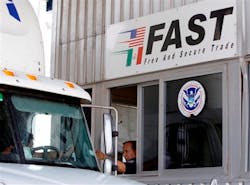
The change to Mexico's strict firearms legislation was approved and enacted May 22. The date when U.S. agents will start going into Mexico to inspect cargo before it heads to this country has not been set.
"This demonstrates once more that Mexico and the U.S. have interest to improve trade between the two countries. This is a huge step," said Manuel Sotelo, chairman of the Juárez Trucking Association.
Double-check no discount: The California Trucking Association has accused the ILWU port union members working the ports and Pacific Maritime Association, the group that represents dockworkers during labor negotiations, of creating an equipment inspections process that ultimately does nothing to reduce congestion around West Coast ports.
According to the Long Beach Press Telegram, the issue—depending upon whom you ask—revolves around the intermodal chassis. Drivers have had so much difficulty obtaining chassis in past months that the equipment is often perceived as being a central factor in congestion problems around the ports of Los Angeles and Long Beach.
“The PMA and ILWU both claim they want to work to resolve congestion, but the implementation of inefficient, unnecessary chassis inspections says otherwise,” the CTA statement charges. “Chassis should be repaired and inspected before they are provided to truckers, not after.”
An ILWU told the newspaper the inspection program is necessary for road safety and not significantly different from the way things have worked around West Coast ports for some 18 months.
KHGI-TV/KWNB-TV/KHGI-CD-Grand Island, Kearney, Hastings
Spotlight: Nebraska’s top truckers made the news this week for what they do well, rather than starring in another video of a highway crash.
The 91 drivers taking part at the weekend competition in Grand Island were competing for a spot in the upcoming national driving championships, but it's not the reason most come to take part, NebraskaTV.com reports.
“It's fun, camaraderie, meet new people, every year it seems like there's somebody different, a lot of new guys coming in and new companies,” says Don Smith, a driver for Hunt Transportation in Omaha.
“We get a lot of skills and kind of see things to practice on and work on, just kind of fun,” agrees fellow Hunt driver Guy Cortney.
Re-gen problems? If you thought emissions-mandated changes in truck engines caused serious problems in 2007 and 2010, you might want to rethink your plans to fly in the not too distant future. The Obama administration now wants to reduce emissions from airplanes, the next step in the fight against climate change that has already included significant regulations on cars, trucks and power plants, as the New York Times report.
Any day now, the Environmental Protection Agency (EPA) will announce that the carbon dioxide expelled from commercial aircraft is harmful, kicking off the regulatory process to reduce that pollution.
Republicans have called the new rules an example of government overreach that will cost jobs and stifle the economy, according to the Times. But environmentalists have praised the administrations aggressive use of the Clean Air Act to get around by Congress to fight climate change.
About the Author

Kevin Jones
Editor
Kevin has served as editor-in-chief of Trailer/Body Builders magazine since 2017—just the third editor in the magazine’s 60 years. He is also editorial director for Endeavor Business Media’s Commercial Vehicle group, which includes FleetOwner, Bulk Transporter, Refrigerated Transporter, American Trucker, and Fleet Maintenance magazines and websites.
Working from Beaufort, S.C., Kevin has covered trucking and manufacturing for nearly 20 years. His writing and commentary about the trucking industry and, previously, business and government, has been recognized with numerous state, regional, and national journalism awards.