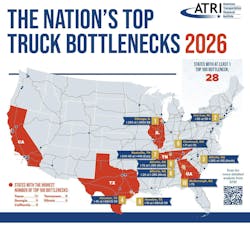
ATRI releases 2026 Top 100 Truck Bottleneck List to highlight most congested freight locations in the U.S.
Key takeaways
- Chicago’s I-294/I-290/I-88 interchange is now the nation’s most congested truck bottleneck, overtaking Fort Lee, New Jersey.
- Average rush-hour truck speeds dropped to 33.2 mph, highlighting growing delays across top freight corridors.
- Data-driven infrastructure investments can reduce chokepoints, improve freight flow, and cut operating costs for fleets.
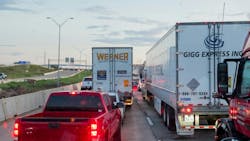
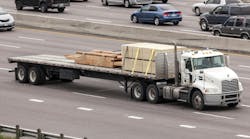
The American Transportation Research Institute (ATRI) recently released its 15th annual Top 100 Truck Bottleneck List, identifying the most congested freight bottlenecks in the United States. The company analyzed truck GPS data from more than 325 national highway locations to produce congestion impact rankings that help guide infrastructure planning and investment.
The company’s 2026 analysis revealed that congestion continues to worsen, with average rush hour truck speeds dropping to 33.2 mph, 2.8% slower than the previous year. Among the top 10 bottlenecks, average rush hour speeds were 29.6 mph.
Top 10 bottlenecks:
- I-294 at I-290/I-88, Chicago, Illinois
- I-95 at SR 4, Fort Lee, New Jersey
- I-285 at I-85 (North), Atlanta, Georgia
- I-45 at I-69/US 59, Houston, Texas
- I-75 at I-285 (North), Atlanta, Georgia
- I-20 at I-285 (West), Atlanta, Georgia
- I-24/I-40 at I-440 (East), Nashville, Tennessee
- I-10 at I-69/US 59, Houston, Texas
- I-71 at I-75, Cincinnati, Ohio
- I-75, McDonough, Georgia
The company’s research provides actionable insights for local, state, and federal governments as Congress prepares to reauthorize surface transportation programs. Targeted investments informed by this data can reduce congestion, lower emissions, and drive economic growth.
“Congestion delays inflicted on truckers are the equivalent of 436,000 drivers sitting idle for an entire year,” Rebecca Brewster, ATRI president and COO, stated. “While these congestion metrics are getting worse, the good news is that states do not need to accept the status quo. Illinois has been home to the country’s top bottleneck before, but following a sustained effort to expand capacity, its previous No. 1 bottleneck at the Jane Byrne Interchange no longer ranks in the top 25. This data gives policymakers a road map to reduce chokepoints, lower emissions, and drive economic growth.”