Schneider eyes more dedicated M&A to expand fleet reach and lock in long-term freight
Key takeaways
- Schneider is accelerating dedicated growth through acquisitions as it says shippers increasingly prefer large, stable carriers.
- The company is pursuing specialty dedicated services—like lightweight equipment and multi-stop retail—for sticky, long-term contracts.
- Despite a tough market, the major carrier hopes for renewed Q3 momentum as customers move stalled deals forward.
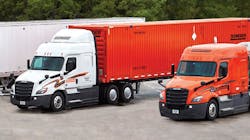
A year after buying Cowan Systems to expand its network in the East and Mid-Atlantic, Schneider National is eyeing more acquisitions in the dedicated space, President and CEO Mark Rourke told a recent gathering.
Wisconsin-based Schneider last December paid about $420 million for Cowan and some related real estate. The purchase fit nicely with the company’s broader strategy of focusing more of its truckload business on the dedicated space. Speaking on November 12 at the Baird 55th Annual Global Industrial Conference, Rourke noted that about 70% of trucks in the truckload segment now focus on dedicated work, which he added generates longer contracts and deeper customer relationships. That’s up from 33% in 2017.
A Schneider goal in growing its dedicated book has been to build business with a specialty component, Rourke said. That could mean using lightweight equipment, relay networks, or a “very high-touch, multi-stop retail-type configuration.” Once secured, that type of work is often sticky, he added, with customers signing contracts lasting three years or more.
Organic growth will play a role in Schneider—No. 7 on the 2025 FleetOwner 500 list of the largest U.S. for-hire carriers—continuing to grow in the dedicated space: Rourke said his teams closed three times as much business in the third quarter as they did in the first half of the year, a sign that shippers are gravitating toward larger players. But that same dynamic also plays into M&A dynamics, and the Schneider team wants to sign an acquisition deal every 12 to 18 months.


“At any point, we have a robust pipeline of targets that we’re looking at in terms of acquisitions […] This environment also—there are opportunities to be opportunistic, right?” CFO Darrell Campbell told the Baird conference. “You did see that with the last transaction that we did […] With more carriers struggling, there is an opportunity.”
Boosted by the Cowan deal, Schneider rang up more than $436 million in dedicated revenues during the third quarter versus $348 million in the same period of last year. That figure equated to 30% of its total revenues. The company ran an average of 8,472 trucks during the quarter.
The broader dedicated market available to carriers is worth about $90 billion, J.B. Hunt Transport Services CFO Brad Delco told a Stephens investment conference on November 18. Brad Hicks, J.B. Hunt’s president of dedicated contract services, said his team—which booked $864 million in revenues during Q3, when its average truck count was down 1% from the prior year—has been facing “a really difficult environment, a lot of pressure to retain your business” in recent quarters and that customers and prospects have generally been slower to make decisions given the tariff and macroeconomic uncertainties they face.
However, similarly to his peers at Schneider having more successes in Q3, Hicks told the Stephens gathering that things might be turning.
“We’ve had a lot of deals right there at the edge and they’re just kind of in a holding pattern,” he said. “I would say that, here towards the end, we feel like some customers are motivated to get the deal done by year’s end. So that’s encouraging as we think about what success we may have here in Q4.”
About the Author

Geert De Lombaerde
Senior Editor
A native of Belgium, Geert De Lombaerde has more than two decades of experience in business journalism. Since 2021, he has written about markets and economic trends for Endeavor Business Media publications FleetOwner, Healthcare Innovation, IndustryWeek, Oil & Gas Journal, and T&D World.
With a degree in journalism from the University of Missouri, he began his reporting career at the Business Courier in Cincinnati. He later was managing editor and editor of the Nashville Business Journal. Most recently, he oversaw the online and print products of the Nashville Post and reported primarily on Middle Tennessee’s finance sector and many of its publicly traded companies.