Advances in reefer management are heating up
With much emphasis placed on the tractor, the trailer can sometimes become an overlooked asset for a fleet. While neglecting the trailer is never a good idea, it is especially unwise when managing a fleet of refrigerated trailers. Thankfully, manufacturers of transport refrigeration units (TRUs) and trailers alike are finding ways to provide reefers that are not only safer and more productive, but also easier to manage and maintain.
The bottom line is that no fleet wants to see unscheduled service with any asset—especially a refrigerated trailer.
“The only time we want to see a TRU going into the shop is for a scheduled maintenance event,” Tom Kampf, product manager for Thermo King, a provider of transportation temperature control systems, said.
Given that underlying objective, fleets should look at the various reasons a TRU might fail in the field. According to Kampf, the most common failure mode is a TRU that simply fails to start. The most common cause is an insufficiently charged battery.
Fleets and TRU manufacturers are looking for ways to prevent battery failure in the field. The harnessing of solar energy is an increasingly popular one.
Tapping into solar
In the case of Thermo King, solar panels have been offered as an aftermarket add-on for more than five years, and as an optional feature from the factory for the past two years.
“A solar panel is now one of the top five options ordered by our customers,” Kampf pointed out. “Our 30W solar panel can mount to either the trailer or the TRU itself. The solar panel helps keep the battery topped off so the TRU can restart after its off-cycle rest.”
Aside from being a relatively inexpensive way to help maintain sufficient TRU battery charge, fleets also like the fact that a solar charging panel is relatively straightforward in both operation and maintenance.
“Our TRUs have an integrated charge controller so we don’t overcharge,” Kampf explained. “Our solar panel system is also all 12V, so we thankfully don’t have to do anything to convert the power generated by the solar panel. Our solar panel is also designed to be a maintenance-free item. Outside of periodic inspections to make sure it’s free of debris buildup, there really is no maintenance to be done.”
Telematics considerations with TRUs
Insufficient battery charge represents a more obvious failure mode for TRUs, but there are also a handful of other more inconspicuous problems that can arise. Kampf said telematics, an increasingly utilized technology, is helping fleets gain more insight into these types of issues.
“Up until a few years ago, when customers told us how their TRUs were failing, the data was somewhat anecdotal,” Kampf said. “We made the investment to make telematics a standard feature on all of our trailer units. This has allowed us to mine data off of our units – data that helps tell us which components are not operating as they should. Maybe it’s a buildup of ice on evaporative blowers, for instance. This helps us, as a manufacturer, make investments in areas that will help the fleet achieve higher utilization. Everything is becoming more data-driven, and a TRU is no exception.”

In addition to utilization, temperature compliance, and fuel consumption, Thermo King’s Kampf said telematics captures hundreds of other TRU readings including valve placement, engine operation, blower speeds, and duty cycle of the compressor.
“A lot of this information is available to our dealers,” Kampf pointed out. “It gets a little trickier when you’re talking about fleet maintenance facilities because they are not tied into our system. That said, a fleet does have the ability to download data on a particular unit to study its previous operation history through a program called Service Watch.”
This could help a fleet identify when a certain parameter may be outside of a normal range, prompting a call to its Thermo King dealer for further diagnosis.
“This is really the key to telematics in general,” Kampf added. “It is really that preventive or prognostic approach to maintenance that helps reduce the likelihood of a downtime incident.”
Options for executing preventive maintenance
Telematics helps fleets gain efficiencies in another big way. Managing TRUs and updating TRU software can largely be done wirelessly. That means technicians no longer have to spend time walking around the yard to service trailers.
That is not to say that technology and telematics are on the verge of rendering the heavy duty service technician obsolete. There is still much to keep an eye on to ensure reliable, long-term performance of today’s TRUs.
Thermo King’s Kampf reminded that when it comes to preventive maintenance, there is no substitute for following the OE’s recommendations for a given product. That said, here is a rundown of some of the more essential preventive maintenance items a technician should be paying attention to.
Pre-trip inspections
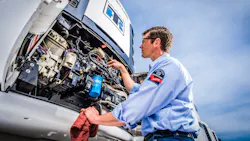
It is always important to check the engine oil level, refrigerant level, antifreeze protection, and belt tension and condition. It is also a good idea to run a test on the microprocessor. Technicians should also regularly inspect the structural integrity of the TRU, searching for things like fluid leaks, loose or damaged parts, bearing wear, hose condition, etc.
Also, every 1,500 hours or so, give the TRU a good cleaning, including the condenser and evaporator coils, and remember to inspect the defrost drain tubes for blockage.
Engine
Every 1,500 hours, a technician should drain water from the fuel tank and check the vent, and inspect/clean the electric fuel pump filter. Every 3,000 hours, a technician should replace the air cleaner element and fuel filter/water separator. The engine oil and filter should also be changed, and the engine valve clearance should be adjusted. Every 4,500 hours or annually, a technician should check the engine mounts for wear. Finally, the coolant should be changed every five years or 12,000 miles.
Electrical
Every 1,500 hours, a technician should inspect the battery terminals and electrolyte level, as well as the wire harness for damage or loose connections. Every 4,500 hours or annually, a technician should inspect the AC generator and alternator wire connections.
Refrigerant
Every 1,500 hours, a technician should check the suction pressure, as well as the compressor oil level and overall condition. Every 4,500 hours or annually, check compressor efficiency and pump down the refrigeration system. It is also important to empty the oil collection container that is mounted on the compressor.
For fleets that would rather outsource TRU maintenance to a dealer, options exist to make the process easier. For instance, Thermo King’s Performance Advantage program offers a set of varying maintenance plans so a fleet can best match to its TRU servicing needs and budget.
Successful management of refrigerated trailers comes down to two vital aspects: maximizing efficiency and protecting the cargo. Manufacturers of TRUs and the refrigerated trailers themselves are making advances to help a fleet achieve both of those objectives. Service technicians continue to play a vital role, as well, with an increasingly influential nudge from technology.
This article originally appeared on Fleet Maintenance.