Managing a large dairy fleet: Prairie Farms’ approach to trucks and trailers
Key takeaways
- Prairie Farms operates a large dairy fleet with trucks, tractors, and refrigerated trailers across 23 states.
- Telematics, maintenance standards, and driver coaching improve reliability, safety, and efficiency.
- Fuel efficiency and sustainability are addressed through new powertrains and interest in alternative fuels.
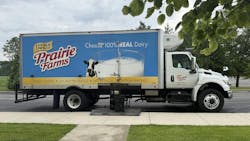
When Scott Nickell, corporate fleet manager, described Prairie Farms as “the biggest small company you’d ever want to be around,” it required some explaining. What he meant, however, quickly became apparent.
For starters, the “big” part of that statement is immediately apparent. Headquartered in Edwardsville, Illinois, Prairie Farms and its joint ventures and subsidiaries operate 48 manufacturing facilities and over 100 branches in 23 states that produce and distribute a large number of dairy products. On the “small” side of the equation are the more than 500 families, each with an average of 120 cows, who own and operate the 87-year-old, farmer-owned cooperative.
Prairie Farms' fleet size, equipment, and operational reach
Across the operation as well is a sizable fleet consisting of 1,600 straight trucks and tractors, 700 light-duty vehicles, and about 2,500 refrigerated trailers. As for power units, the company almost exclusively operates International MV Series trucks and LT tractor models.
Truck bodies at Prairie Farms are supplied primarily by Hercules, and the newest trailers are Utility models. Refrigeration units, including some dual-temp models for hauling refrigerated and frozen products, come mainly from Thermo King, along with some Carrier Transicold systems.
Spread across a large geographic area, the Prairie Farms fleet runs both long and short routes, with some trucks covering 20 to 30 stops per day and others running only 1,000 miles per month. According to Nickell, fleet reliability is paramount, regardless of a vehicle’s use.
“Many of our products, especially fresh milk, have a short shelf life,” Nickell said. “With proven specs and the backing of suppliers, including International and our dealers, we can ensure it gets to stores and other customers on time.”
In addition, Prairie Farms purchases new trucks and tractors to replace units that have reached the end of their service life.
“We buy a substantial number of vehicles every year, but it’s always a financial decision,” Nickell related. “We will also swap bodies onto new chassis and rebuild engines. With the constantly rising cost of new equipment, that can make sense.”
“Sustainability is also an equipment consideration,” he continued. “Our newest Internationals, for example, have the manufacturer’s S13 Integrated Powertrain, and we’re seeing an 11% to 14% mile per gallon increase with those units.”
“We’re always open to other opportunities to lower our fleet’s carbon footprint,” Nickell added. “Without the infrastructure in our operating area, it’s currently hard to justify the expense of many alternative fuels. But that will change over time, and we’re especially interested in technologies like hydrogen when solutions such as exchangeable fuel cylinders become available.”
Maintenance, safety, and driver training drive efficiency and reliability
Efficiency and reliability for the Prairie Farms fleets are also the focus of the company’s decentralized maintenance program, which includes some company shops and a network of contract maintenance providers, especially in areas where a small number of vehicles are based.
“We determine best practices, and we’re implementing company-wide maintenance standards,” Nickell explained. “We’re also using the Geotab platform, which provides telematics data that can help us get ahead of potential problems.”
The Geotab systems and electronic logging devices provide Prairie Farms with safety-related data, including information on driver habits that need to be addressed, such as speeding, hard braking, and cornering. Implemented 24 months ago, a comprehensive driver coaching and training program supported by J.J. Keller is used when corrective action is needed.
The program is also central to ongoing driver training for new hires and veteran operators. New drivers are assigned 12 courses in their first two weeks, and all truck, tractor, and yard spotter drivers complete a monthly series of classes that last an average of 25 minutes each.
“Training is essential for safety,” Nickell emphasized. “At the same time, we are always focused on finding new drivers. Even though we can offer static routes and a return home every day, it continues to be a challenge to find younger people who want a career as a driver and people who want to move heavy crates at delivery locations. Our goal is to be able to address that need over the long term.”
“Dedication is at the heart of Prairie Farms,” he continued. “The farm families who make up our cooperative selflessly take on the tremendous task of producing milk 24/7, 365 days a year. Just as important to our ongoing success as our farmer-owners is the fleet they rely on every day.”
About the Author
 Seth Skydel
Seth Skydel
Seth Skydel, a veteran industry editor, has more than four decades of experience in fleet management, trucking, and transportation and logistics publications. Today, in editorial and marketing roles, he writes about fleet, service, and transportation management, vehicle and information technology, and industry trends and issues.