Large fleet closings dominate the news, but it’s the small fleets that should worry
Key Highlights
- Small fleets have remained resilient due to low overhead costs and utilization of technology, despite a sluggish freight market.
- Recent regulations, such as stricter ELD enforcement and CDL licensing changes, disproportionately impact small carriers, increasing their risk of closure.
- Regulatory efforts aim to improve safety and compliance but may inadvertently accelerate small fleet exits, shaping future industry dynamics.
- Experts warn that driver shortages could re-emerge around 2026-2027, especially if current regulatory trends continue, impacting long-term capacity and profitability.

There’s no denying that trucking capacity must exit for the industry to once again become profitable. With a downturn in the market, there isn’t enough freight to justify the amount of trucks on the road, yet industry players have managed to remain afloat.
Industry analysts, such as FTR Transportation Intelligence’s VP of trucking, Avery Vise, believe that what has kept these smaller operators above water is likely due to the business stimulus funds granted during the COVID-19 pandemic and, unlike larger carriers with offices, mechanics, and additional support staff and managers, these small operators have very little overhead.
“In 2021 [small fleets] were making a lot of money, and a lot of them paid off trucks, and they paid down debt,” Vise told FleetOwner. “Their cost structures, in a lot of cases, are very low. And so while rates came down because of their ability to handle freight without more rate, they made up for that, to some degree, by having better utilization through technology.”
From this angle, it might appear that the economy favors the smaller carriers to stay on top while the larger carriers fold.
We’ve seen this happen already.
Earlier this month, 10 Roads Express, a truckload carrier whose largest customer is the United States Postal Service, announced it will close at the end of January. Vise reminds us that while what happens in the truckload segment won’t significantly affect the LTL segment, the closing of this decades-old carrier is an indication of just how volatile trucking has become.
Yet even if 10 Roads Express’ closing directly impacted the LTL segment, the company’s 2,000-plus truck count would only be a drop in the bucket, as Vise said closings, or fleets that lose their operating authority, have hovered around 14,000 per month for the past several months.
These are closings that don’t often make the headlines because they are mostly smaller fleets.
If the economy favors smaller fleets, as previously stated, then why are they closing? The answer is that while the economy favors smaller trucking operations, recent regulations have proven to hurt them—and perhaps, keep hurting them.
Regulations that could send small fleets out of business
The Trump administration is cracking down on English language proficiency among drivers, standardizing non-domiciled CDL requirements and restrictions, and more recently, modifying its electronic logging device (ELD) approval process. Each of these regulations—or the stricter enforcement of them—disproportionately affects small fleets.
The ELP crackdown
Drivers that fail English proficiency screenings when stopped by law enforcement will be taken out of service, as the Commercial Vehicle Safety Alliance added English proficiency to its list of out-of-service criteria this year. Vise alluded that this has the potential to disproportionately affect smaller fleets and owner-operators that have immigrated to the U.S.
According to the Federal Motor Carrier Safety Administration (FMCSA), English proficiency has been a standard for operating a commercial vehicle; however, CVSA’s addition to its out-of-service requirements has the potential to put more drivers out of service than year’s past.
It’s worth noting that of the past four years of FMCSA roadside inspections, “poor English proficiency accounted for only 0.16% of all inspection violations,” FleetOwner reported, and Vise told FleetOwner that he doesn’t expect the ELP enforcement to affect capacity significantly.
 Conventional cab trucks on highway
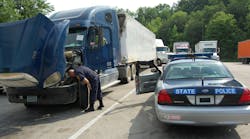 truck inspection enforcement
The ELD Crackdown
Cracking down on ELD compliance is necessary, but enforcement will primarily affect small fleets rather than large carriers. Large carriers with hundreds of trucks typically employ “more robust, reliable, and credible” logging devices, Vise explained. Therefore, these carriers are at less risk of their drivers being sent out of service because of a noncompliant ELD. On the other hand, small fleets are more likely to use less robust, less expensive, and lesser known ELDs that are at risk of being flagged as noncompliant, much like these five that the FMCSA recently listed as noncompliant.
Additionally, the FMCSA has overhauled how it will approve ELDs going forward. The new process will require verification of contact info, technical specs, and device images for initial review.
Nondomiciled CDL crackdown
Issuing licenses of all kinds, including commercial driver's licenses, is a state responsibility, yet this year the FMCSA has altered the state’s authority to issue nondomiciled CDLs and, in some cases, asked states to revoke licenses already issued.
Changes to nondomiciled regulations include new eligibility requirements for drivers and additional paperwork requirements. Drivers who wish to renew a nondomiciled CDL will also face changes. FleetOwner outlines these changes here.
While Vise believes these three regulation crackdowns will affect the smaller carriers and fleets much more so than larger carriers, he admits that only time will tell for certain.
“We don't really have any way of knowing how many of these very small carriers might actually be affected by proficiency or nondomiciled CDLs … because nobody really has good data on all this,” Vise explained. “All we can really go on is what's happening in the market.”
Although these regulations could spell trouble for the small players in the industry, Vise assures that they are aimed at safety and ensuring compliance.
Additionally, the administration has placed a focus on ensuring adequate training at CDL schools, which Vise said will not immediately impact capacity but has the potential to significantly impact the number of new CDL holders that enter the workforce in the years to come.
Overall, these regulations could make for a stronger and safer trucking workforce in the years to come.
“We're taking drivers out of the system, not based on what would happen naturally, but based on other forces, some of which are indeed … tightening enforcement to match the rule,” Vise said. “You can’t really argue with that.”
 electronic logging device interface
 truck driving paperwork
How will these regulations shape trucking's future?
With regulations and laws, it’s always a good idea to follow the rules, and the tightening of these regulations and increased enforcement will help the trucking industry do just that. What’s more, with the increased capacity and slow economy, the industry is at a place where it can afford to have drivers sidelined and even whole businesses shut down if they aren’t properly adhering to the law.
The question then becomes, what will happen when the market finally does turn?
“I would caution that at some point, whether it's late 2026 or 2027, we're going to be back to talking about the driver shortage again,” Vise said. “It's quite possible that some of the people who've been encouraging some of the actions that have been taken might regret having done so, but we'll see.”
With the economy preventing larger trucking companies from much growth and the government ensuring the smaller companies follow the rules, the industry’s capacity problem could solve itself.
About the Author
 Jade Brasher
Jade Brasher
Executive Editor Jade Brasher has covered vocational trucking and fleets since 2018. A graduate of The University of Alabama with a degree in journalism, Jade enjoys telling stories about the people behind the wheel and the intricate processes of the ever-evolving trucking industry.