Key takeaways
- Shari Pheasant emphasizes a people-first approach, focusing on culture, soft skills, and collaboration to drive business success.
- Her axiology-based strategy helps identify what is valuable to a company, boosting ROI and employee engagement.
- Pheasant’s leadership has resulted in zero turnover at her shop and doubled revenue over three years.
- She advocates for industry change through policy efforts, mentorship, and community initiatives to support independent auto shops.
For over a decade, FleetOwner has looked at ways to shine a light on how women are shaping the transportation industry in the 21st century. This year, the team profiled six women from different parts of the industry, showcasing their accomplishments and how they have overcome. You can view all six profiles here.
Despite co-owning A Master Mechanic repair shop in Sparks, Nevada, and being named 2025 Shop Owner of the Year by Women in Auto Care, Shari Pheasant doesn’t call herself the Queen of Horsepower because she can tune an engine with regal grace. She lets her husband and son handle the repair side of the mixed fleet/consumer shop.
Still, the name fits because the certified axiologist has a proven skill in turbocharging the businesses’ ability to reach new profit levels. She has done the same for many other transportation businesses and Fortune 500 companies for a dozen years and now certifies consultants on an axiological approach.
Now, what exactly is axiology? The fast-talking Italian American from Springfield, Massachusetts, explains that it’s a people-first approach set on identifying what is valuable to your company that ultimately drives ROI.
“There are moments that can break your culture, and the only way to keep those from happening is to constantly feed the development of your people, to feed the collaboration,” the growth specialist explained.
By doing so, people are in the right place to spread their wings and succeed while leaders focus on the right KPIs to determine success, Pheasant said.
Knowledge doesn’t just come from a database, as a spreadsheet doesn’t tell the full story. For example, a technician’s standard repair time may take a hit because of a rusted bolt or custom equipment. Pheasant wants leaders to extrapolate that to the whole business.
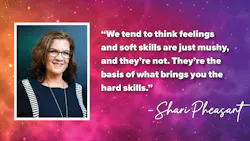
“We tend to think feelings and soft skills are just mushy, and they're not,” she asserted. “They're the basis of what brings you the hard skills.”
With the importance of hiring and retention at a zenith, and fleets tasked with doing more with less, Pheasant’s version of horsepower is in more demand than ever.
Her challenge is that she’s working in an industry that “doesn’t like change,” but it is “changing more than any [other].”
Her job is to change that one business at a time.
Human diagnostics
Her root cause analysis starts by collecting culture and leadership sentiment data through engagement assessments. Personality assessments then help leaders calibrate how they communicate with each individual.
She explained that a direct and outgoing person (like herself) might talk fast and want to act quickly after a discussion. Someone with a more deliberate cadence is prone to going by the book and taking time to reflect.
Neither is wrong, she noted, and knowing helps maintain those relationships. She practices what she preaches. Her 12-bay shop has used the assessments for several years and has had zero turnover in the last 18 months. The shop also doubled its revenue over the last three years.
“Hire for attitude, not aptitude,” Pheasant advised. You can train on how to make a repair or speak to customers, but only if the employee is willing to learn. “When you fire, you fire for attitude, because the attitude affected the aptitude,” she added.
One shop owner, Kathleen Callahan of Xpertech Auto Repair in Florida, said Pheasant’s mentorship over the past two years has been “a gigantic inspiration,” and it “has significantly improved our internal communication, the overall work environment, and our shop productivity.”
That all traces back to focusing on your people.
When recent hurricanes ravaged the south, Callahan’s focus was not on keeping the shop fully staffed but securing affected employees’ well-being by delivering supplies to their homes. That trust carries to the workplace.
“We had a great team culture before adding the assessments, and this has only increased our ability to understand each other more, thus lessening conflict,” Callahan said.
 wit_images_paige
 wit_images_kim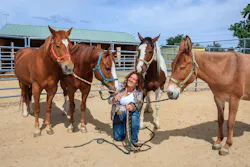
Horse sense
Pheasant noted this is the year of the Fire Horse. She’s not into astrology but likes what that represents: intense energy and rapid change. And growing up out West gave her an affinity for horses. She now has three of her own, which she trained to assist her clients, including Fortune 500 executives, with becoming stronger leaders.
“A horse always asks for movement,” Pheasant explained. “They're honest with you. You get what you give—it's 98% person; 2% horse.”
Horse herds are also run by the mare, Pheasant noted—another reason she vibes with them. At 23, she was running a clothing retail business earning $8.2 million in revenue annually and managing 120 women.
It hasn’t always been easy. In the early 2000s, she was trudging through a gauntlet of medical issues, and her husband Jeff left a job as a UPS technician to fix cars out of the home garage. She recognized that Jeff’s skills and the value he provided customers could scale to a much larger operation. Eventually, they got a 10,000-sq.-ft. shop space, with Pheasant running the business and Jeff handling the shop work. Son Gregory, who achieved ASE World Class Technician in 2023, also works in the business as shop foreman.
And while Pheasant doesn’t turn the wrenches, she is moving the industry in several ways. Through the Auto Care Association, she has stumped for Right to Repair in Nevada and even on Capitol Hill, fiercely advocating for indie shops’ ability to compete with dealerships.
She has also led the local NAPA Elite Business Development Group, where she got a display installed, including a lift and car, at a local museum, where kids can remove and install a muffler to get them interested in the trade.
In addition, Pheasant facilitated a diagnostic tool-sharing cooperative to compete with those dealers, even though they are competitors.
“Do you think the top 8% needs to have friction between each other? No, we need to collaborate,” she offered.
Long live the queen.
About the Author
 John Hitch
John Hitch
Editor
John Hitch is the editor-in-chief of Fleet Maintenance, providing maintenance management and technicians with the the latest information on the tools and strategies to keep their fleets' commercial vehicles moving. He is based out of Cleveland, Ohio, and was previously senior editor for FleetOwner. He previously wrote about manufacturing and advanced technology for IndustryWeek and New Equipment Digest.