How Titan Freight Systems cut distracted driving and boosted LTL efficiency
Key takeaways
- Titan Freight’s standardized Freightliner fleet simplifies maintenance, improves uptime, and supports consistent performance across LTL routes.
- The fleet tracks True On-Time Delivery, counting late, partial, missed, and delayed shipments to drive daily accountability and process fixes.
- Fleet-wide adoption of AI safety tech and renewable diesel reduces incidents, lowers operating costs, and improves reliability and emissions performance.
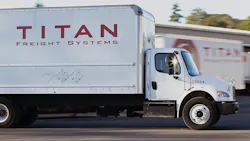
For more than half a century, Titan Freight Systems has built its reputation across the Pacific Northwest on the promise to deliver freight faster and more reliably. What began in 1968 as two small operations has evolved over the years into a highly disciplined, technology-driven, less-than-truckload (LTL) carrier whose relentless focus on efficiency defines every aspect of its business.
Headquartered in Portland, Oregon, Titan Freight Systems operates seven service centers across Oregon, Washington, and Idaho, providing next-day LTL and 28-ft. truckload service throughout the region. Additionally, the company provides expedited air freight and forwarding services, as well as warehousing and pool-point distribution services.
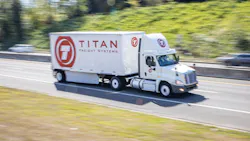
Titan drives performance with fleet-wide on-time delivery standards
For Titan, success is measured by a performance framework centered on what it calls True On-Time Delivery. Rather than relying on traditional delivery status reporting, the metric tracks six distinct service failures. Shipments delivered late (even by one minute), partial deliveries, missed pickups, or delayed guaranteed deliveries all count against Titan’s on-time performance.
These uncompromising standards drive accountability at Titan. Service failures are reviewed company-wide during daily operations meetings, where root cause analysis leads directly to procedural changes or targeted training. Titan reports that, despite the difficulty of meeting such a high standard, it consistently achieves its 98% True On-Time Delivery goal.
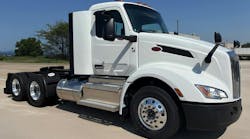
Operational efficiency is further reinforced at Titan by fleet standardization. With the carrier’s all-Freightliner fleet limited to just three truck and tractor models, it can reduce maintenance complexity, lower operating costs, and maintain a higher level of equipment uptime across millions of miles annually.
Safety initiatives further reinforce Titan’s efficiency model. Since deploying artificial intelligence-based driver assistance technology in 2019, the company has reduced distracted driving incidents by 96%, overall incidents by 66%, and property claims by 80%. According to the company, fewer incidents translate into lower costs, higher service reliability, and stronger customer confidence.
Efficiency at Titan also extends to sustainability. Each linehaul truck and trailer averages 144,000 miles per year, making fuel strategy a critical lever for both cost control and environmental impact.
As a result, Titan has invested heavily in cleaner energy solutions and emerging technologies to reduce emissions. Today, renewable diesel accounts for 54% of the carrier’s total fuel use across the Northwest and 93% of fuel consumption in Oregon. Those environmental gains also translate into lower maintenance costs for the exhaust system.
In addition, Titan is preparing for the next evolution in fleet efficiency. As part of a partnership with Portland General Electric and Freightliner, the company is adding six electric tractors to its fleet, positioning itself at the forefront of zero-emission regional freight operations.
 img_0442_edited
Titan integrates TMS to unify dispatch, dock, and back office
On the management front, Titan’s leadership recognized that traditional systems were hindering operational performance as the company grew. Without software purpose-built for LTL carriers, the company struggled to implement consistent processes across dispatch, billing, dock operations, and accounting. Titan also needed an integrated platform that could scale with its business rather than force the company to adapt its model to off-the-shelf tools.
The turning point came in 2008, when Titan went live with the Carrier Logistics FACTS transportation management system. Designed specifically for LTL operations, the CLI FACTS platform provides dispatch, pickup and delivery, linehaul, cross-docking, customer-facing tools, and a full back-office suite.
“FACTS has driven significant time and cost savings across our operations,” Jason Altamirano, president of Titan Freight Systems, said. “Previously, we had two people working 24 hours per day, combined, handling 200 freight bills per month. Today, because of the software’s automated features, one person can process a high of 500 bills per month in four hours.”
The impact extended to Titan’s cross-dock operations, where using paper-based processes for an average of 200 freight bills per month required six employees to search for freight each night. After implementing the CLI Dock Management System (DMS) in 2010, Titan cut that staffing requirement in half while more than doubling its monthly volume to 500 freight bills. At the same time, the carrier reduced cargo claims to 0.05%, well below the industry average.
At the dawn of its sixth decade, Titan Freight Systems continues to prove that efficiency is not a single initiative but a culture built on continuous improvement. The company’s formula remains clear: Invest in the right systems, set uncompromising standards, and never stop refining how to move freight more effectively and productively.
About the Author
 Seth Skydel
Seth Skydel
Seth Skydel, a veteran industry editor, has more than four decades of experience in fleet management, trucking, and transportation and logistics publications. Today, in editorial and marketing roles, he writes about fleet, service, and transportation management, vehicle and information technology, and industry trends and issues.