Driver shortage reemerges as fleets face fewer than 20,000 build slots for 2026
Key takeaways
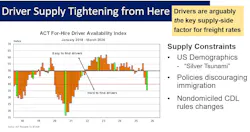
- Structural driver crisis: The driver availability index has collapsed from 55 in December to 30 in March, signaling the fastest labor market contraction since 2021. The core issue is now retention, not recruitment.
- Vanishing 2026 build slots: Only an estimated 15,000–20,000 heavy-duty build slots remain open for 2026 equipment—the final equipment before the stringent pre-EPA 2027 NOx regulations take effect.
- Historic capacity shift: The market capacity split has shifted to a historic 55% private fleet to 45% for-hire, requiring fleets to maintain internal stability.
- Future tech delays: The total cost of ownership (TCO) payback for zero-emission vehicles has been pushed deep into the 2030s without government stimulus.
ORLANDO—The commercial vehicle market is barreling toward a chaotic mix of tightening labor, vanishing equipment slots, and a massive shift in capacity.
Why it matters: After a few years of dissipating driver-shortage talk in the North American trucking markets, fresh data shows the labor market is contracting at its fastest rate since 2021.
Driving the news: Ken Vieth, president of ACT Research, delivered a stark reality check on these market pressures during his keynote address at the National Private Truck Council’s (NPTC) annual conference and later joined FleetOwner’s The Fleet Lead podcast to elaborate on the complex market facing transportation operations.
By the numbers: ACT Research’s driver availability diffusion index has cratered over the last few months.
- A score below 50 indicated a contracting supply of drivers.
- The index plummeted from 55 in December to 30 in March.
- Roughly 200,000 non-domiciled commercial driver’s licenses (CDLs) are being removed from the market, with California recently pulling 18,000 and Indiana revoking 1,800.
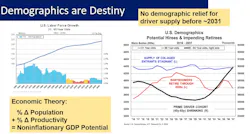
- The population of 45- to 65-year-olds—the traditional demographic for commercial drivers stepping into a second career—has been shrinking since 2017.
- Trucking is also losing another potential driver demographic: immigrants. "Opening restaurants and driving trucks have been kind of two paths for new immigrants in this country, and we're really tightening the screws on immigration right now," Vieth said.
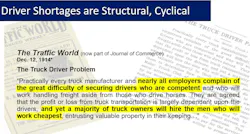
Between the lines: While Vieth noted that driver shortages have existed since the dawn of the motorized truck, he told FleetOwner that the real hurdle today isn’t necessarily recruitment, but retention.
- “It’s never a driver shortage in the extent that you can always find people to at least come in and try driving, but then a lot of people come in and find out driving is a hard job,” Vieth said on the podcast. “It seems like there’s always a flow of warm bodies in the door. It’s how do you keep them in once they’ve walked through the door?”
The big picture: The chaos of pandemic-era supply chain bottlenecks pushed companies to invest heavily in their own private capacity. This triggered a historic shift in the market share.

 FO primary with title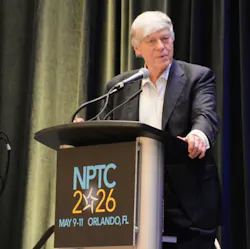
- NPTC CEO Gary Petty highlighted this dynamic during a Q&A session following Vieth’s keynote address on May 9. “If you look at the FMCSA database … it has been about 50% private fleets, 50% for-hire … over a 20-year cycle,” Petty noted.
- Petty asked: “You told me earlier that private fleets are about 55% and for-hires 45%. First, is that true? And secondly, is it sustainable?”
- Vieth confirmed the data points to a 55/45 split, largely because private fleets brought freight into their own networks rather than relying on for-hire capacity.
State of play: Fleets hoping to secure equipment for 2026 are running out of time—facing sudden price shocks, as OEMs roll out equipment next year to meet the stringent U.S. Environmental Protection Agency (EPA) NOx reduction regulations that have been years in the making.
- The heavy-duty backlog exploded from 95,000 units in November to an estimated 181,000 by the end of April, according to ACT Research data.
- "Our back-of-the-envelope math suggests there's maybe like 15,000 to 20,000 open build slots left in 2026, so if you are thinking about it, if you don't have your orders placed yet, just make a call as soon as we get off the stage here,” Vieth advised transportation managers in the audience.
- Furthermore, changes to tariff structures are throwing a wrench into budgets. “Your OEMs are calling you back and saying, ‘Oh, those orders you have, they’re more expensive now than you thought,” Vieth told FleetOwner. “It has been a planning nightmare for corporations.”
What’s next: The timeline for future trucking technology is also shifting.
Decarbonization:
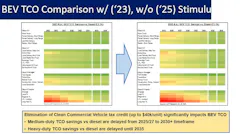
- Without government stimulus, the total cost of ownership (TCO) payback for zero-emission vehicles has been pushed deep into the 2030s, according to ACT Research. “Carriers buy trucks to make money, and TCO is such an important consideration,” Vieth told FleetOwner. “It’s market-driven at this point.”
- Self-driving trucks: Autonomous commercial vehicles are making steady geographic progress. With California finally granting limited autonomous commercial vehicle testing in April, the industry is inching closer to coast-to-coast autonomous capabilities across the Sun Belt. However, Vieth told FleetOwner this won’t eliminate driving jobs entirely. “I do think the value proposition with autonomy is hubs and spokes and long-haul distribution. But you’re still going to have drivers, most likely on the distribution side.”
The bottom line: The next driver shortage is structural, not just cyclical. With equipment slots vanishing and zero-emission goals delayed, fleets must aggressively prioritize driver retention while navigating a highly constrained supply chain environment.
- More insights: Be sure to look for the Fleet Lead podcast episode with Vieth, where he shares more details on the complex commercial vehicle procurement and labor markets with FleetOwner. That episode will be available at FleetOwner.com/podcasts and on popular podcast apps this week.
About the Author
 Josh Fisher
Josh Fisher
Editor-in-Chief
Editor-in-Chief Josh Fisher has been with FleetOwner since 2017. He covers everything from modern fleet management to operational efficiency, artificial intelligence, autonomous trucking, alternative fuels and powertrains, regulations, and emerging transportation technology. Based in Maryland, he writes the Lane Shift Ahead column about the changing North American transportation landscape.