Trucking operational costs hit record $2.336 per mile, ATRI reports
Key takeaways
- Overall trucking costs increased by 3.4% in 2025, reaching an average of $2.336 per mile, outpacing inflation.
- All cost categories except permits/licenses saw increases, with repair and maintenance costs rising by 8.6%.
- The Northeast was the most expensive region by average operational cost, while the South-Central was the least.
- Fuel costs remained stable at around $0.482 per mile.
- Early 2026 data indicates continued cost increases, especially in insurance premiums and fuel.
Operating a heavy-duty Class 8 truck reached an all-time high in 2025, according to the American Transportation Research Institute’s (ATRI's) latest Analysis of the Operational Costs of Trucking.
Even as freight demand remained lukewarm and carriers suffered capacity reductions, line-item expenses rose across almost every category.
But what does that look like in more detail? To get the information in a more concise, readable format, enjoy these charts and summaries from the report. Below is a breakdown of how operating costs have changed, where regional disparities hit hardest, and what early Q1 data signals for the rest of 2026.
 truck acquisition and demand- podcast thumbnail concept
 arcb_arcbest_terminal
The operational cost report's sources
ATRI’s report compiles data from several sources. In addition to data from the American Trucking Associations (ATA), Bureau of Labor Statistics, and ATRI’s own survey efforts, the report also factors in:
- Fuel costs from the Energy Information Administration (EIA)
- Truck payments from Omdia Automotive and ACT Research
- Maintenance costs from Decisiv, ATA's Technology & Maintenance Council, Fullbay, and Motor Information Systems
- Truck insurance costs from the Council of Insurance Agents & Brokers, Fitch Ratings, and AM Best
Overall fleet costs
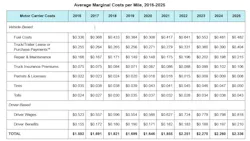
The average operational cost of trucking rose 3.4% in 2025 to $2.34 per mile. Excluding fuel, the average operational cost rose 4.2% to $1.85 per mile.
Both measures outpaced national inflation under the Consumer Price Index, which grew 2.7% in 2025.
The rising cost of trucking is spread across all aspects of fleet operation: Every tracked cost category in ATRI’s annual report increased, save for permits/licenses.
By region, the most expensive area to operate remained the Northeast ($2.52 per mile), and the least expensive region remained the South-Central U.S. ($2.23), just like it was in 2024.
Comparing each region’s average marginal cost in 2025 to the previous year, the West experienced an astounding 12.55% increase in average costs year over year.
Fuel costs not so extreme
The average cost of fuel for trucking operations was $0.48 per mile in 2025, just 0.1 cents higher than in 2024.
With the price of oil dominating headlines for the last four months, it is refreshing to read this tidbit from the report:
“Average on-highway diesel prices in 2025 enjoyed their most stable year since the pandemic.”
By U.S. region, fuel costs were highest in the West ($0.54 per mile) and lowest in the Southeast ($0.45), which should come as no surprise.
Truck/trailer procurement
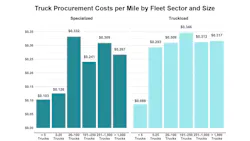
The average cost of trucks and trailers rose 3.6% in 2025 to $0.40 per mile.
The latest ATRI report is the first time the group reported truck and trailer costs as distinct categories: Truck procurement costs averaged $0.28 per mile, and trailer procurement averaged $0.12.
By U.S. region, truck procurement costs were highest in the West ($0.32 per mile) and lowest in the Southeast ($0.27). Trailer costs, while still highest in the West ($0.13), were lowest in the South-Central U.S. ($0.11).
Repair and maintenance
Repair and maintenance costs rose 8.6% in 2025 to an average $0.22 per mile.
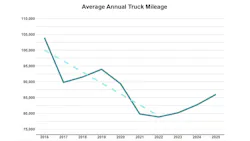
Part of that increase is due to repair and maintenance costs having fallen by 2% from 2023 to 2024. Another reason is that carriers’ trucks are growing older.
The average truck age rose in 2025 to 3.6 years, up from 3.4 years in 2024 and the first increase since 2022. The average truck’s annual mileage also increased, up 4% to 85,991 miles. ATRI’s measure of annual mileage has increased steadily since 2022.
By region, repair and maintenance costs were highest in the Northeast ($0.22 per mile) and lowest in the South-Central U.S. ($0.19).
Truck insurance premiums
Liability and insurance cargo premiums rose 3.9%, costing carriers an average $0.11 per mile.
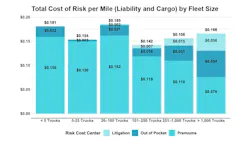
ATRI’s authors noted that the commercial auto segment of the insurance industry has been unprofitable in all but one of the last 10 years, in part due to rising crash costs and litigation payouts.
By region, insurance premiums cost the most in the Northeast ($0.12 per mile) and the least in the Midwest ($0.10).
Permits and licenses
Permitting and licensing maintained its status as the smallest line-item in ATRI’s cost reports. The average cost of permits fell to $0.008 per mile, primarily representing oversize, hazmat, and similar specialized permits. It specifically does not include truck registration or CDL costs.
By region, permitting and licensing cost the most in the South-Central U.S. ($0.011 per mile) and the least in the Midwest ($0.007).
Tires
The industry’s average tire cost per mile increased 6.4% to $0.05 per mile.
By region, tire costs were highest in the South-Central U.S. ($0.052 per mile) and lowest in the West ($0.046)—which is the opposite of the industry’s other major petroleum product, fuel.
Tolls
Toll costs rose 13.2% to an average $0.043 per mile.
By region, tolls cost the most in the Northeast ($0.079 per mile) and the least in the West ($0.021).
With rising diesel prices, the authors of the report speculate that some fleets will drive more miles on toll roads in 2026 to reduce fuel costs.
Driver compensation
The average cost to employ a driver was $1.028 per mile—comprised of driver wages ($0.818) and benefits ($0.210).
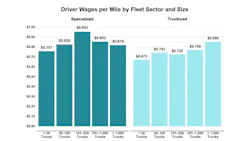
Though driver wages haven’t kept up with inflation, driver compensation remained one of the largest industry costs—and 2025 was the first year that ATRI’s measure of combined driver compensation (wages and benefits) averaged above $1 per mile.
Driver wages rose 2.5%, slightly under CPI inflation’s 2.7% (in 2024, driver wages similarly grew 2.4%, just under inflation’s 2.9%).
By region, fleets pay the most for driver wages and benefits in the Northeast ($1.10 per mile) and the least in the Midwest ($0.934).
This year, for-hire fleets are already raising driver wages further. Executives at J.B. Hunt Transport Services, Schneider National, and Werner Enterprises have said they’re preparing for driver pay to climb. However, with freight demand still mostly flat, ATRI’s report predicts “driver wages are likely to remain stable.”
2026’s costs keep rising, too
The report also includes some financial data for the first quarter of 2026: Costs continued to rise across almost all categories. Comparing Q1 2026 to all of 2025, the per-mile cost of truck insurance premiums jumped 6.4%, most categories increased around 2%, and tire costs fell 4.8%.
About the Author
 Jeremy Wolfe
Jeremy Wolfe
Editor
Editor Jeremy Wolfe joined the FleetOwner team in February 2024. He graduated from the University of Wisconsin-Stevens Point with majors in English and Philosophy. He previously served as Editor for Endeavor Business Media's Water Group publications.