Building on American trucking grit
Key takeaways
- Trucking is shifting from mechanical equipment to software-defined trucks with AI and over-the-air updates.
- Fleets are adopting multi-fuel strategies, balancing renewable diesel, biofuels, and battery electric for ROI.
- The next era of trucking depends on power grids, data pipelines, and freight corridors, moving from experiments to execution.

In the days leading up to Independence Day and America's 250th anniversary, we'll look back at how transportation has helped shape America into what it is today. We'll highlight archival photos that capture an era when American ingenuity was measured by the sheer mechanical grit and American spirit that pushed heavy-duty trucking across a developing interstate system.
Looking at these images of vintage trucks, factories, and American workers might make you feel a sense of nostalgia for a simpler time as our industry grew from horse-drawn wagons into the 80,000-lb. diesel-powered workhorses that fuel the U.S. economy of today. When our predecessors were celebrating the American Bicentennial in 1976, the blueprint for hauling freight was clear, uniform, and unquestioned: diesel engines, manual transmissions, and drivers relying on road instinct.
But as we stand on the doorstep of the nation’s 250th birthday, the lane ahead is shifting more drastically than at any point in logistics history.
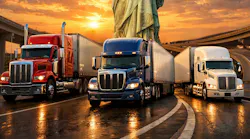 ecm8331_featureimage
As we look back proudly this summer on the nation we’ve built, the industry is transitioning into its next era of advanced transportation technology. We are already moving past the early, starry-eyed experiments around alternative fuels, autonomous trucks, edge computing, and artificial intelligence. The hard, pragmatic work of real-world execution is underway.
When future generations gather to celebrate the nation’s tricentennial in 2076, how well will they view what the industry does over the next 50 years to build the backbone of trucking’s technological evolution?
From horsepower to megawatts
Fifty years ago, America was watching the interstate system come to life, creating the groundwork for modern long-haul trucking and supply chains. But today’s transportation work is harder for the average American to see than the construction of new highways and bridges.
The next transportation revolution is in full swing. Trucking and transportation industry grit remains the foundation of freight, but the focus is shifting from wrenches to coding.
The next 50 years of American transportation means routing megawatts of power to terminal grids, securing data pipelines, and establishing multi-fuel freight corridors. The fleets leading this charge aren’t waiting for a singular, magic-bullet technology to solve the future. Instead, they are taking a distinctly American approach to problem-solving: deploying a diverse mix of renewable diesel and other biofuels, targeted battery-electric platforms, and advanced computing.
A pragmatic, capitalistic pivot
This pragmatic, capitalistic approach is simple: Find the most efficient and sustainable way to move goods that delivers the best return on investment while keeping total ownership costs down and trucking profitable. The iconic American truck is evolving from a purely mechanical powerhouse into a software-defined asset.
It might feel like we’re leaving trucking tradition behind, but the transition to 18-wheel computers, AI, and predictive data streams is just the latest way fleets and suppliers are edging out the competition. A truck that optimizes its own efficiency as it moves or improves its safety technology and maintenance overnight, thanks to an over-the-air software update, isn’t a rejection of our hardworking roots. It is the modern manifestation of the same drive for efficiency that motivated freight pioneers a century ago.
As you dive into this nation's incredible history, remember that the early truck operators who built the American supply chains we rely on today also faced daunting, messy transitions as they traded horses for horsepower. Our generation’s challenge is to build the digital and clean-energy infrastructure that will carry us to 2076.
The trucks look different, and the data moves faster—but the mission remains unchanged. Trucking is still the backbone of America. And trucking grit and ingenuity will keep America moving forward for the next 50 years and beyond.
About the Author
 Josh Fisher
Josh Fisher
Editor-in-Chief
Editor-in-Chief Josh Fisher has been with FleetOwner since 2017. He covers everything from modern fleet management to operational efficiency, artificial intelligence, autonomous trucking, alternative fuels and powertrains, regulations, and emerging transportation technology. Based in Maryland, he writes the Lane Shift Ahead column about the changing North American transportation landscape.