Fleet manager survey reveals top concerns for 2026
Key takeaways
- Asset maintenance ranked as fleet managers' top concern, with 54% of fleet managers focusing on reducing downtime and preventing breakdowns.
- Nearly half of respondents prioritize FMCSA compliance and employee safety, with a notable shift toward safety culture over safety policy enforcement.
- Driver training concerns center on ensuring drivers are fully qualified and compliant, with a growing emphasis on practical skills.

Ask any fleet manager how easy their job is, and they’ll likely scratch their head. Fleet management is anything but easy. Yet, the fleet manager is expected to handle it all: from a COVID trucking boom to a years-long bust, from regulatory uncertainty to the sky-high prices of fuel. When a fleet manager goes from feeling on top of the world to feeling like they’re drowning, they likely don’t feel alone.
Trucking consultant J.J. Keller’s annual State of Fleet Management survey is a benchmark that helps determine where fleet managers are placing their efforts and their attention. This year’s survey included responses from more than 500 fleet management professionals in January 2026.
While the survey was taken before the war in Iran, the costs of running a fleet—specifically maintenance to prevent breakdowns—was the top concern among respondents. Other top concerns included safety, compliance with the Federal Motor Carrier Safety Administration (FMCSA), and driver training.
Read on to see whether you identify with your peers’ concerns and challenges.
Top concerns among fleet managers
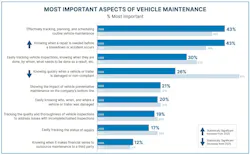
Managing asset maintenance (54%)
It takes money to efficiently run a fleet. Aside from salaries that must be paid, assets must be maintained and fueled up for each day’s work. Expense management is likely a skill that most fleet managers have mastered, but this year, fleets are most concerned about maintaining vehicles to decrease downtime and preventing asset breakdown altogether.
Compared to 2025 survey results, fleet managers are now less concerned about how quickly they know when an asset is damaged or noncompliant. This signals “a recalibration toward long-term vehicle reliability rather than reactive fixes,” the report states.
FMCSA compliance and the value of employees (49%)
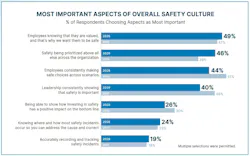
Ensuring the fleet stays up to date with FMCSA regulations and having employees “knowing that they are valued, and that’s why we want them to be safe” were two completely different metrics that nearly half of respondents agree upon. These metrics were chosen as the top concerns in the “FMCSA Compliance” category and in the “Overall Safety” category.
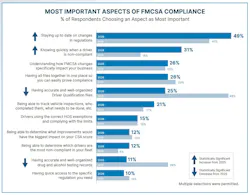
Compared to 2025, there was a 15% increase in respondents believing that “quickly knowing if a driver is in compliance” is the top concern when it comes to FMCSA compliance, from 16% in 2025 to 31% in 2026. "Staying up to date on changes in regulations" was also a top compliance concern last year; the percentage of respondents who believe this increased from 41% to 49%.
As for wanting to keep their employees safe, the report suggests that fleet companies are shifting from safety policies to a safety culture. In other words, “fleet safety culture continues to move from rules to relationships,” the report states.
This is an apparent shift from last year's results, which placed safety on the responsibility of the driver. Last year, 51% of respondents agreed that the most important aspect of safety culture was that drivers consistently make the same “safe choices” across different scenarios.
Driver training (47%)
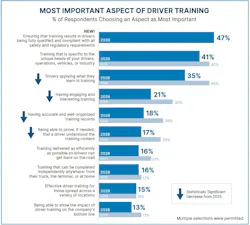
Fleet managers’ concerns about driver training today are also linked to their concerns about compliance, as 47% of respondents agree the top training concern is “ensuring training results in drivers being fully qualified and compliant with all safety and regulatory requirements.”
This is the first year this particular answer choice was added to the survey; therefore, we can’t compare the year-over-year increase or decrease in fleet management’s opinion on the importance of this metric. However, what’s interesting about the results is the significant decrease in the importance of other metrics between 2025 and 2026.
Top training concerns shifted the burden from the fleet’s ability to show that training was conducted in 2025 to how well the drivers exhibit their training and compliance.

A further breakdown of fleet management and compliance
Understanding regulations and whether employees and assets are compliant with them is part of the job. Compliance is what allows a fleet to operate legally. Non-compliant drivers made headlines in 2025. It stands to reason that respondents noted that “having accurate and well-organized driver qualification files” was their top concern with compliance that year.
However, this year the focus has shifted to simply staying up to date with current regulatory changes and knowing quickly when a driver falls into non-compliant territory.
“We are a small company, and therefore we all wear many hats,” one respondent shared. “Keeping up with … everything can be challenging.”
Another respondent shared a similar sentiment: “I cover EHS and DOT. That’s a lot of regs to keep up on, as well as the rest of my job duties.”
Interestingly, a moderate compliance concern of fleet managers in 2025—”Having accurate and well-organized drug and alcohol testing records”—slid down to the second-lowest compliance concern among fleet managers this year, from 26% in 2025 to 11% in 2026.
Overall, the report states that “this reflects a broader industry move from documentation to rapid detection and corrective action.”
A further breakdown of fleet management and driver training
Respondents were surveyed on two different categories pertaining to drivers. The first category was on important aspects of driver training. The other category was on the most important driver knowledge and skills.
While most respondents are aligned on the most important aspects of driver training (“Ensuring training results in drivers being fully qualified and compliant with all safety and regulatory requirements” at 49%), there was more variety in what fleet managers believed were the most important driver knowledge and skills. Comparing results from this year with last year, the top answer remains the same; however, the percentage of those respondents who chose that answer plummeted.
While it resulted in the top answer, only 30% of fleet managers believe that “How to safely and correctly operate their specific vehicle” is the most important driver knowledge or skill. This is compared to 58% of fleet managers who believed the same last year. In contrast, metrics that increased this year from last were “How to avoid distracted driving,” from 24% in 2025 to 29% in 2026, and “How to avoid injury while working and driving,” from 20% in 2025 to 26% in 2026.
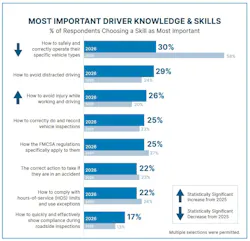
“The pattern suggests fleets are doubling down on practical, high-frequency risks and reinforcing core habits that reduce incidents across vehicle types and operating environments,” the report states.
See the full 2026 State of Fleet Management report, including insights about leadership priorities, job stress, maintenance, and driver training methods, here.
About the Author
 Jade Brasher
Jade Brasher
Executive Editor Jade Brasher has covered vocational trucking and fleets since 2018. A graduate of The University of Alabama with a degree in journalism, Jade enjoys telling stories about the people behind the wheel and the intricate processes of the ever-evolving trucking industry.