Holiday-season cargo theft surges as thieves expand tactics and target high-demand freight
Key takeaways
- Cargo theft is climbing year-round, with holiday-season spikes driven by high-value goods.
- Strategic theft is growing, but straight theft still accounts for most losses across fleets.
- Slowing down at pickup and tightening verification remain the most effective defenses.
- What cargo theft threats fleets and shippers can expect in 2026.

The holiday season may bring joy and good cheer, but it also brings inevitable hiccups, such as snow and ice causing travel delays, the mad dash of holiday shopping, and the dreaded political conversations with family around the dining table. But for the trucking industry, the biggest holiday hiccup is cargo theft.
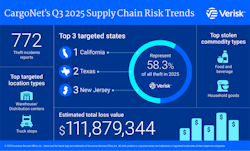
CargoNet reports that cargo theft surged during the third quarter, with 772 theft events across the U.S. and Canada. The total value of stolen goods reached $111.88 million.
With Thanksgiving behind us and the holiday season in full swing, cargo theft activity is expected to increase through the end of 2025.
Holiday cargo theft trends shaping fleet risk and security planning
According to CargoNet, cargo theft activity typically increases in Q4, peaking in December. But Scott Cornell, national practice lead, transportation/Inland marine crime and theft specialist, Travelers, notes that this Q4 peak is becoming less distinct as cargo theft has increased year-round.
Cornell said typical commodities targeted during the holidays are electronics—as many new TVs, game consoles, and headphones are purchased as gifts—and alcohol, often bought for holiday parties or as gifts as well. CargoNet notes that vehicle tires are also frequently targeted.
The growing and evolving methods thieves are using are hindering and confusing the trucking industry, according to Cornell.
“For the majority of my career, there were maybe five or six methods in play at any given time, and as we sit here today, there's probably somewhere between 20 and 30 methods in play at any given time, which makes it extremely difficult on the industry,” Cornell said.
Many of these “new” methods are really twists on older methods, and Cornell is still seeing new twists emerge. While strategic theft is still on the rise, Cornell warns against overlooking straight theft.
“Strategic theft has seen the biggest single increase of the two categories over the past three years or so,” Cornell said. “But I think people get so distracted by that that they forget that straight theft is still the majority of all cargo theft.”
Straight cargo theft is when thieves physically steal cargo from a shipment. Strategic cargo theft involves deception, i.e., when thieves trick shippers, brokers, or carriers into handing over the cargo. Cornell said that strategic theft makes up about 30% of all cargo thefts, while straight theft makes up the rest.
 Massive egg heist: 100,000 eggs stolen in Pennsylvania raises questions about cargo theft trends
 fleetsexplained_11
According to CargoNet, the top states for cargo theft right now are California, Illinois, Texas, Florida, and Georgia. But the New York City metropolitan area also deserves special attention this holiday season.
"What we're seeing in the New York City metropolitan area is particularly concerning," Keith Lewis, VP of operations at Verisk CargoNet, stated in a press release. "Criminal organizations have transformed this region into a sophisticated operation hub for shipment misdirection and fraud. Combined with the persistent threats in California, Illinois, and Texas, the geographic spread of organized cargo theft requires a coordinated, industry-wide security response during the Thanksgiving period and beyond."
Strategies fleets can use to reduce theft risk during peak season
The key to preventing cargo theft, according to Cornell, is working together, communicating, and slowing down when needed. Cornell acknowledges that slowing down is the last thing the industry wants to do, especially during the holiday rush, but doing so can save both money and time.
“What takes more time? Five more minutes at the point of pickup or dealing with a cargo theft once it happens?” Cornell asked. “I promise you, dealing with the cargo theft will go on for days, weeks, or months, as opposed to the extra five minutes at the point of pickup. So the industry needs to really work together on the freight broker saying to the shippers, ‘Hey, we want to make sure that your load is secure and that we don't have any thefts, so work with us on the procedures at the point of pickup.’”
Cornell suggests fleets, drivers, brokers, and shippers all pause when they sense something suspicious and double-check the details of the load. Proceeding cautiously is especially important at the point of pickup, whether this is at a distribution center, warehouse, or elsewhere. Strategic thieves, for example, target pickup points.
According to Cornell, cargo thieves view the supply chain as segmented and assume that everyone is too focused on moving cargo efficiently and quickly to notice anything suspicious. That’s why it’s important for drivers, dispatchers, shippers, and others working in the supply chain to slow down and communicate when something seems off.
Key cargo theft threats fleets should anticipate in 2026
Looking ahead to 2026, Cornell sees three factors that will be especially relevant to the future of cargo theft: technology-improved schemes, creative twists, and industry monitoring.
Rising tech-driven cargo theft tactics target carriers
Social engineering, phishing, and spoof emails are expected to increase in 2026, according to Cornell. He also expects more technology-driven cargo theft to become increasingly creative.
Evolving theft variations complicate fleet defenses
More and more, Cornell is seeing cargo thieves make slight adjustments or twists to existing types of theft. These creative twists are confusing the industry and making it harder to spot and prevent certain types of strategic cargo theft.
How thieves track industry behavior to exploit supply chain gaps
According to Cornell, cargo thieves are closely watching the industry and its attempts to prevent cargo theft. Thieves are adapting their methods in response to fleet defenses—and they’re doing so quickly, making it difficult for the industry to act.
“The industry needs to stop trying to keep up, and the industry needs to harden itself,” Cornell noted. “If you harden yourself as an industry, if you harden the supply chain, you don't have to keep up because you're just not as easily targeted or taken advantage of.”
About the Author
 Jenna Hume
Jenna Hume
Digital Editor
Digital Content Specialist Jenna Hume joined FleetOwner in November 2023 and previously worked as a writer in the gaming industry. She has a Bachelor of Fine Arts degree in creative writing from Truman State University and a master of Fine Arts degree in writing from Lindenwood University. She is currently based in Missouri.