Kodiak selects Bosch for autonomous truck components
Key takeaways
- Kodiak and Bosch announced a partnership to scale Kodiak's autonomous truck platform.
- Bosch will provide Kodiak with hardware components at scale.
- The partnership is another step in Kodiak's plans to scale its autonomous platform.
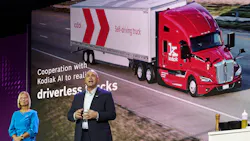
LAS VEGAS—Kodiak AI will work with Bosch to scale Kodiak’s autonomous truck platform. The companies announced their new partnership for the autonomous platform during the Consumer Electronics Show (CES) on Monday here.
Under the agreement, Bosch will supply Kodiak with a variety of hardware components, including sensors and steering technologies, to help the Kodiak Driver perceive and navigate its environment. The exact components and timeline for the partnership were not disclosed.
Kodiak gains the support of a massive global technology manufacturer, and Bosch gains a foothold in autonomous trucking. Paul Thomas, president of Bosch in North America and Bosch Mobility in the Americas, framed the partnership as a “win-win.”
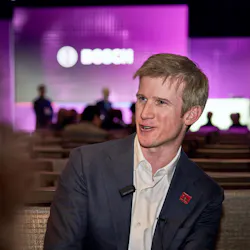
“It offers us a great opportunity to deepen our understanding of real-world autonomous vehicle requirements,” Thomas told journalists at CES.
Scaling up from early autonomous pilots
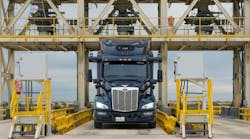
Kodiak's platform is a system of specialized hardware and software that converts a standard heavy-duty truck into an autonomous truck. The company deployed several autonomous trucks in 2025 to haul frack sand on private roads with Atlas Energy Solutions.
Last year saw several significant milestones in autonomous validation runs across the industry, and the technology’s leaders are now facing the next challenges: a scalable equipment platform, end-to-mile logistics, and carrier buy-in.
“But always the big question was ‘how are you going to leverage technology to enable scale?’” Don Burnette, founder and CEO of Kodiak, told industry journalists in a smaller Q&A session. “How do you move from five trucks to 10 trucks, to 100 trucks, into the thousands, tens of thousands, and hundreds of thousands? For that, we need great, powerful, established, experienced partners.”
The partnership, Burnette explained, was all about “the hardware and software to enable scale, bringing this beyond the onesies-twosies of self-driving that we hear today, and actually bring this into the mainstream.”
Kodiak’s current hardware partners were “a little bit of a hodgepodge of partnerships up until this point," Burnette said. The company just announced a partnership with ZF to purchase 100 steering systems for Kodiak Driver-equipped trucks in November.
What’s next for Kodiak? More trucks, fewer humans
Though the Bosch partnership is vague, Burnette said that it could be “several years.” In the meantime, he had more concrete goals in mind for Kodiak in 2026:
- The company is discussing delivering 100 trucks this year.
- In the second half of 2026, Kodiak wants to remove the human safety observer from its over-the-road long-haul applications.
“We haven’t given firm projections for 2027 and beyond,” Burnette said, “but you can imagine that it’s going to ramp up.”
About the Author
 Jeremy Wolfe
Jeremy Wolfe
Editor
Editor Jeremy Wolfe joined the FleetOwner team in February 2024. He graduated from the University of Wisconsin-Stevens Point with majors in English and Philosophy. He previously served as Editor for Endeavor Business Media's Water Group publications.