Next-gen fleet safety tech: A headrest that scans drivers' brains
Key takeaways
- Neumo's contactless EEG sensor detects driver fatigue and distraction by monitoring brainwaves from up to 12 inches away.
- The device is small, easy to install, and connects via USB to vehicle electronics.
- The technology aims to work alongside dashcams, reducing false positives.
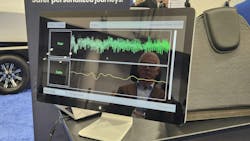
Many commercial carriers already employ cameras that watch drivers' faces at all hours. What if fleets started monitoring drivers' brains?
Technology company Neumo is currently developing and testing a contactless sensor to monitor drivers’ brainwaves. The technology could measure driver fatigue, attention, and cognitive load using a relatively small device mounted on the driver’s headrest.
Current fleet safety standards rely heavily on dashcams and video telematics to monitor driver behavior.
“Today, cameras are the primary method in trucking,” Niall Berkery, CEO and co-founder at Neumo, told FleetOwner at the Consumer Electronics Show in Las Vegas. “The camera is very good at detecting what we call physical distraction—your eyes off the road, looking on a phone, you’re eating a hamburger, or whatever. Now, fatigue is being added to some dashcams, but the camera can’t do a really good job of that.”
Video-based fatigue detection only relies on external symptoms. By the time a driver exhibits physical signs of fatigue, they may have already long suffered cognitive impairment. There are also many online complaints from drivers about the false flags that camera systems can pose.
“That is something that takes place very late in the process,” Berkery said. “And it’s also not very reliable.”
How this sensor works to measure driver fatigue
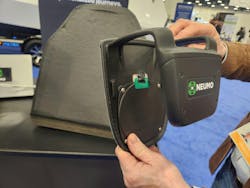
Neumo’s device uses electroencephalography (EEG), a method of measuring the brain’s changes by the frequencies of its electromagnetic activity, effectively acting as a passive radio receiver. Traditionally, capturing these signals required sensors placed directly against the head; Neumo said its patented technology can measure signals at a distance of up to 12 inches.
Neumo’s sensor comprises an antenna array and processing electronics, all within a relatively small, discrete package.
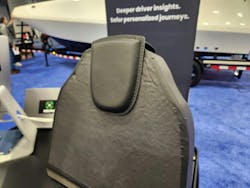
The sensor can be installed quickly without major modifications to the vehicle. It is secured to the headrest via straps and connects to the vehicle’s electronics via USB. Neumo also offers a passenger car version of the sensor, which can be installed in the headrest and is almost unnoticeable.
Because an EEG device monitors the neural progression toward sleep, the data could be used by fleet management software to recommend rest stops before the driver gets too exhausted. While cameras would still be an essential technology, EEGs could work in tandem with cameras to better detect risk.
The system captures raw neural signals and parses them into specific frequency bands. The bands each have broad associations with different cognitive states. The Delta band, measuring less than 4 Hertz, is associated with deep sleep and some continuous-attention tasks; the Theta band (4-7 Hz) is associated with drowsiness and inhibition; and so on.
By monitoring the dominance of these bands in real time, the system generates an analog signal showing the progression of a driver's state. Since every person’s brain activity is different, the sensor creates a driver baseline after gathering data for 10 minutes. This provides a measurable trend of fatigue or distraction that goes much deeper than a yawn.
Next steps: Collaborating with fleet dashcam companies
Neumo plans to supply the technology to other safety technology players, though no major partnerships have been announced yet. The company is in talks with several major fleet safety companies.
“Our go-to market is in collaboration with dashcam companies,” Berkery said.
Neumo also has broader plans for its sensor: The company’s roadmap includes monitoring for impairment and critical health events.
 Teletrac Navman unveils research to highlight the role of safety technology in driver exoneration
 truck crash illustration
About the Author
 Jeremy Wolfe
Jeremy Wolfe
Editor
Editor Jeremy Wolfe joined the FleetOwner team in February 2024. He graduated from the University of Wisconsin-Stevens Point with majors in English and Philosophy. He previously served as Editor for Endeavor Business Media's Water Group publications.