How a self-driving truck would boost your operations
Key takeaways
- Autonomous trucks can ease driver hiring challenges by providing a reliable, non-quitting workforce that can scale operations beyond current limits.
- Removing hours-of-service restrictions enables long hauls without breaks, significantly speeding up expedited loads.
- Self-driving systems can reduce accidents caused by human error.
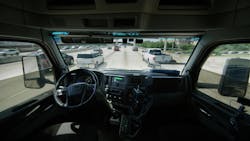
What once sounded like a distant science experiment is now a growing freight segment. Several autonomous truck developers are using self-driving technology to move real freight on public roads.
As carriers imagine autonomous trucking as a “how” instead of an “if,” there are key tailwinds—and headwinds—pushing the technology.
As industrialization has shown time and time again, replacing human labor with machinery fundamentally changes market economics. Freight hauls no longer limited by biology make a strong business case.
The technology enables several value propositions, outlined well by Xiaodi Hou, founder and CEO of Bot Auto and founder of former autonomous truck company TuSimple.
“There are safety benefits because the truck never sleeps; the truck never drives under the influence,” Hou told FleetOwner. “There are efficiency benefits: Autonomous driving is going to drive 24 hours in a row without any stops. The removal of the driver has a huge economic impact.”
Another major autonomous truck company, Torc Robotics, an independent subsidiary of Daimler Truck AG, hopes for similar gains by removing the driver. Andrew Culhane, chief commercial officer for Torc, said that the company wants to compare its autonomous driver to “the best CDL driver on their best day, best night of sleep, best cup of coffee.”
“That bar is really high,” Culhane said. “The professional drivers that are on the road are fantastic. … But at the end of the day, humans are humans.”
Human drivers necessarily have limitations—such as hours-of-service regulations, home time, communication, or general fatigue. As many fleets can attest, finding drivers can also be a challenge, particularly for long-haul for-hire operations. Autonomous vehicles could fill the needs that arise from those problems.
Solving a driver shortage
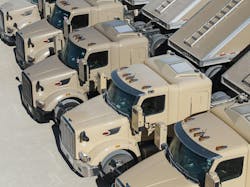
Commercial carriers—particularly running long-haul, for-hire operations—have been haunted by driver hiring and retention challenges for ages. Many autonomous truck developers, including Kodiak AI’s founder and CEO Don Burnette, suggest that self-driving trucks could help resolve that problem.
“We’ve heard repeatedly for many decades now that fleets have had many challenges with the status quo. That being, it’s hard to find great drivers, and sometimes there’s more or less drivers,” Burnette said. “You’ve heard a lot of talk about the driver shortage, but really, when it comes to the quality of drivers, that’s where the challenge is.”
Self-driving systems offer a convenient solution for that long-haul capacity. An autonomous driver does not quit, retire, or fail a drug test. It guarantees truck utilization in a way that traditional hiring cannot.
“What that means for fleets is it offers them the ability to potentially scale their operations beyond what they have access to today, because they don’t have to worry about hiring that incremental driver,” Burnette explained.
Fewer truck accidents, perhaps
Major tech booms
Even a few years ago, when Dean Bushey, director of programs for the North American Council for Freight Efficiency (NACFE), participated in autonomous design operations just before the pandemic, the pathing software was much simpler.
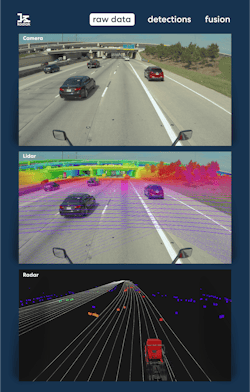
“We were really just looking at four or five potential paths forward for the truck,” Bushey said. “Now, in the blink of a second, being the autonomous truck, I can be moving. I can look at the environment. I can sense all the different actors and tell you what they are, what their movement is, and accurately calculate an estimation of hundreds of thousands of different potential movements of each of these actors and give you the best possible solution. The ability to do real-time, edge-based computing to predict the movement of actors and the best possible path is really exciting.”
And as computation advanced, sensor costs dropped dramatically. Long-range mechanical lidar systems, for example, dropped from tens of thousands of dollars a little over a decade ago to only a few hundred dollars today, without even accounting for inflation. The result is an autonomous truck simultaneously more advanced and more affordable than before.
The majority of truck-caused accidents are due to driver error. The most common truck driver errors, according to the Federal Motor Carrier Safety Administration’s 2006 Large Truck Crash Causation Study, are when the driver fails to observe a situation or makes a poor judgment.
Well-made autonomous drivers are likely safer than human drivers in most circumstances. Though research is ongoing, studies have found that these driving systems can be safer than humans during routine driving and rainy environments. They can detect objects from farther away and can react much more quickly.
A virtual driver, though not perfect, is also perfectly immune to many kinds of human error, as Burnette explained.
“One thing you’ll always be able to rely on when it comes to self-driving trucks is that they never get drowsy. They’re always paying attention. They’re never driving intoxicated. They’re also conservative, compliant drivers, so they’re good stewards of the roadway,” Burnette told FleetOwner.
Easier expedited truckloads
A driver that never gets tired removes one of the industry’s most serious capacity bottlenecks: hours-of-service regulations.
“From the fleet perspective, the real game-changer for autonomous driving is that it unleashes unlimited capacity,” Bot Auto’s Hou said. “The time limitation removal is one of the major benefits of autonomous driving. That made it possible to even compete against air freight.”
A traditional driver’s day has a fixed clock. To move freight any faster, a fleet would need to pay much more in additional driver wages.
“A truck driver can only drive 11 hours, and they need rest,” Dean Bushey, director of programs for the North American Council for Freight Efficiency (NACFE), said, referring to general hours-of-service rules. “There needs to be either slip seating, or you have team driving, or you need a safety driver.”
By removing those mandatory breaks, autonomous systems enable direct coast-to-coast hauls that were previously impossible for a single driver.
“You could essentially launch it in Jacksonville, Florida, and drive it across [Interstate-10] all the way up to Los Angeles,” Bushey said. “All it needs to do is occasionally stop for refueling, gas, a little bit of maintenance, or swapping out cargo. It can get there a lot quicker—and for a trucking fleet, that’s huge.”
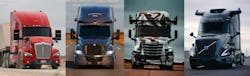
Autonomous truck developer Aurora may have the longest autonomous haul to date. The company in February announced validation of a 1,000-mile lane between Fort Worth, Texas, and Phoenix, Arizona, “positioning Aurora as the first company to autonomously haul freight on a route that extends well beyond hours-of-service limitations.”
The technology is particularly useful for time-sensitive hauls, such as refrigerated goods that are susceptible to spoilage. Kodiak’s Burnette expects autonomous trucking to gain some initial popularity with those speedy loads.
“I think you’re going to see the biggest impact in the early days of autonomy in the expedited freight market, where you would traditionally have team drivers that could move a truck more smoothly across a long lane,” Burnette said.
More fuel-efficient driving
Autonomous drivers are also significantly more fuel efficient than traditional trucks. The driving systems can anticipate road conditions and adjust engine speeds with inhuman precision.
“If a truck knows how to exactly drive at the right speed during the right terrain, and it does predictive driving based on what’s coming ahead, and it knows what maintenance to be done, it can optimize fuel efficiency,” Bushey explained. “The truck will drive better than most humans.”
Autonomous trucks could also minimize the idling and non-revenue miles required to accommodate humans, further improving a self-driving fleet’s miles per gallon.
Overall, autonomous developers seem confident that autonomy will cut a fleet’s fuel costs. Now-defunct TuSimple in 2019 estimated autonomous trucks could reduce fuel consumption by 10%. Kodiak’s website suggests fuel consumption reductions as high as 25%. Aurora estimated in 2024 that autonomous trucks could be 32% more energy efficient.
Autonomous ROI is a question of cost
Safer, more efficient, easy to expedite—the benefits of autonomous trucking sound pleasant. But a carrier can only incorporate a self-driving fleet if it makes financial sense. How much would it cost to adopt autonomous trucking?
Beyond the cost of the autonomous truck itself (which is rather opaque today), carriers have several financial and logistical challenges on the path to driverless hauls.
This is the first part of two articles on the benefits and challenges facing autonomous trucks. Part two is available here.
 einride_roozbeh_charli_1
 2026 FleetOwner 500: For-hire carriers show stability at the top amid industry M&A activity
About the Author
 Jeremy Wolfe
Jeremy Wolfe
Editor
Editor Jeremy Wolfe joined the FleetOwner team in February 2024. He graduated from the University of Wisconsin-Stevens Point with majors in English and Philosophy. He previously served as Editor for Endeavor Business Media's Water Group publications.