Volvo unveils third autonomous truck lane: Dallas to Oklahoma City
Key takeaways
- Volvo's new lane between Dallas and Oklahoma City is its first cross-state, direct-to-customer autonomous freight route.
- The direct-to-consumer model is a step beyond hub to hub and requires closer collaboration with customers.
- Volvo plans to remove its safety drivers from the VNL Autonomous within quarters rather than years.

LAS VEGAS—Volvo Autonomous Solutions (VAS) is expanding its operations in the U.S.
The autonomous arm of Volvo Trucks revealed at ACT Expo that it has opened a new lane in the Sun Belt: Dallas, Texas, to Oklahoma City, Oklahoma.
The expansion is a major milestone for one of the trucking industry’s major autonomous players: This is Volvo’s third autonomous lane, its first cross-state lane, and its first direct-to-customer deliveries—or, as Sasko Cuklev, head of on-road solutions for VAS, called it, “an end-to-end setup.”
“We do this in what we call an end-to-end setup, meaning that we are moving the freight from and into a customer facility,” Cuklev told media at the conference. “It will require a higher operational precision from us. It will require a much deeper integration with the customer. But it also really shows that autonomous solutions can operate in the environment and the processes that our customers are operating in today.”
The details on VAS’s new autonomous truck lane
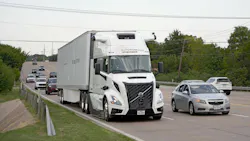
Volvo is using a purpose-built VNL equipped with the Aurora driver to move loads between two customer locations, from Dallas to Oklahoma City, a distance of roughly 200 miles.
The VNL began moving in the lane roughly “a couple of days [to] a week” before Volvo’s announcement, Cuklev told FleetOwner.
The autonomous VNL moves a dry van loaded with freight in both directions along the lane, but the company would not disclose more details about the lane’s customers or the goods moved.

Volvo’s current autonomous trucking setup
Volvo uses a purpose-built VNL equipped, primarily, with the Aurora driver. The company also has a partnership with a separate autonomous developer, Waabi, but has not yet disclosed any commercial hauls with Waabi’s driver. The VNL Autonomous is manufactured in Volvo’s New River Valley, Virginia, facility.
Volvo Autonomous Solutions began making real commercial hauls in the U.S. around 2024, when it partnered with DHL for its first two lanes: Dallas to Houston and Fort Worth to El Paso. Volvo still keeps a safety driver in the VNL during its hauls today, but plans to remove the driver soon.
But Volvo’s latest step into the direct-to-customer model explores how businesses can interface with trucks and loads when no driver is present—and the model requires very close collaboration with the customers.
“You need to have some kind of landing zone. You need to have some kind of launching zone,” Cuklev explained. “You need to have an area where you do inspections of the trucks. You need to be able to pass the gates in and out because usually it’s a driver that goes out with the paper today.”
What’s next for the autonomous VNL?
Volvo’s next big goal is to remove its safety driver from the autonomous VNL’s commercial operations.
“The big thing is to remove the safety driver so that they are fully autonomous,” Cuklev said, which he expects VAS to do soon. “We’re getting really close. I would say we are more talking about quarters than years.”
The company also plans to continue to expand its autonomous operations across new lanes and geographies. And, as the company continues to enhance its processes, those new lanes will open even more quickly.
“It doesn’t take months or years to open up a new lane," Cuklev said. "It will go fast."
About the Author
 Jeremy Wolfe
Jeremy Wolfe
Editor
Editor Jeremy Wolfe joined the FleetOwner team in February 2024. He graduated from the University of Wisconsin-Stevens Point with majors in English and Philosophy. He previously served as Editor for Endeavor Business Media's Water Group publications.