Standard Fleet simplifies telematics and EV integration for fleet managers
Key takeaways
- Standard Fleet's software-first approach reduces setup friction by connecting directly to onboard systems for most vehicles, eliminating the need to install extra hardware.
- The platform enables remote vehicle management, including locking/unlocking, driver assignment via digital keys, and real-time alerts for safety events.
- It offers driver behavior monitoring, coaching modules, and safety alerts to improve fleet safety and driver accountability.
- Specialized features for electric vehicles include battery health tracking, charge level monitoring, and integration with EV charging networks for cost transparency.
We talk a lot about the benefits of telematics at FleetOwner. Telematics captures vehicle data and helps fleet owners and managers make sense of it. This can lead to improved asset utilization, predictive and preventive maintenance practices, and even a safer fleet.
But not every fleet uses telematics.
“When [fleet owners] look out into the market and try to find solutions for telematics, they're frustrated by how difficult it is to get a high-quality device, get it installed, and keep it installed and keep it active,” David Hodge, Standard Fleet CEO, told FleetOwner. “We're seeing where people are either frustrated with devices, or they haven't made the leap to use telematics because of the amount of friction involved in setting something up.”
Hodge’s company, Standard Fleet, is a software-first telematics provider. This means that for most vehicles, there is no need to install hardware, and implementation is essentially a flip of a switch. Therefore, lessening the frustration associated with telematics is simply a byproduct of the Standard Fleet solution.
 digital key screen
 forum_mobility
How Standard Fleet simplifies fleet telematics management
The key to Standard Fleet’s simplicity is its software-first foundation, which was built by Hodge, a former engineer for Apple, along with other Apple alumni. Hodge describes Standard Fleet this way: “We build fleet management software, and we try to build it in a way that is user-friendly.”
Software-first simplifies telematics implementation by connecting directly to the vehicle modem or its cellular connection to capture essential data.
“We build official, authorized partnerships that allow us to connect to vehicles directly to their onboard computer system in the same way that many vehicles now can accept ... your Spotify account or something over the internet,” Hodge said.
The only time Standard Fleet requires hardware to enable data capture is when a fleet has older vehicles or equipment that lacks a modem.
Telematics for electric vehicles
Standard Fleet also touts a robust telematics solution for electric vehicles (EVs). As Hodge says, you can’t take a “typical telematics approach” to EVs, and because of this, the company has “heavily invested in” its EV solution. This is because the different propulsion systems have different needs.
“In some cases, [EVs] are easier to manage because they need less maintenance,” Hodge said. “But in some cases, there's other considerations, like charge level or charging costs.”
Standard Fleet can help monitor EVs to ensure a healthy battery, sufficient range, and charge, and provide price transparency at the charging station. It accomplishes this by wirelessly connecting with the EV’s software and by forming partnerships with EV charging providers.
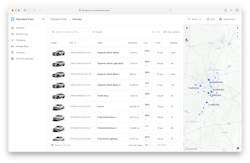
Tesla was the first OEM to allow Standard Fleet “official API” access, according to Hodge. Connecting with Tesla’s API, or application programming interface, enables Standard Fleet software to communicate with the vehicle’s software. Standard Fleet reports vehicle data back to the fleet manager on the Standard Fleet dashboard and the driver app.
In addition to reporting data, Standard Fleet also shares alerts with fleet managers and drivers.
“There are hundreds of different alerts that we track from vehicles, and we categorize them and prioritize them for our users,” Hodge explained. “Some of them relate to the battery. Additionally, we do track battery health and battery capacity over time.”
Fleet managers can choose where they see that alert and even pipe that alert directly to a specific group or person. For example, if they use the messaging app Slack, they can receive alerts directly to their Slack account or send those alerts directly to the Slack channel for the operations or maintenance teams, Hodge said.
A common gripe among EV owners is the lack of price transparency offered at EV charging stations. Often, an EV driver won’t know the cost of the charge until after they’ve finished charging. Standard Fleet seeks to eliminate this by building partnerships with charging companies—like how a fuel card provider partners with fueling stations—to ensure and display the most up-to-date pricing within the driver app.
Standard Fleet also offers charging data and reporting, enabling fleet managers to recall specific charging transactions within the platform.
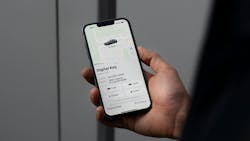
Once the vehicle is connected, fleet managers have access to the data they need along with other remotely enabled features. For example, a fleet manager can assign a digital key to a driver through a mobile device, allowing physical keys to remain with the manager or at home base at all times. Once it’s time for the next driver, the fleet manager can unassign the vehicle from Driver 1 and offer a digital key of the same vehicle to Driver 2.
Additionally, Standard Fleet monitors driver behavior and offers a driver coaching module within its system, something customers are increasingly interested in, Hodge said.
Standard Fleet can also access vehicles remotely; a fleet manager can lock and unlock a vehicle miles away while sitting at their desk. In the event of theft, fleet managers can also limit a vehicle’s operational capabilities and pinpoint the vehicle’s exact location to assist in recovery.
“There's just a lot more that you can do when you're directly integrated with a car, rather than plugged into the OBD port of a vehicle,” he explained.
Standard Fleet in action: Real-world fleet applications
Standard Fleet customers come in all shapes and sizes. The platform helps fleets manage both vehicles and motorized equipment. DriveWhip, a Standard Fleet customer, uses the platform to manage its fleet of internal combustion engine (ICE) vehicles and EVs.
“From on the fleet side, [Standard Fleet] centralizes fleet management and gives you real-time vehicle tracking,” DriveWhip CMO Bobby Taheri told FleetOwner. “On the driver side, you get the ability to monitor driver behavior.”
For DriveWhip, some of Standard Fleet’s most heavily used features include its digital key capabilities, speed limiting, and real-time alerts. The digital key feature prevents DriveWhip from ever loaning a vehicle’s physical key to the driver; instead, DriveWhip grants them access via a digital key. Further, limiting vehicle speed helps prevent the severity of accidents. And when an accident or safety event does happen, such as a deployed airbag, low battery life, or a flat tire, DriveWhip’s fleet managers receive alerts instantly. This helps the DriveWhip operations and maintenance teams handle the problem and ensure the vehicle and driver can get back on the road as quickly as possible.
Aside from vehicle data, DriveWhip relies on Standard Fleet for driver behavioral data such as speeding and harsh braking. Knowing this information helps DriveWhip take more control of its fleet safety, Taheri said.
“Our reputation is really driver-first and being driver-centric, and if we have really reckless people behind the wheel, that really doesn't help to further that mission,” Taheri said. Standard Fleet’s driver monitoring insights “will save you time in the long run by figuring out that, ‘OK, this is someone I need to take off the road before they cause an accident.”
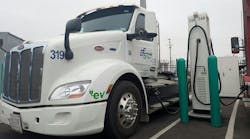
Worth noting, while most of Standard Fleet’s experience has been the management of smaller vehicles, such as with DriveWhip, the company is rapidly expanding into the large truck market. This expansion is propelled by investments from industry players such as Wex, which holds a prominent fuel card provider.
Improving fleet management UX for managers and drivers
Taheri praised Standard Fleet’s abilities to centralize his fleet’s management operations. And that centralization is all part of the fleet manager user experience—which Standard Fleet aims to improve in a world where fleet managers often have to sift through different portals and different dashboards. Standard Fleet offers all its data, insights, and information in real time within its management dashboard.
For drivers, an app houses need-to-know information and features such as the digital key. The app was designed with a pleasant user experience in mind, allowing drivers to find information they need in a way that’s 'easy to consume,'” Hodge said.
“We're trying to bring a high-quality software user experience to telematics, an industry that we feel has historically not had the best user experience, partially because they're selling hardware devices,” Hodge said.
About the Author
 Jade Brasher
Jade Brasher
Executive Editor Jade Brasher has covered vocational trucking and fleets since 2018. A graduate of The University of Alabama with a degree in journalism, Jade enjoys telling stories about the people behind the wheel and the intricate processes of the ever-evolving trucking industry.