The future of sustainable fleets: Electric, hydrogen, and AI transformations in 2026
Key takeaways
- Fleets are diversifying their powertrain options, with increased use of renewable diesel, biodiesel, natural gas, propane, and electric vehicles to navigate regulatory and economic uncertainties.
- AI adoption in fleet management is growing, with nearly half of respondents using AI for daily tasks, resulting in significant savings in fuel and operational costs.
- Hydrogen vehicle adoption remains limited due to high costs and infrastructure challenges, but ongoing R&D suggests potential future growth.
- Regulatory changes and the end of federal EV incentives have slowed EV adoption, though some segments like yard tractors show promising growth and ROI.

The transportation industry faced a lot over the last year: regulatory uncertainty, the repeal of alt-fuel vehicle incentives, and, most recently, the rising cost of fuel. The seventh annual State of Sustainable Fleets report, compiled by consulting group TRC Companies, reveals what fleets are thinking and doing in their businesses concerning new technologies, both within the cloud and under the hood.
“This year's market brief records how transportation businesses are responding to extended uncertainty by doubling down on fundamentals, by seeking new signals, and by diversifying their drivetrain mix,” Nate Springer, VP of market development at TRC Companies, said during a webinar discussing the report.
Let’s dive in.
Here’s where the industry stands on powertrain choice
The state of diesel in 2026
The slump in the trucking industry was evident in 2025, as new Class 8 diesel truck registrations were down 16% compared to 2024. And while diesel still remains king in the transportation segment, more than a third of fleets (38%) use efficiency technologies and practices, and 46% plan to increase their use of efficiency technologies to squeeze more miles out of every drop of fuel.
In 2025, more fleets began using diesel alternatives, such as renewable diesel (RD) and biodiesel (BD). Nearly 60% of respondents report using BD or RD (56%), and 21% reported using both. Combined, both fuels displaced traditional diesel by 74% in the state of California in 2024, and diesel displacement reached 71% in the first three quarters of 2025. While it’s worth noting that fuels receive more carbon credits in the state than any other fuel type, the prevalent use of the alternative fuel helps prove its performance. The report predicts domestic production of the alternative fuels will increase in 2026.
Infrastructure for the fuels is also expanding. Pilot Travel Centers has installed multiple B99 pumps at its stations throughout the Midwest, primarily in states that incentivize the fuel.
The state of natural gas in 2026
Natural gas vehicle registrations experienced an overall decline from 2024 to 2025, but that could be due to the application. Judging by the data—natural gas tractor truck registrations fell 83% year over year, while natural gas straight truck registrations increased 27%—one could infer that natural gas is better suited for applications that employ straight trucks. Regardless, the introduction of the Cummins X15N natural gas engine is breeding fresh interest among fleets looking to diversify their operations.
Of fleets using the X15N, 71% report cost savings relative to diesel, and 59% report savings relative to other natural gas vehicles. While the X15N is a young engine, already more than one-third of fleets using the engine intend to increase the powertrain across their fleet.
Compressed natural gas (CNG) has its benefits and its drawbacks, however. The drawback lies in its performance. Traditionally, drivers of natural gas powertrains experience a more sluggish take-off and less capability. Yet, according to Cummins, fleets using the X15N have reported CNG performance that’s comparable to diesel. The engine was also featured in trucks participating in the latest North American Council for Freight Efficiency Run on Less, with impressive results. Kleyson Group drivers reported that their trucks drove like a diesel, and J.B. Hunt reported a 3-5% mpg gain over the Cummins 12L natural gas engine.
Another drawback lies in infrastructure. CNG can’t be found at nearly all fueling stations like diesel. But it can be found at hundreds of stations nationwide. Additionally, CNG providers are known to work with fleets to develop on-site fueling infrastructure.
Two benefits of CNG over diesel are its cleaner burn—Freightliner reports up to 20% reduced emissions compared to diesel—and its lower price volatility compared to worldwide crude oil prices, which fluctuate with every foreign conflict. Because CNG is domestically produced and isn’t priced on a global scale as with crude oil, its pricing is much more stable.
Further, renewable natural gas (RNG) lowers emissions even more. According to the report, 65% of CNG users say they use RNG for 78% of their fueling volume. In California, RNG replaced 97% of natural gas use and offered a 301% GHG reduction in 2025 compared to diesel, the report states.
“This is another option … another arrow in the quiver for a customer that has [an RNG] filling station nearby and their route makes sense,” Paul Rosa, SVP of procurement and fleet planning at Penske, said during the webinar. “The amount of consumption per mile is going to offset the additional cost of [RNG]. We're seeing tremendous success thus far with the X15N.”
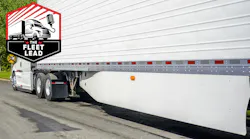 trailer skirt to improve tractor fuel efficiency
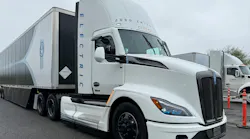 kenworth electric T680
The state of propane in 2026
Propane vehicle registrations increased by 3% between 2024 and 2025. The alternative fuel has reigned supreme among school buses, but school bus registrations actually declined by 7%, while service vehicle registrations increased by 7.5% year over year.
Along with school buses, current propane vehicle registrations include light- and medium-duty Ford pickups and chassis, box trucks, utility trucks, construction fleets, and rail industry applications. According to the report, 41% of operators using propane intend to increase its use in their fleet.
As with CNG, fueling stations can be built on-site. A majority (76%) of propane users fuel via private infrastructure and report prices from $1.32 to $2.91 per gasoline-gallon equivalent; that’s a 19 to 63% savings over gasoline, the report states. Further, building on-site fueling infrastructure for propane is “one of the least capital-intensive investments among all alternative fuel types, and a new fueling operation can be set up in as little as a day,” the report states.
Like renewable diesel and renewable natural gas, propane also has a renewable option, which 32% of fleets using propane vehicles report as their fueling source. Those 32% report using renewable propane for 83% of their propane volume.
The state of battery electric vehicles in 2026
Federal incentives for battery electric vehicles (BEVs) crashed and burned in 2025, but medium- and heavy-duty EV registrations increased by 21% from 2024. However, evidence points to buyers pulling their EV purchases forward to take advantage of the $7,500 federal EV tax credit that expired in September 2025, considering Q4 EV sales fell rapidly, the report states.
With “federal funding having gone away, fleets are faced with that total cost of ownership making sense in the here and now—the first generation of equipment,” Rosa said. Removing funding opportunities “certainly has put more customers on the sideline when they were maybe ready to get in the [EV] game.”
OEMs took the non-renewal of federal incentives to heart and canceled or paused EV programs indefinitely. Including pickups, the total number of medium-duty EV models fell from 62 in 2024 to 33 in 2025, the report states.
One U.S. Class 8 segment that has experienced BEV growth is the yard tractor segment, led by Orange EV’s yard tractors.
“Lazer Logistics, North America’s largest outsourced yard management provider, surpassed 2.5 million ZE miles with its Orange EV yard tractor fleet and reported over $5 million in fuel and maintenance savings, with some customer sites achieving ROI in under two weeks,” the report states.
The state of hydrogen in 2026
Hydrogen research development was significantly stunted in 2025 after hydrogen’s nearly $8 billion funding was cut. Overall, registrations for hydrogen vehicles declined by 12% from 2024 to 2025; however, registrations for hydrogen transit buses increased by 24% year over year. Despite the increase in transit applications, only 12% of all hydrogen-powered vehicle fleets intend to increase their use of hydrogen over the next two years.
A new player in the powertrain market, the cost of operating a hydrogen-powered vehicle is high. Fleets using hydrogen report prices at an average of $18.86/kg in 2025, and the price of hydrogen fuel had an 89-135% premium over diesel, the report states. While hydrogen is more efficient than diesel, the efficiency gained does not cancel out hydrogen’s higher price.
Regardless, manufacturers are still developing hydrogen-fueled powertrains. Toyota recently partnered with Daimler and Volvo in their joint venture, Cellcentric, a fuel cell company with a mission to “become a leading global manufacturer of fuel cells,” the company’s website states. With private investments, such as Cellcentric’s, into hydrogen R&D, there still could be a future for the fuel.
Hydrogen “has its paces to go through. But as far as the technology itself, it has possibilities, without a doubt,” Rosa said. “The evaluation we did with the NACFE Run on Less project along with the Hyundai vehicle was very successful. That's what we tried to do with this: to show that [a hydrogen powertrain] can work despite all the other things that have to be figured out.”
Artificial intelligence and fleets today
Since the introduction of ChatGPT, artificial intelligence (AI) has infiltrated every aspect of our lives—and that includes the transportation and trucking industries. As time goes on, AI capabilities improve. Trucking technology companies have integrated AI directly into their software and embedded conversationally driven features into their customer-facing dashboards. This enables fleet managers to quickly ask, “Which vehicles need maintenance this month?” and receive answers instantly.
Nearly half of survey respondents (48%) indicate that they use AI for daily responsibilities. In fleets, AI is most popularly used in route planning and dispatch (21%), maintenance diagnostics (19%), and preventive maintenance management (19%). Interestingly, while nearly half of respondents use AI for their responsibilities, they estimate that only 20% of their fleets have “been enabled” by AI, and 49% said that none of their fleet had been enabled by AI. This could indicate that AI is active “behind the scenes, embedded in hardware and software,” the report states.
But those using AI report savings. Penske conducted a survey of company leadership and found that roughly 40% of fleets using AI for route optimization reported 50% savings in fuel costs, operational expenses, and distance traveled.
On its own, 2025 was a tough, unpredictable year for the trucking and transportation industries. But TRC’s Springer said the entirety of the 2020s has been some of the most transformative years of the industry to date. From COVID-19 to the EV revolution to AI and autonomous vehicles, “we have seen more uncertainty, more shock, and more innovation in this industry than ever before,” Springer said during a webinar discussing the report.
And that’s just from the first half of the decade. Where will trucking take us in the second half?
About the Author
 Jade Brasher
Jade Brasher
Executive Editor Jade Brasher has covered vocational trucking and fleets since 2018. A graduate of The University of Alabama with a degree in journalism, Jade enjoys telling stories about the people behind the wheel and the intricate processes of the ever-evolving trucking industry.