Industry shakeup: Ford's pivot to profitable EVs and battery energy storage business
Key takeaways
- Ford has ended production of the current F-150 Lightning and will introduce a next-generation F-150 EREV with over 700 miles of range and increased towing capabilities.
- The company is focusing on a new Universal EV Platform to develop affordable, efficient EVs, starting with a midsize pickup in 2027, aiming for EV profitability by 2029.
- Ford is shifting its commercial vehicle lineup to include more gas and hybrid models.
- This strategic pivot reflects industry-wide challenges, including significant EV program losses.

The much-ballyhooed all-electric Ford F-150 Lightning, launched in 2021, is no more—part of a decisive shift in Big Blue’s electrification strategy revealed Monday. In its place will be an F-150 with an electric powertrain supplemented by an on-board generator for extended range, with production details still to come, the company statement read.
The pivot is part of Ford Motor Company’s planned capital redeployment, aimed at driving profitable growth and aligning production with evolving customer demand.
“This is a customer-driven shift to create a stronger, more resilient, and more profitable Ford,” Ford president and CEO Jim Farley said in the company’s statement. “The operating reality has changed, and we are redeploying capital into higher-return growth opportunities: Ford Pro, our market-leading trucks and vans, hybrids, and high-margin opportunities like our new battery energy storage business.”
Under the updated product strategy, Ford is focusing its pure electric vehicle development on a new, low-cost, flexible Universal EV Platform. This architecture is engineered to serve as the foundation for a high-volume family of smaller, highly efficient, and affordable electric vehicles designed to be accessible to millions of customers.
The first vehicle built on this platform will be a fully connected midsize pickup truck, scheduled to start production at the Louisville Assembly Plant in 2027. This renewed focus is key to providing a path to profitability for Ford Model e, the company’s lineup of electric vehicles, by 2029, with annual improvements targeted to begin in 2026, the statement explained.
Ford is expanding its choice of powertrains across its portfolio, emphasizing a range of hybrids and extended-range electric vehicle (EREV) systems. By 2030, Ford anticipates that approximately 50% of its global volume will consist of hybrids, extended-range EVs, and fully electric vehicles, a significant increase from 17% in 2025.
The next-gen EREV F-150 targets range, towing, and real-world fleet capability
A centerpiece of this strategy is the next-generation F-150 Lightning EREV, which will be propelled entirely by electric motors, maintaining the pure EV driving experience, but adds a high-power generator to support an estimated range of over 700 miles. This change addresses customer demand for range and capability, making heavy-duty towing and cross-country travel more achievable. Production of the current F-150 Lightning has concluded, with the next-generation EREV model slated for assembly at the Rouge Electric Vehicle Center in Dearborn, Michigan.
“The F-150 Lightning is a groundbreaking product that demonstrated an electric pickup can still be a great F-Series,” Doug Field, Ford’s chief EV, digital, and design officer, said. “Our next-generation Lightning EREV is every bit as revolutionary. It keeps everything customers love—100% electric power delivery, sub-5-second acceleration—and adds an estimated 700-plus-mile range and tows like a locomotive. It will be an incredibly versatile tool delivered in a capital-efficient way.”
In parallel, Ford is adjusting its commercial vehicle lineup by replacing planned electric commercial vans for North America and Europe with new gas and hybrid models. U.S. plants are being repurposed to support this transition; for instance, the Tennessee Electric Vehicle Center is being renamed the Tennessee Truck Plant to produce all-new gas-powered trucks starting in 2029. The Ohio Assembly Plant will become a central hub for Ford Pro, assembling the new gas- and hybrid-powered commercial van.
 RIP Bollinger Motors
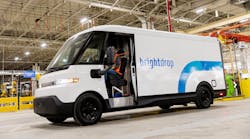 gm_brightdrop_1
Ford launches battery energy storage business to unlock new revenue streams
As part of its move to higher-return opportunities, Ford is launching a new Battery Energy Storage System (BESS) business. This venture aims to capture large-scale demand for energy storage from data centers and infrastructure. Ford plans to leverage currently underutilized U.S. battery manufacturing capacity in Kentucky, converting the site to produce advanced BESS systems. The company expects to begin shipping these systems in 2027, leveraging LFP technology and positioning the company to deploy at least 20 GWh annually by late 2027.
In essence, Ford’s revised strategy is a measured response to market realities, balancing the commitment to a carbon-neutral future by 2050 with the immediate need to secure profit margins through flexible propulsion choices and a focus on smaller, affordable EVs.
What Ford’s strategy reset signals for the EV market and auto industry
Ford’s announcement signals a major shift in an industry that was once bullish on electric vehicles’ future. With the amount of money lost in the process—and with EV programs and manufacturers folding left and right—this shift could be seen as necessary.
Ultimately, Ford expects a loss of $19.5 billion in its quest to build EVs. The OEM isn’t alone. In October, General Motors announced an expected $1.6 billion loss due to slowing EV sales. At this time, GM has not announced plans to overhaul its EV strategy, though it has significantly cut EV production.
The other Detroit-based auto manufacturer’s EV strategy has been a bit different. In North America, Stellantis (Chrysler, Jeep, Ram) has significantly lagged behind in the EV race—but has it had the winning strategy all along?
Ram is currently developing its 1500 REV, an electric pickup that also features a generator (sound familiar?) and has a projected availability of 2026. In addition, the brand has already developed a one-platform strategy for electric vehicles with its STLA platform. For the one Big Three that was once losing the EV race, could this shift in the industry allow the company to pull ahead?
This has been a tough year for the automotive industry, and the programs most costly and least profitable are finally seeing their demise. It’s likely that more strategy shift announcements will come in 2026. At FleetOwner, we’re waiting on GM’s end-of-EV announcement.
About the Author
 Kevin Jones
Kevin Jones
Editor
Kevin has served as editor-in-chief of Trailer/Body Builders magazine since 2017—just the third editor in the magazine’s 60 years. He is also editorial director for Endeavor Business Media’s Commercial Vehicle group, which includes FleetOwner, Bulk Transporter, Refrigerated Transporter, American Trucker, and Fleet Maintenance magazines and websites.
Working from Beaufort, S.C., Kevin has covered trucking and manufacturing for nearly 20 years. His writing and commentary about the trucking industry and, previously, business and government, has been recognized with numerous state, regional, and national journalism awards.
 Jade Brasher
Jade Brasher
Executive Editor Jade Brasher has covered vocational trucking and fleets since 2018. A graduate of The University of Alabama with a degree in journalism, Jade enjoys telling stories about the people behind the wheel and the intricate processes of the ever-evolving trucking industry.