Key takeaways
- Average EV battery degradation is about 2.3% per year, leading to roughly 81.6% capacity after eight years.
- Frequent use of high-power DC fast chargers increases degradation rates from 1.5% to 2.5% annually.
- Operating in hot climates accelerates battery degradation by approximately 0.4% annually due to increased thermal stress.
- Keeping the battery at extreme states of charge (below 20% or above 80%) for prolonged periods can negatively affect battery health, though operating at these extreme states are less harmful.

Electric vehicles have been on the market for quite some time. Yet their time in the industry doesn’t compare to internal combustion engines (ICE). This hasn’t given fleet owners or even consumers enough time to understand how to fully compare the two powertrains. Will an electric vehicle (EV) battery withstand the useful life cycle most owners and OEMs expect? Or will its degradation eat into any potential return on investment advertised by OEMs, offsetting fuel and maintenance savings?
Telematics provider Geotab recently conducted a study to understand the lifespan and performance of an electric vehicle battery. Its findings include annual battery degradation and what accelerates degradation the most.
A high-level view of Geotab battery health study results
Specifications of Geotab’s study
- Battery degradation is the measure of the gradual decline in a battery’s ability to store energy.
- Geotab based the "lifespan” of EVs on the industry standard life cycle warranty of eight years or 100,000 miles.
- This study analyzed more than 22,700 EVs consisting of 21 different models within Geotab’s network.
Geotab’s study sought to understand the annual battery degradation rates of electric vehicles of all shapes, sizes, and manufacturers. Because a vehicle’s degradation rate impacts its range, performance, and even resale value over the course of its lifetime, it’s important that fleet owners and potential EV buyers understand these rates when comparing an EV to an ICE vehicle.
The study found that the average annual battery degradation rate for electric vehicles is 2.3%, meaning that by the time an EV reaches its full lifespan (eight years), its battery’s performance will be about 81.6% of its original performance.
The study also found, unsurprisingly, that multiple factors affect an EV battery’s degradation rate, including climate, the use of direct current (DC) fast charging, and more.
Breaking down what impacts EV battery health
By far, the biggest contributing factor to EV battery degradation is DC fast charging; however, other factors, such as operating in hot climates and consistently keeping the battery charged between 80 and 100%, also play significant roles in battery degradation.
Fast charging fast-tracks the loss of battery performance
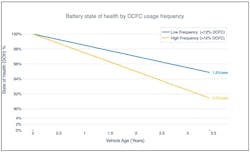
Geotab found that both the frequency of fast charging use and the higher the power flow when fast charging can degrade vehicle batteries at a higher rate. To determine this, Geotab split EVs into two groups: those that use fast chargers less than 12% of the time, and those that use fast chargers more than 12% of the time. The result found that EVs using fast chargers less frequently saw a battery degradation rate of 1.5% annually, while those that used fast chargers more frequently experienced a degradation rate of 2.5% annually.
Does this mean fleet owners should use fast chargers less often? That depends.
“After several years of operating, the [battery] capacity is always going to go down—that's just the nature of batteries,” Charlotte Argue, Geotab’s senior manager of sustainable mobility, told FleetOwner. “But if they start noticing that the drop is becoming faster all of a sudden, or that particular vehicle is dropping faster than similar vehicles in their fleet, that's when they probably want to pay attention.”
It’s worth noting that Geotab’s 2025 EV data on fast charging use has more than doubled since the company began collecting EV data in 2020. This is a result of a growing DC charging network, Argue said. What’s more, the average power in these charging sessions has increased from about 70 kW to 90 kW, according to Geotab data. This also signals an improvement in DC chargers. Yet, this increase in power output also has a negative effect on battery health.
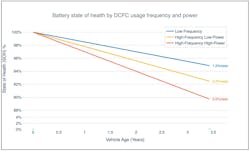
Geotab found that of the EVs that frequently use DC charging, those that use high-power DC charging more frequently see an annual battery degradation rate of 3%. Geotab projects these EVs will have a battery health of 76% after eight years.
But what if a fleet vehicle requires a high-powered fast charger to complete its duty cycle?
“From our data, we've seen that charging power and frequency of charging at high power influences individual vehicle rate of degradation the most compared to any other of the factors that we looked at,” Argue said. But “it’s not something to look at and say, ‘Wow, I'm never going to charge my vehicle on a fast charger.’
“If I need high-power charging in order to meet the daily requirements for my vehicle, I'm going to use it, but I'm not going to fall into the trap of bigger is always better,” Argue continued. “I don't necessarily need megawatt charging if my vehicles are sitting overnight every day. Rather than defaulting to the fastest power available, it's more appropriate to then size the charging to the need that I have in my fleet.”
 Hexagon Agility CNG truck
How climate impacts battery health
EV batteries are sensitive to temperature, and harsh climates take their toll on battery health as well. Geotab found that EVs operating in hot climates are more likely to see increases in battery degradation than those that operate in temperate climates. This is because “heat increases chemical activity and stress inside the cell,” Geotab states. While EVs are built to accommodate for this, the battery pack has to work that much harder to regulate battery temperatures, leading to increased degradation.
To determine the rate of degradation for vehicles operating in hot climates, Geotab, again, split the EVs into two groups: those that operated in weather above 77 degrees Fahrenheit less than 35% of the time and those that operated in weather above 77 degrees more than 35% of the time.
The result? Vehicles operating in hot climates see an average annual degradation rate of 0.4% more than those operating in mild climates.
How an EV’s charge percentage affects degradation
EV owners might be familiar with the advice that keeping a vehicle between 20 and 80% state of charge (SOC) is optimal for battery health. But Geotab’s data doesn’t back that claim.
“We essentially myth-busted that one,” Argue said. But with an exception.
While the data found that running an EV within 1 to 20% battery life or 80 to 100% battery life is perfectly fine for overall battery health, the data found that the prolonged or habitual state of keeping the battery below 20% or above 80% (identified as “extreme SOC”) is what negatively affects the battery.
“If your vehicle is sitting at 100% for more than 80% of the total time, then that's when it adds enough stress where we're seeing an increase in battery degradation,” Argue said. “But otherwise, charging up to 100 [percent] on occasion or on regular use doesn't seem to have an impact.”
To calculate battery degradation rate affected by a battery’s state of charge, Geotab segmented the EVs into three groups: low exposure (spending less than 50% of time at extreme SOC); medium exposure (spending 50 to 80% of time at extreme SOC); and high exposure (spending more than 80% of time at extreme SOC).
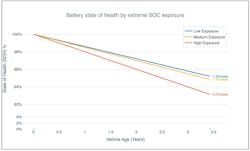
Data shows a 2% annual degradation rate for EV batteries with a state of charge between 1 and 20% and 80 and 100% for more than 80% of the time. In contrast, EVs that spend less time in an extreme SOC have an average annual degradation rate of 1.5% or lower.
This finding could be seen as a positive for fleet leaders, as it essentially “opens up 40% of the battery pack on either end: 20% at the bottom end and 20% of the top end,” Argue said. “I think that's a good news story for EV operators.”
High output + more charge cycles = more battery degradation
How often a battery completes a charge cycle also impacts its health. Charge cycles are measured by the percentage a vehicle charges in multiple sittings over time, not necessarily topping it up to 100% during each charge. However, if an EV is charged from 0 to 100% in one sitting, that equates to one charge cycle.
Here are some examples of how charge cycles are calculated:
- Charging from 75% to 100% four times = one charge cycle
- Charging from 20% to 80% + 70% to 90% + 80% to 100% = one charge cycle
- Charging from 20% to 60% + 50% to 75% + 60% to 80% + 75% to 100% = one charge cycle
To understand battery degradation by charge cycles, again, Geotab segmented EVs into groups: low charge cycles with EVs that completed a full charge cycle every seven days or more (less than 15%); medium charge cycles with a full cycle completed every three to six days (15 to 35%); and high charge cycles with a full cycle every one to two days ( more than 35%).
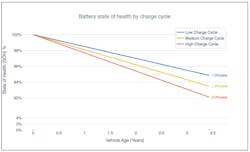
This is one of the more significant factors for fleets, which expect high productivity—or high output—from their vehicles, which leads to an increase in charge cycles. Vehicles with higher charge cycles experience an annual degradation rate nearly a full percentage point (0.8%) higher than those with lower cycles, leading to an increase in about 6% battery degradation over the course of the vehicle’s life.
Overall, Geotab’s data signals good performance from Argue’s perspective: “These EV batteries are performing really well, and they're maintaining their capacity quite well.”
While Geotab’s data says a lot about EV battery health, it’s the responsibility of the fleet manager to ensure a long battery life. Geotab suggests fleet managers follow the following guidelines: Be strategic with charging power; be aware of climate; prioritize vehicle utilization; and avoid an extreme state of charge.
Specifications of Geotab’s study
- Battery degradation is the measure of the gradual decline in a battery’s ability to store energy.
- Geotab based the "lifespan” of EVs on the industry standard life cycle warranty of eight years or 100,000 miles.
- This study analyzed more than 22,700 EVs consisting of 21 different models within Geotab’s network.
About the Author
 Jade Brasher
Jade Brasher
Executive Editor Jade Brasher has covered vocational trucking and fleets since 2018. A graduate of The University of Alabama with a degree in journalism, Jade enjoys telling stories about the people behind the wheel and the intricate processes of the ever-evolving trucking industry.