The state of electric vehicle adoption: Challenges, industry sentiment, and future outlook
Key takeaways
- Industry sentiment is mixed, with some viewing EVs as essential for future sustainability, and others criticizing them as expensive, unreliable, and environmentally questionable.
- Most fleet respondents do not currently own EVs, but a notable percentage have tested or own multiple units, indicating cautious interest in electrification.
- Policy changes, such as the rollback of emissions regulations, have decreased industry interest in expanding EV fleets, with some operators citing economic and operational challenges.
- Some fleet owners are integrating EVs selectively, such as yard trucks, to reduce emissions and operational costs, while others remain skeptical about EV performance and longevity.
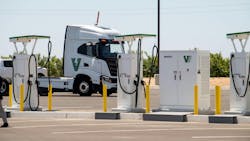
After a turbulent year for everyone, it’s time to do an industry wellness check on the adoption of electric vehicles (EVs). Just a few years ago, industry consultants, the government, and vehicle manufacturers had high hopes for electrification. But soon after, reality set in, and the lack of charging infrastructure and long-range battery technology resulted in industry pushback.
One could argue that pushback led to the discontinuation of EV tax credits, federal incentives, and federal investment into charging infrastructure under the Trump administration in 2025.
By the end of Trump’s first year in his second term in office, both legacy vehicle manufacturers and manufacturers that produce only electric vehicles had either cut EV model programs completely—such as the discontinuation of Ford’s Lightning and General Motors’ BrightDrop—or had gone out of business, as with Bollinger Motors.
This begs the question: Does the industry care about EVs anymore?
Why many FleetOwner readers don’t own EVs—yet—and what could change that
Do FleetOwner readers own EVs?
Unsurprisingly, most respondents do not yet own electric vehicles, though EVs were once in their plans or remain on the table. However, more than 8% of respondents own at least one EV, and just as many own more than 20 EVs. Nearly 6% of respondents own between six and 20 EVs.
Upon seeing these low numbers, one could infer that EVs are dead. But these numbers don’t tell the full story.
So your fleet doesn't employ any EVs; tell us why.
As no two fleet operations are the same, neither are the reasons a fleet owner or manager is interested in or opposes EVs. To better understand the industry’s attitude toward EV adoption, we asked readers who do not own EVs where they stand.
Among respondents who do not own EVs, 43% are unlikely to be swayed, selecting the answer, “I never want an EV—ICE ‘til I die.”
Additionally, 35% of respondents who do not own EVs indicated they are interested in them, but the technology has kept them from proceeding. These respondents selected the answer “I’m interested in EVs, but I work in an application where they don’t make sense due to range, cost, weight restrictions, etc.”
The remainder of respondents indicated that, at one point, they were interested in implementing EVs into their operation. Yet, once the Trump administration rolled back emissions regulations in 2025, their interest subsided. These respondents selected the answer “I was only interested in EVs because of government requirements. Now that those requirements have loosened, I’m no longer interested.”
There was one outlier among the group of respondents who did not own EVs but had tested them in the past. This respondent selected the “Other” answer in the survey and then elaborated further.
“Tested Peterbilt and Freightliner EV day cabs and didn’t work due to range, cost, weight, and productivity (availability to haul weight),” the respondent wrote.
In a later survey question, the same respondent indicated they might consider EVs for smaller trucks in their fleet.
 FleetOwner Top 10 E&E 2025
 Kenworth primary
Do EV owners plan to grow their EV fleets?
If the results of the FleetOwner reader survey are any indication of the industry’s attitude toward EVs among early adopters, consider the industry a mixed bag. Where some current EV owners plan to add more electric vehicles to their fleet within months, the majority plan to add them within the next one to six years.
Additionally, one current EV owner has no plans to add more electric vehicles to their fleet within the foreseeable future.
EV owners who have no plans to add more electric vehicles to their fleet or plan to add EVs much further down the road have their reasons, which run the gamut from application to infrastructure.
Some respondents with EV fleets ranging from one to five vehicles to more than 20 EVs indicated that they have no current plans to purchase EVs because the technology prevents them from using battery-electric vehicles across their business operations. These respondents selected the answer “I only purchased EVs for a specific part of my business; EVs won’t work for other aspects of my business.”
One respondent with a fleet of EVs ranging from six to 20 vehicles indicated that they purchased them strictly because of emissions regulations and have no plans to buy more now that regulations have loosened.
Another respondent with a fleet of more than 20 EVs indicated that they have already converted their entire fleet to electric powertrains and have no need to purchase more.
Finally, one current EV owner selected the answer “I tried EVs and, it turns out, they suck.”
There was one outlier among respondents who answered this question, however. While this respondent indicated they have no electric vehicles in their fleet, they have a good reason: infrastructure.
“We have talked to our local power company. The power grid cannot support even one electric truck,” the respondent wrote.
Readers sound off on EVs, citing real-world pros, cons, and barriers to adoption
The five-question survey ended with an open-ended question about your thoughts on electric vehicles. The responses below are edited only for grammar and anonymity. Enjoy!
“Currently only use E-yard trucks, as OTR vehicles cannot meet range needs and limited re-charge infrastructure.” Respondent owns more than 20 electric vehicles.
“The company uses EV yard trucks for yard logistics operations to reduce emissions and fuel consumption, improve uptime and safety/health, and lower operational costs. The Bureau of Labor Statistics reports that truck driver turnover remains among the highest in the industry. Yet, healthier, safer yards help attract and retain skilled drivers, reduce injuries, and lower turnover. Since a single diesel yard truck consumes 1,800 gallons of fuel per year, multiply that across a network, and the financial impact is immediate. Replacing 50 diesel yard trucks across the network can cut over 1,000 metric tons of CO2 per year, equivalent to removing 200-300 passenger cars from the road. However, transitioning to electric is not as simple as ordering new trucks—success requires planning and expertise. Many enterprise shippers turn to specialized yard partners who provide immediate access to EV fleets without the heavy upfront investment and offer smarter fleet management through monitoring, analytics, and predictive maintenance.” Respondent owns more than 20 electric vehicles.
“Having options for trucks is not the ‘messy middle.’ Having people and groups push EVs when it is not a good business proposition is self-serving and pushing a ‘messy end.’” Respondent owns zero electric vehicles but has tested them.
“EVs suck. They just cannot outperform an ICE (internal combustion engine).” Respondent owns zero electric vehicles.
“Electric commercial vehicles are the worst. Too expensive to own, maintain, and constant mechanical breakdown issues. Began trying EVs nearly 20 years ago. They were a failure then, and they are a failure now. Why does this media always push EVs? I think we know why. Electric is NOT the future in any market. No one wants it, and if they had their way, they would monopolize the entire industry. The data is in. EVs do not help the environment and certainly do not present a lower cost. So why the push?” Respondent owns zero electric vehicles.
“For our rural area, EVs in our fleet are a no-go. They are unreliable, too expensive, and create more toxic waste at the end of their life cycle. If they are in an accident or catch on fire, they expose everyone around to horrible toxic fumes. Don't see the upside.” Respondent owns zero electric vehicles.
“No infrastructure, they are heavy, and really expensive.” Respondent owns zero electric vehicles.
“At this time, EVs are a bad investment.” Respondent owns zero electric vehicles.
“Too much money for too little return.” Respondent owns zero electric vehicles.
About the Author
 Jade Brasher
Jade Brasher
Executive Editor Jade Brasher has covered vocational trucking and fleets since 2018. A graduate of The University of Alabama with a degree in journalism, Jade enjoys telling stories about the people behind the wheel and the intricate processes of the ever-evolving trucking industry.