Ford Lightning Pro Review: A familiar, powerful electric pickup for commercial use
Key takeaways
- The Ford Lightning Pro offers 580 hp, 775 lb.-ft. of torque, and a 320-mile range, making it a powerful and practical electric work truck.
- Designed for commercial use, it features multiple outlets, storage options, and onboard power, with a towing capacity of up to 7,700 lb. with the Extended Range battery and 10,000 lb. with the Max Trailer Tow package.
- The vehicle maintains a familiar driving experience, requiring little to no learning curve for drivers accustomed to traditional gas-powered trucks.
- EV-specific features include battery status monitoring, charging management, and route planning with charging station suggestions, enhancing fleet operational efficiency.
- The truck FleetOwner reviewed, priced at just over $60,000, provides a cost-effective, electrified alternative to traditional pickups, suitable for fleet managers seeking reliability and performance.
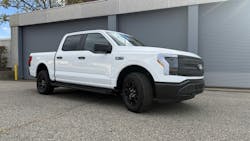
No matter where you’re located, you’ve probably seen them on the road. While they don’t carry the typical look of an electric vehicle, the Ford Lightning is a popular EV. In fact, it’s the most popular electric pickup in America. FleetOwner got a chance to test one out.
FleetOwner tested the 2025 Ford Lightning Pro, which is the brand’s Lightning product designed specifically for commercial use. Coming off the heels of a review of the Chevrolet Silverado EV, comparing the experience between the two vehicles was like day and night. But that’s not a bad thing.
Here’s why I think the Ford Lightning Pro offers a great value and could be a perfect introduction to EVs for any skeptical fleet driver.
The Ford Lightning Pro is built for work
The Ford Lightning Pro is the most basic of the five trims Ford offers for its electric pickup. The Lightning we tested was powered by Ford’s Extended Range battery, which offers 580 hp and 775 lb.-ft. of torque and an estimated range of 320 miles. The Lightning Pro can tow up to 7,700 lb. with the Extended Range battery and up to 10,000 lb. with the Max Trailer Tow Package.
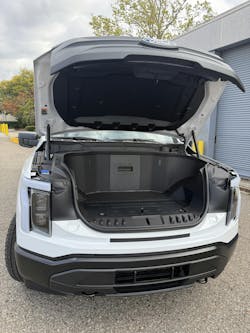
It’s also equipped with other work-ready features, like multiple outlets to power devices and equipment, multiple storage areas, including the frunk, and onboard power. Other work-ready features that aren’t EV-specific include Ford’s integrated tailgate step and an integrated ruler that runs the length of the tailgate.
Because it’s the most basic of the Lightning trims and designed for commercial use, the interior of the truck lacks certain creature comforts. It features vinyl, manually adjustable seats, no heated steering, and limited safety and security features. The Ford Lightning Pro does not feature adaptive cruise control or a lane-keeping assist system; however, it does offer lane-keeping and forward collision alerts.
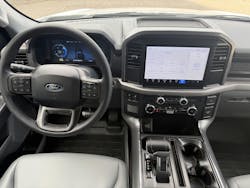
An electrified version of the nation’s best-selling pickup
Ford has taken a different approach to electrification than other brands. Where Tesla, Rivian, and General Motors with its Silverado EV have built electric vehicles from the ground up, Ford essentially electrified its existing F-150 pickup. Considering the truck has been the best-selling pickup for decades, can you blame them? (If it isn’t broke, don’t fix it. Am I right?)
There are different ways of viewing this approach. Some believe electrifying a vehicle built for gas and diesel engines leaves the product lacking—which I’m sure is true in certain cases. Yet my main thought when I got behind the wheel of the 2025 Ford Lightning Pro was that this was possibly one of the best electric vehicles a fleet could introduce to drivers who have a “never will I ever” mindset about electric vehicles.
What is one-pedal driving?
All electric vehicles and many hybrid vehicles employ regenerative braking to capture energy and squeeze every ounce of power from the electric vehicle’s battery. Regenerative braking “uses the onboard electric motors to slow down the [vehicle],” FleetOwner explained in a previous article. “This shifts the load from the foundation brakes to reduce wear and tear and generates electric energy for the battery to extend range.”
One-pedal driving is a feature that helps capture as much energy from the moving vehicle as possible. When activated, one-pedal mode causes the vehicle to “brake” as soon as you take your foot off the gas pedal. While many drivers prefer this driving mode when operating electric vehicles (myself included), it takes a few miles of driving to fully grasp.
Like the electric version of the Ford Transit, the Ford Lightning Pro requires little to no learning curve that other electric vehicles require. Yes, the Lightning features one-pedal driving mode, but that’s a feature that can be turned off. For the most part, driving the Ford Lightning Pro felt like I was driving an average gas- or diesel-powered work truck.
With that said, one feature I believe clearly distinguishes the Ford Lightning Pro from any ICE vehicle is its sheer, and frankly, seemingly unrestrained power. The Lightning Pro allows you to go from 0 to 60 in an ungodly amount of time without going into the settings and clicking into a cutely named mode, like Tesla’s “Ludicrous” mode or General Motors’ “WTF” and “WoW” modes, for example. In these modes from other manufacturers, more power is drawn from the electric battery than in regular driving modes, which then increases the torque.
From my experience, the Ford Lightning Pro can achieve this without selecting a particular drive mode, meaning that any Ford Lightning Pro driver can slam the accelerator and beat any vehicle on the imaginary drag strip at red lights—in a work truck! Don’t get me wrong, the fact that Ford allows this is absolutely insane, and part of me thinks this has to be an oversight error. I hope no one at Ford reads this review and decides to limit the Lightning Pro’s acceleration to a cutely named driving mode because I had too much fun testing it out.
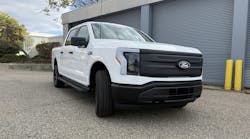 2025 Ford Lightning Pro front
EV-specific features
I said the Ford Lightning Pro had little to no learning curve, but that doesn’t mean it isn’t equipped with EV-specific features.
Most of these features are housed in the infotainment system. Clicking through the menu, operators can view the status of their EV battery, set certain charging settings, and even set a “Departure and Comfort” calendar. The Departure and Comfort calendar allows operators to set a departure time and desired cabin temperature for each day of the week. While this allows the operator to feel comfortable when they get behind the wheel, this feature also works hand-in-hand with Ford chargers to ensure the vehicle is charged to its preferred percentage (which operators can determine within the charging settings) before you depart for the day. This setting also helps maintain the battery by cooling or heating the cabin while the vehicle is plugged into a charger instead of waiting to cool or heat the cabin when you’re on the road.
The truck’s navigation system also has EV-specific features. Once operators set a destination, they’re shown the estimated percentage of the battery upon arrival. If a charge is needed to reach the destination, the navigation system will suggest charging stations along the route. This is such a helpful feature to have, but it’s imperative that operators use Ford’s native navigation system or use an Android device to see the vehicle’s estimated battery life, as this information is not yet available via Apple CarPlay.

Well-suited for fleet use
Overall, I believe Ford’s approach to vehicle electrification is a great approach for fleets. Instead of designing something from the ground up that requires a bit of a learning curve or completely changes the driving experience, many of the Ford Lightning’s features are carried over from the popular Ford F-150. This approach could enable fleet managers to iron out all the kinks of charging and charge management while ensuring their fleet drivers feel confident on the road in a familiar vehicle.
Additionally, the price of the Ford Lightning Pro also places it at an advantage compared to other electric pickups on the market—especially if used as a work truck. The 2025 Ford Lightning Pro I tested has an MSRP of just over $60,000 and it included Ford’s 131 kWh Extended Range battery as well as the Max Trailer Tow package. While it might lack certain creature comforts and the more premium features of other electric pickups, it doesn’t mean it won’t be suited for your fleet.
About the Author
 Jade Brasher
Jade Brasher
Executive Editor Jade Brasher has covered vocational trucking and fleets since 2018. A graduate of The University of Alabama with a degree in journalism, Jade enjoys telling stories about the people behind the wheel and the intricate processes of the ever-evolving trucking industry.