Why are U.S. EV truck costs rising while Europe’s fall?
Key takeaways
- Recent reports show U.S. prices for Class 6-8 electric trucks are rising, unlike in Europe where prices are falling.
- Industry stakeholders suggest that higher costs in the U.S. may be due to supply chain challenges, warranty requirements, and regional market strategies, but these remain theories without definitive proof.
- A 2026 ERM report indicates that non-component costs for electric trucks are significantly higher than for ICE vehicles, raising questions about OEM pricing transparency and industry practices.
A popular theory that's circulated around the electric vehicle community is that, as battery technology improves, the cost of the vehicle will come down. Many folks have likened this theory to plasma screen televisions, which hit the market with a sticker price of thousands of dollars. Today, they're only hundreds (and much bigger and flatter).
If that were the case, wouldn't the cost of EVs have started to decrease by now? In the smaller vehicle segment, that's happening, a report has found. But the same report also found that for larger vehicles, the price is only rising.
Here’s what’s happening:
ICCT finds U.S. price for Class 8 EVs keeps climbing
The International Council of Clean Transportation (ICCT) conducted a report outlining the costs of Class 6 to Class 8 vehicles over the years within different segments, such as buses, straight trucks, and tractors.
Class 6-8 electric vehicle pricing data
The ICCT report notes that determining exact costs for vehicles is a difficult task, as commercial vehicle prices can vary from customer to customer and unit to unit, depending on how they are appointed and upfitted. Manufacturers of these heavy vehicles are also unlikely to advertise prices as is common with light-duty, consumer-focused products. ICCT gathered vehicle pricing information primarily from publicly accessible data from government incentive programs and a small number of fleet leaders.
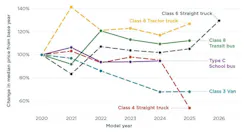
The report found that, unlike Class 5 electric vehicles and smaller, which have decreased in price over the years, Class 6 to Class 8 electric vehicle prices are climbing in the straight truck and over-the-road tractor segment. This price increase in the U.S. comes even while the cost of electric vehicle batteries is decreasing and as the sticker price for comparable vehicles in other regions, such as Europe, is falling.
The report found that from 2020 to 2025, Class 6-8 commercial electric vehicles have risen 27%, with the largest annual increase from 2020 to 2021, jumping 40%. Comparatively, in the European Union, the equivalent battery-powered tractors and straight trucks decreased in price by 32% and 23%, respectively, since 2020.
 New Harbinger Motors HC Series
If battery costs are lower and if comparable vehicles are sold for less in other regions, what’s contributing to this price increase?
Theories about why Class 6-8 EV costs in the U.S. have increased despite a price decrease in other regions
While much of the ICCT’s 33-page report outlined costs, one section is dedicated to possible theories on Class 6-8 EV prices. The report claimed to have reached out to several industry stakeholders to gather theories. These stakeholders included “vehicle manufacturer representatives, fleet operators, independent research organizations, and state incentive program staff,” the report states.
Though ICCT didn’t specify which OEMs it reached out to, the ones that did respond cited rising costs of raw materials, warranty requirements, and supply chain challenges as reasons for the increased prices of their electric vehicles.
“A manufacturer also explained that going forward, U.S. trucks will be consistently more expensive than European trucks because their longer driving ranges will require larger batteries,” the report states.
Other OEM comments include:
- The customers an OEM serves play a role, meaning “a large fleet customer will be less price sensitive than a smaller one, leading to higher prices for larger customers,” the report states.
- OEMs don’t often see the final price of a unit and only have control over the vehicle’s wholesale price to the dealer.
Fleet representatives offered another perspective. Of those who spoke with ICCT, one disagreed with the claim that OEMs only control the wholesale price, citing that dealers operate on tight margins that are directly affected by the “pricing manufacturers give them.”
Another fleet representative cited the impact on heavy-duty EV prices in the early days as a result of the influx of start-up units that entered the market. Once legacy OEMs developed electric models of their own, “dominant market positions and loyal customers” helped contribute to price increases.
Independent researchers contacted by ICCT suggested different theories. One theory is the increase in EV price is to make up for the investment OEMs have made to develop natural gas powertrains at the request of fleets.
Other independent research theories include:
- Price variability depends on upfit costs, echoing the same sentiment from OEMs.
- Larger fleets with more power can negotiate a better price for EVs, sometimes 10 and 30% lower.
- Minimum zero-emission truck purchase requirements could have an “inflationary effect” on heavy-duty BEVs.
- As for the regional differences, independent researchers theorize that Europe’s heavy-duty BEVs are sold at a lower price to “sell more of them to meet the CO2 emission standards, which require manufacturers to reduce emissions by 15% by 2025,” the report states.
It’s important to understand that these statements are all only theories and that none have been proven to explain the increase in heavy-duty EV prices over the years. Additionally, aside from the comments suggesting larger batteries are necessary for the U.S. market and the lower price of EVs to meet emissions standards, these theories do not explain why U.S. prices have risen while European prices have fallen.
Are U.S. OEMs suckering EV buyers? If they are, they aren’t alone.
The ICCT report established that heavy-duty EV prices are falling in Europe, but another report suggests the price breakdown of large electric trucks is still suspicious at best.
A 2026 report from consulting firm Environmental Resource Management (ERM) found that in Europe, electric vehicle non-component costs are more than double those of non-component costs in comparable ICE vehicles.
Non-component costs consist of multiple things, according to ERM. These include:
- Assembly costs, such as factory workers’ salaries and the electrical and maintenance needs to run an assembly line. ERM expects these costs to be similar to those of the assembly costs of ICE vehicles.
- Company indirect costs and company profit. These are costs that aren’t associated with vehicle production but instead help fund running the corporation. ERM states that these costs could be added to each unit as a set value or as a percentage of the total cost. Adding this value as a percentage would negatively affect EV buyers.
- Investments in EV production capacity. “This could include developing and construction of new assembly lines, securing supply chains, new tools, and upskilling workers to produce (EVs),” ERM states in the report. These costs could be collected via an increase in sticker price for every unit sold by the company, or the extra cost could be placed only on electric models, leading to a higher price of fewer EV models sold.
The graph below reflects the difference in non-component costs and component costs of ICE and EVs. While the percentage of non-component costs for ICE and EVs is minimal (30% versus 33%), pay attention to the cost associated with each. Non-component costs for ICE vehicles are £42,900 compared to non-component costs for EVs, which are more than double, at £85,992.
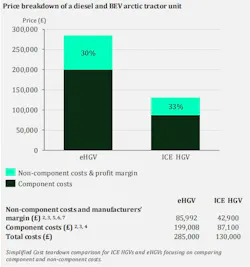
“From this analysis, it is unclear how these additional costs are distributed, if increased costs are extraneous, or how many are a justifiable increase due to immaturity in eHGV [electric heavy goods vehicle] manufacturing processes,” ERM states in the report.
Regardless, ERM believes that non-component costs will have to decrease in Europe, at least until more electric units are sold, to help make these models more accessible to customers.
About the Author
 Jade Brasher
Jade Brasher
Executive Editor Jade Brasher has covered vocational trucking and fleets since 2018. A graduate of The University of Alabama with a degree in journalism, Jade enjoys telling stories about the people behind the wheel and the intricate processes of the ever-evolving trucking industry.