Diesel still drives trucking's future beyond 2027
Key takeaways
- Combustion is far from dead: 130 years after the first truck was built, diesel engines are still the backbone of the supply chain and will carry the industry into the 2030s.
- A 99% success story: Today’s Class 8 clean diesel tractors have already reduced key pollutants by 99% compared to the 1980s. Capturing the final 1% for 2027 is a monumental, expensive engineering challenge.
- The regulatory reality check: Mandating cleaner trucks doesn't work if fleets can't afford to buy them. For 2027 equipment to succeed, Washington must allow the market to dictate freight efficiency and protect fleet profitability.
The commercial transportation industry has been changing for over a century as fleets, manufacturers, and suppliers continue to find better ways to power the supply chain. Trucking began driving the U.S. economy within a generation of German inventor Gottlieb Daimler putting a 4 hp, 2-cyl. engine on the back of a horse-drawn goods wagon in 1896. The Daimler Motor-Lastwagen, considered the world’s first truck, showed off the power of combustion.

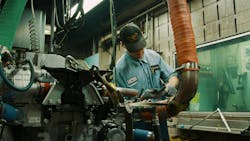
Last month—130 years after Daimler invented the trucking business—I was standing on the factory floor of Daimler Truck North America’s (DTNA's) Detroit Manufacturing Plant, where the next generation of internal combustion engines will come to life. It was yet another mid-decade reminder that while we’ve spent recent years chasing headlines dominated by megawatts and hydrogen fuel cells, the diesel engine is far from a legacy technology.
The 99% emissions success story
It’s likely lost on the public at large—and on many 21st-century regulators—how far the industry has come. Today’s clean diesel trucks have reduced key pollutants by 99% compared to the 1980s. According to DTNA, it now takes more than 100 Class 8 tractors to produce the same NOx emissions as a single tractor built in the 1990s. It was a monumental challenge for OEM engineers to meet the 2027 35 milligram/hp-hr NOx limit, but changes to airflow, aftertreatment architecture, and diesel exhaust fluid dosing led to success. As any fleet maintenance director knows, that last 1% is always the most expensive and complex to capture.
Yet, manufacturers are finding a way.
DTNA, maker of Freightliner and Western Star trucks, became the second U.S. manufacturer to detail how its powertrains will meet the U.S. Environmental Protection Agency’s 2027 NOx reduction regulations when it unveiled three next-generation heavy-duty diesel engines in February.
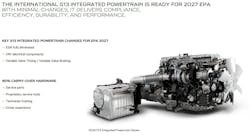
In January, International Motors shared how its S13 Integrated Powertrain will be updated in time for 2027. While both OEMs are meeting the required more than 80% reduction in nitrogen oxides in different ways, they are focused on ensuring fleets can maintain the equipment without bringing on a new generation of fleet technicians.
The engineering work by these OEMs will carry our industry into the 2030s—provided they aren’t just building compliance machines that meet federal regulators’ wants while leaving out carriers’ needs to be more efficient.
Zero-emission utopia vs. grid reality
It was easy for regulators, the uninformed public—and even OEMs—to get swept up in the visions of a zero-emission freight utopia. While most OEMs still list goals to cut carbon emissions to zero by 2050, they aren’t talking about it as much—particularly since data centers and AI are now competing with trucking for access to the electricity infrastructure needed to support significant battery-electric fleet operations.
In the 130 years since Gottlieb Daimler put an engine on a horse cart, if we’ve learned anything, it’s that diesel remains the undisputed, most efficient way to haul 80,000 lb. of freight over the Rocky Mountains or through the dense, unforgiving congestion of the Northeast Corridor. The next generation of Daimler’s diesel engines is 150 times more powerful than the one its namesake used to build history’s first truck.

 laneshift_primary
Protecting the bottom line
While we await details on how the other OEMs are capturing those final fractions of a gram of NOx, regulators need to remember one thing: While most fleets genuinely want to be cleaner, this equipment must help carriers be profitable so they can afford to be cleaner. Without profits, there’s no investment capital. More efficient powertrains can help, but emissions regulations inherently make equipment more expensive because of the technology required to capture NOx. (To DTNA's credit, leadership noted in Detroit that the 2027 premium won't be as steep as the industry has anticipated, but fleets are naturally protective of their capital.)
Even in the more trucking-friendly regulatory environment under the Trump Administration, the federal government could still be considered the biggest impediment to fleet profits. This is why we still see so much older equipment on the roads: The upfront and maintenance costs of used trucks seem lower—even though more efficient trucks can help defray costs in the long run.
Don’t forget that Congress has failed the trucking industry for a century by refusing to repeal the federal excise tax (created to fund World War I) that tacks on 12% to the cost of any truck or trailer.
In the short video clip below, Chris Spear, American Trucking Associations' chief executive, told Congress that repealing that federal tax could make it easier for fleets to invest in more modern, cleaner diesel equipment that would cut emissions.
For more than a century, this industry has overcome regulatory and economic roadblocks dropped in its path. An efficient, profitable trucking industry isn’t just a talking point; it’s the backbone of a booming U.S. economy. The internal combustion engine will continue to shoulder that weight into our future. But the more Washington stays out of the way and allows the market to dictate freight efficiency, the better off everyone is.
About the Author
 Josh Fisher
Josh Fisher
Editor-in-Chief
Editor-in-Chief Josh Fisher has been with FleetOwner since 2017. He covers everything from modern fleet management to operational efficiency, artificial intelligence, autonomous trucking, alternative fuels and powertrains, regulations, and emerging transportation technology. Based in Maryland, he writes the Lane Shift Ahead column about the changing North American transportation landscape.