Trucking Efficiency Roundup: Fleet electrification grows as OptiGrid, Vanair, Workhorse expand power and EV trucks
Key takeaways
- OptiGrid shows that battery-integrated chargers can bypass grid limits, speeding fleet EV deployment.
- Vanair highlights idle reduction tech as a key lever to cut maintenance costs and extend asset life.
- Workhorse underscores rightsized EV range and lower cost as critical for last-mile fleet adoption.
Optigrid begins EV charger manufacturing in Kansas for commercial fleet deployment
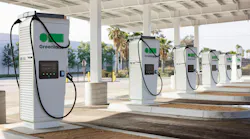
OptiGrid recently began manufacturing its Reservoir DC fast chargers in Kansas City, Kansas, marking a transition from design to commercial deployment. Production at Orange EV’s 440,000-sq.-ft. facility supports assembly, testing, early customer deliveries, and scaling. Orange EV received initial units on March 13.
“This is a pivotal milestone for OptiGrid,” Tyler Phillipi, CEO of OptiGrid, stated. “Start of production means Reservoir, a fourth-generation battery-integrated charger design, is tested and ready for real fleet operations. We designed it to deliver high-performance charging without requiring fleets to wait for time-consuming and costly grid upgrades. Manufacturing in Kansas City will allow us to leverage existing manufacturing capacity and experience to scale production rapidly and meet fleet demand nationwide.”
Demo units are being deployed, including an installation at a U.S.-based marine terminal, to validate performance in constrained grid environments and support fleet electrification. Reservoir’s battery-integrated design stores grid energy in a 180 kWh onboard system to deliver up to 200 kW fast charging, reduce grid input by up to 85%, install quickly, and enable more vehicles on limited power. Read more…
Vanair expands electrified power systems for fleets with idle reduction focus
Vanair recently introduced five new products at Work Truck Week 2026 to expand its Electrified Power Equipment (EPEQ) ecosystem with solutions aimed at idle reduction and fleet efficiency. The lineup includes a 48V EPEQ Power Center, a new 12V battery and inverter system for lighter-duty vehicles, a Solar Assist vehicle solar charging system, upgraded 48V ELiMENT batteries, and a chassis-mounted mobile DC fast charger. These additions are designed to help vocational fleets reduce engine idling, extend equipment life, lower maintenance costs, and support growing electrical demands from onboard systems.
“The conversation around idle reduction has intensified,” Dean Strathman, VP of sales for Vanair, stated. “It’s not just about CO2 and fuel savings anymore. Today, the spotlight is on extending the life of assets that are more expensive to acquire and more complex to maintain. Every product we’re introducing gives fleet operators a way to put money back in their pockets by keeping that engine off, without sacrificing performance.”
The Solar Assist system provides continuous battery charging with integrated solar panels, while the mobile DC fast charger enables charging in remote or emergency scenarios using a truck-mounted configuration. The 12V system delivers isolated auxiliary power for smaller vehicles without draining starting batteries, and the upgraded 48V batteries add improved durability, monitoring, and environmental protection across the EPEQ platform. Read more…
Workhorse adds lower-cost electric step van for last-mile delivery fleets
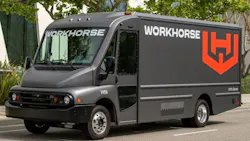
Workhorse Group recently debuted a new W56 step van with a 140 kWh battery, expanding its electric vehicle lineup for last-mile delivery fleets. The new configuration has an estimated 100-mile range, a starting price of $169,000, and is designed to meet customer demand for lower-cost electric fleet options.
“The new 140 kWh version of our W56 step van is a result of listening to customer feedback and purpose-building a product to meet their needs,” Scott Griffith, CEO of Workhorse, stated. “We’ve been able to balance the functional needs of fleets—range, durability, reliability, and performance—with a lower entry price to offer a ‘no-compromise’ electric truck.”
The model is based on the same platform as the 210 kWh version, with multiple wheelbase options, up to 1,000 cubic feet of cargo space, and payload capacities up to 11,000 lb. The introduction comes as rising fuel costs and operational pressures drive fleets to adopt electric vehicles, with production supported by Workhorse’s U.S. manufacturing facility and its recent merger with Motiv Electric Trucks. Read more…