ACT Expo 2026 highlights hydrogen, EV trucks, and fleet charging technologies
Key takeaways
- Hydrogen Class 8 and H2ICE tech show fleets viable zero-emission paths without major operational changes.
- Battery-electric trucks and EV control platforms help fleets improve efficiency while meeting emissions rules.
- Wireless charging and integrated systems could cut downtime and simplify EV fleet operations.
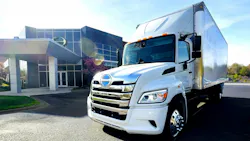
Toyota and Hyroad to deploy 40 hydrogen Class 8 trucks in major zero-emission push
Hyroad Energy and Toyota Motor North America recently partnered to deploy 40 hydrogen fuel cell Class 8 trucks in Southern California, marking one of the largest U.S. zero-emission freight deployments. The agreement combines trucks, hydrogen fueling infrastructure, maintenance, and software into a single commercial model to support Toyota’s logistics operations.
"Accelerating the hydrogen economy requires collaboration, and Toyota is proud to work with Hyroad to move the heavy-duty sector forward," Jason Zahorik, GM of Toyota Hydrogen Solutions, said. "By bringing the critical elements together, we're demonstrating how fuel cells create tangible value across supply chains while advancing a foundational pillar of the hydrogen economy. With hydrogen, we share a vision for cleaner, more powerful and more energy independent mobility."
The trucks offer up to 500 miles of range with 15-20 minute refueling and produce only water vapor emissions. Hyroad’s pay-per-mile model and full-service approach aim to remove cost and operational barriers to fleet decarbonization. Read more…
Hino Trucks debuts Le Series electric medium-duty truck at ACT Expo 2026
Hino Trucks introduced the all-new Le Series battery-electric medium-duty vehicle at ACT Expo 2026. The Le Series is offered in 25,950-lb. L6e and 33,000-lb. L7e GVWR configurations and features a 269 kWh battery system with fast charging and up to 260 kW of peak power.
"Introducing the Le Series is an important step in our efforts to reduce environmental impact and support our customers' sustainability goals," Rodney Shaffer, VP of national accounts and zero emission vehicles of Hino Trucks, said. "We've focused on delivering a solution that builds on our proven platform and is well-suited for the applications where electric vehicles make the most sense, helping fleets take practical and meaningful steps toward lower emissions."
The truck is designed for improved efficiency and operational performance, with regenerative braking, optimized energy use, and enhanced driver comfort from smooth electric torque and quiet operation. Standard safety features include automatic emergency braking and lane departure warning. Production is scheduled to begin in Q3 2026. Read more…
New Eagle launches single-controller EV platform to simplify commercial vehicle systems
New Eagle recently launched the OpenECU NX3, a single-controller platform designed to simplify electric vehicle architectures by combining charging and supervisory control functions. The system integrates Megawatt Charging System and Combined Charging System protocols into one ECU, reducing complexity, wiring, and potential failure points.
“The OpenECU NX3 is designed to simplify vehicle control systems architecture,” Kevin Alley, CCO at New Eagle, said. “We’re eliminating multi-controller complexity and delivering a single, production-ready platform that accelerates deployment of next-generation EV systems.”
Built on the OpenECU platform, the NX3 supports model-based development, C-code workflows, and production-ready safety and cybersecurity standards. The platform is part of a broader expansion that includes additional charge control and driveline solutions aimed at scaling electrified vehicle systems. Read more…

Phinia debuts hydrogen combustion LCV with near-zero CO2 emissions at ACT Expo 2026
Phinia showcased its first homologated hydrogen internal combustion engine light commercial vehicle developed with Aramco at ACT Expo 2026. The vehicle is certified for road use, meets Euro 7 standards, and delivers up to a 99% reduction in tailpipe CO2 emissions with a driving range of up to 500 km (311 miles).
"Reducing emissions from commercial transport will require multiple solutions,” Todd Anderson, CTO at Phinia, said. “Hydrogen combustion could be a potential pathway, building on proven engine technology while delivering near-zero tailpipe CO2 emissions. Our homologation achievement proves that existing engine architectures can be adapted to run on gaseous fuels, with few modifications, to align with regulatory requirements. This development reinforces that advanced combustion technologies support efforts toward emissions reductions, especially when combined with lower-carbon fuels, while delivering similar performance to today’s traditional internal combustion engines.”
The hydrogen-powered van demonstrates how existing combustion engine platforms can be adapted for hydrogen fuel with minimal changes while maintaining diesel-like performance. Phinia highlighted broader hydrogen and alternative fuel technologies at the event, positioning H2ICE as a scalable pathway for lowering emissions in commercial transport. Read more…
Honda showcases hydrogen and battery systems for commercial vehicle applications at ACT Expo 2026
Honda recently showcased zero-emissions power technologies at ACT Expo 2026, including the upcoming U.S. launch of its Mobile Power Pack e: for B2B integrations. The company highlighted its broader strategy to expand clean energy solutions and pursue carbon neutrality across products and operations by 2050.
"ACT Expo is a great place to explore the latest clean energy tech, and we're excited to meet potential new business partners this week," Joe Juliano, business unit lead of sustainability and business development at American Honda Motor, said. "With decades of electrification and hydrogen power experience, Honda is a natural collaborator for companies seeking to develop zero-emissions products and energy solutions."
Honda also presented current and next-generation hydrogen fuel cell modules with improved durability, lower costs, and higher power density. Its fuel cell power generator offers scalable clean electricity for large facilities, supporting wider adoption of hydrogen-based energy systems. Read more…
HEVO advances wireless charging for commercial EV fleets at ACT Expo 2026
HEVO highlighted its wireless charging strategy for commercial electric fleets at ACT Expo 2026, focusing on addressing charging infrastructure challenges. The company is advancing from prototype systems toward scalable deployment and exploring partnerships to support future manufacturing.
"Manual plugging and unplugging of charging cables for electric delivery vans every day is time-consuming, labor-intensive and creates massive wear on connectors," Jeremy McCool, founder and CEO of HEVO, said. "Wireless charging eliminates these pain points entirely. As autonomous driving and smart warehousing advance, 'Park & Charge' becomes an irreversible requirement for truly automated fleet operations."
HEVO’s integrated Rezonant hardware and Journey software platform provide wireless charging, real-time monitoring, and fleet energy optimization. The company is also in early-stage discussions with Foxconn Interconnect Technology to evaluate high-volume production and expand its role in fleet electrification. Read more…