Inside Stellantis' new Pro One unified fleet strategy
Key takeaways
- Pro One consolidates Stellantis' fleet solutions into a single, customer-focused ecosystem, connecting brands like Ram, Jeep, and Chrysler for streamlined service.
- Pro One Next leverages vehicle connectivity and data to reduce downtime, improve predictability, and support real-time maintenance interventions.
- Stellantis has doubled its North American Mopar and Pro One staff and expanded regional technical advisors to enhance personalized support and operational efficiency.
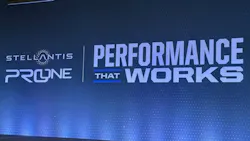
PONTIAC, Michigan—It’s peak wedding season here in Michigan, and Stellantis announced the official union of its product, upfitting, logistics, and data service all in one.
Michael Ferreira, SVP of Stellantis U.S. fleet sales since April 2025, shared his plans for the business unit last fall during a call with media, hinting at an eventual marriage of fleet solutions under one roof. At that time, the unit was still branded as Stellantis Fleet and Business Solutions. But now, after the “wedding,” as Ferreira called it during his welcome speech at a Stellantis customer event, the fleet business unit in North America is now officially Stellantis Pro One.
The ceremony included high-level business updates, in-depth data platform walk-throughs, and a chance for fleet customers to drive vehicles from the Stellantis lineup, including the reborn Ram ProMaster City, available later this year.
So what is Stellantis Pro One, and how does it improve the lives of fleet owners?
How Stellantis Pro One and Stellantis Pro One Next improve fleet operations
Think of Pro One as a one-stop shop for all things Stellantis fleet, prioritizing the fleet customer and their needs. Last fall, Ferreira described Pro One as an “ecosystem,” and that’s because while it’s a standalone business unit of Stellantis brands, alongside Ram, Jeep, and Chrysler, it can connect each of those business units for the convenience of the fleet customer.
Pro One is already part of the Stellantis fleet strategy in Europe, and it’s proven successful. But the specific needs of the North American market have prevented Stellantis from bringing the same fleet strategy here. Yet, with a few modifications, Ferreira is making it happen.
“For our North American market for light-duty, heavy-duty, and van segment, is a solution that we will support in terms of what you need to run your fleet more effectively,” Ferreira said. “We want to make sure that from an anticipated customer requirement [and] predictive data from the vehicle … you’re going to get the priority service you deserve through our dealer organization.”
Technology will play a major part in this restructuring; but fleet owners won’t have to worry about additional hardware. Instead, Stellantis will pull data directly from a fleet’s connected vehicles.
That vehicle connectivity becomes even more valuable for fleets that employ the new Stellantis Pro One Next, powered by Mopar.
Stellantis Pro One Next is an extension of Pro One, adding Mopar vehicle data—and the Stellantis agents behind it—to help fleet owners make intelligent business and fleet decisions.
“Pro One Next is the all-encompassing value proposition, which incorporates not only the basic fleet solutions, but it also incorporates the systems, the tools, and then most importantly, the people that can help you … run your business,” Ferreira said.
 Stellantis company sign
 stellantis fleet strategy 2025
One of the most impactful ways Pro One Next improves fleet operations is through uptime. Connected vehicles are monitored in real time by Mopar and dealer agents at the Stellantis Pro One Uptime Command Center. This “allows faster intervention through coordinated dealer, parts, and technical networks, ensuring reduced cycle times, improved predictability, and enhanced business continuity for customers,” Stellantis stated in a press release.
When Command Center agents see a fault code triggered or an issue arise, they will contact the fleet manager to ensure the vehicles are serviced to prevent as much downtime as possible. This includes scheduling maintenance with the fleet, scheduling a bay with a dealer or other service center, and ensuring the replacement part is available when the vehicle is at the shop.
Stellantis Pro One Next also benefits fleet customers even before their vehicle is delivered.
The Pro One Next platform allows customers to order their vehicle and its necessary upfits or body in one place—a feature that the Pro One team estimates will save fleets time (up to 48%, Ferreira said). The platform then follows the vehicle through the entire build and upfit process until it’s delivered at the fleet’s preferred dealer. This adds to the mission of placing the customer first and offering vehicle location transparency, where many fleets were previously left in the dark.
Being customer-centric requires a customer-facing workforce
Ferreira’s vision for Pro One—making the customer first and ensuring they have solutions at their fingertips—requires buy-in from the parent company. One way Stellantis CEO Antonio Filosa is proving that Stellantis, headquartered in Europe, is all-in on North American initiatives is by investing in the Pro One workforce.
Since last year, Stellantis has doubled its North American Mopar and Pro One staff and grown its regional fleet sales divisions from five to eight. This gives each fleet customer a more personalized and dedicated experience from their fleet reps and helps ensure there are plenty of Pro One agents to accomplish Ferreira’s goals for Pro One.
“We've also added more regional technical advisors dedicated to fleet vehicles, including upfitted units with the focus on uptime and operational support when repairs are more complex,” Darren Bradshaw, SVP of Mopar North America, said during a presentation. “As we grow those teams, we're on track to achieve a seven-to-one dealer-to-technical resource ratio, which will be best in class.”
So far, it’s working.
“As a result of these collective actions, in 2025, we achieved a 17% reduction in warranty cases remaining open beyond five days,” Bradshaw explained. This growth also contributed to a 33% reduction in warranty service events for a construction fleet when comparing 2024 to 2025, Bradshaw said, which allowed these fleets to “focus more on operations versus chasing repairs.”
Moving from a reactive fleet business model to a proactive one is driven by an increase in the workforce, Bradshaw said. And this is Stellantis’ way of taking on the accountability for its fleet customers’ vehicle uptime.
“We as Pro One are now taking ownership, and we are now accountable to get that vehicle to a service center,” Ferreira told FleetOwner.
In fact, accountability is something Ferreira mentioned multiple times throughout the day, and not only in a future-focused context. Ferreira also took accountability for ways Stellantis has failed its fleet customers in the past.
“The recalls that we issued has probably been the biggest impact of my career, in terms of disappointment,” he said to the crowd. “I give you my personal promise that I will do everything in my ability to make sure that fleet [customers] get the fair share of what they need.”
With this new, customer-focused fleet strategy and the integration of multiple Stellantis business units to drive value for fleet customers, it seems that Stellantis North America finally has a vision and a roadmap for the future. While Ferreira said Pro One has distinct differences that keep it from being a direct competitor with fleet business units from other OEMs, Stellantis fleet customers now have a one-stop shop for all their product and data needs with Stellantis Pro One and Pro One Next, powered by Mopar.
About the Author
 Jade Brasher
Jade Brasher
Executive Editor Jade Brasher has covered vocational trucking and fleets since 2018. A graduate of The University of Alabama with a degree in journalism, Jade enjoys telling stories about the people behind the wheel and the intricate processes of the ever-evolving trucking industry.