Sigma Powertrain's electric transmission boosts heavy-duty EV performance
Key takeaways
- Sigma Powertrain's electric transmission features multiple gears and smart electric clutches, optimizing EV performance across different load and terrain conditions.
- Its modular system allows scalability across vehicle classes, from light-duty pickups to heavy-duty Class 8 trucks.
- The transmission enhances long-haul efficiency by enabling hybrid and electric operation.
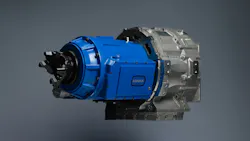
LIVONIA, Michigan—When will electric powertrains for electric vehicles catch on? Electric transmission manufacturer Sigma Powertrain is helping the industry accelerate on that front sooner rather than later. The company developed an electric transmission that increases efficiency in electric vehicles (EVs), both light-duty and heavy-duty.
Just like an internal combustion engine (ICE), EV motors have their sweet spot. Light-duty EVs, such as light-duty pickups and consumer vehicles, perform just fine with that single gear when the payload consists only of a few passengers and when the terrain is relatively flat. But with a heavy-duty electric vehicle (EV) that’s hauling commercial-sized loads or even an electric pickup towing a trailer, that electric motor is forced to work double time, surpassing its sweet spot, and decreasing efficiency.
Smaller, consumer-focused EVs don’t have “a ratio changing box … They oversize the motor to give them good launch characteristics,” John Kimes, Sigma president and CEO, told FleetOwner. “It's a good trade-off for [a passenger] car, but as you go up in GVW, you get into higher classes—5, 6, 7, 8—the need for a transmission becomes apparent. You can't just keep oversizing the motor.”
The solution is multiple gears that allow these commercial electric vehicles to stay in their sweet spot throughout the drive by providing a larger range of torque than a direct-drive system. Enter the Sigma Emax Electric Transmission.
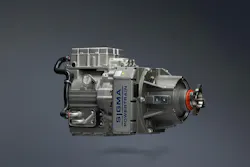
“We don't compromise; we give you ratios that are appropriate for climbing a 30% grade at max GVW, and we can shift to highway speeds when you need to go highway speeds,” Kimes explained.
Sigma designs electric transmissions for all vehicle classes: The Emax is suited for heavy-duty applications in Class 6-8; the Mid-Series Multi-Mode Electric Transmission is designed for Classes 1-6. Sigma uses a modular system to scale between capabilities. Each design uses the same gear set across classes. These gears are engineered to withstand the most challenging operations. While these gear sets are 30% larger than those in a traditional Class 8 transmission, spacing within the system isn’t a problem. We’ll address this further down.
Here’s how the Sigma electric transmission works
While EV transmissions are not yet mainstream, Sigma isn’t the only company to design electric transmissions. Eaton and BAE have also developed a transmission for electric powertrains, which FleetOwner wrote about in 2024. However, the distinction from those two transmissions is that Sigma’s is 100% electric, removing all hydraulic systems from the equation. This alone increases efficiency by up to 15%, Kimes said.
Removing hydraulics means less heat generation and fewer moving parts, which results in a transmission with virtually no expiration date. “When somebody asks me ‘What’s your warranty,’ I say ‘What do you want?’” Kimes said.
Removing hydraulics also makes room for Kimes and his team to design those gear sets that are 30% larger. Using the same gear set in each transmission decreases Sigma’s manufacturing costs and contributes to Sigma’s modular design.
You might wonder how a clutch can function without hydraulics in this electric transmission. Sigma uses electric, “smart” clutches to shift gears. These clutches are what make Sigma’s electric powertrain possible.
Traditional clutches lock in both directions or are free in both directions. But Sigma’s electric clutches are independent, which allows one to lock in one direction and not the other. This feature enables a Hill Hold function for even the heaviest loads. Further, these clutches only consume power in transition. That means they can hold the vehicle in place without relying on the electric motor or brake system to keep it there. Further, the clutches engage and disengage electronically via speed sensors embedded within them.
And these clutches are housed along with the gear sets inside the Sigma transmission. All of it fits together in a much smaller package than a traditional transmission.
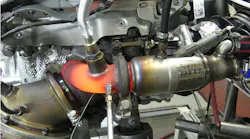 RCH system glow
 ebi_heavy_duty_evs
An electric transmission for the long haul
While the clutch is what makes these EV transmissions so special, the clutch can also be used in other powertrains. And this is where the potential for long-haul efficiency really shines.

“It can be either all electric, serial hybrid, parallel hybrid—it's flexible,” Kimes said. “It's all about … the e-clutch technology that we can package in different ways and provide different hookups that allow you to electrify or hybridize.”
Imagine a Class 8 long-haul rig with a hybrid powertrain. It has two e-motors, both powered by the diesel engine. One motor sends energy to the wheels, the other motor stores the energy in a battery pack. In a traditional hybrid, that energy in the battery pack is used in the city, and the ICE engages at highway speeds or when the battery is depleted.
With Sigma’s electronic clutch technology, the battery power can be split. This means that both the diesel engine and the battery pack, through the motor, can provide torque to the wheels during take-off. It also means that when a big rig is pulling a heavy load up a mountain, the battery can send power to the wheels to lighten the load on the diesel engine. This helps the truck scale the hill without losing significant speed. It also helps retain efficiency.
Battery power can also be sent to the wheels whenever a diesel engine is pulling more weight or simply when it needs that additional push to keep it running in its “sweet spot.”
“If I can run my ICE in its sweet spot more than not, I get better fuel economy, and that's what a power split does,” Kimes said.
What’s more, the hybrid battery pack can be used to power the auxiliary power unit (APU) to keep the cabin cool or warm when a long-haul driver stops to rest for the night.
For fleets with shorter, known routes, the battery can power the whole trip, ensuring fuel savings.
An electric transmission that offers efficiency for every fleet
For EVs, “it's all about keeping the motor happy,” Kimes said, “and it's not happy as a one-speed.” The transmission enables the EV to run optimally whether it’s hauling equipment or speeding down the highway.
For ICE vehicles, “it means I have a transmission that's about four inches wide that bolts onto the back of a semi truck with two e-motors, and it gets 30% more fuel economy,” Kimes said. “When I'm in the city, I'm all electric. When I'm in between cities, I'm a hybrid. I just fixed the long-haul problem.”
While the Emax and Mid-Series are currently only available as upfits, the powertrain has the ability to transform a fleet’s efficiency for both electric and ICE vehicles.
About the Author
 Jade Brasher
Jade Brasher
Executive Editor Jade Brasher has covered vocational trucking and fleets since 2018. A graduate of The University of Alabama with a degree in journalism, Jade enjoys telling stories about the people behind the wheel and the intricate processes of the ever-evolving trucking industry.