New rapid heating technology promises cold start emissions reductions
Key takeaways
- The Rapid Catalyst Heating system quickly elevates catalyst temperatures, reducing harmful emissions during the critical cold start phase.
- The system is designed for easy integration into light- and medium-duty gasoline and hybrid vehicles.
- Bosch's RCH has demonstrated emission reductions of up to 65% in pickup trucks and 50% in SUVs during cold starts.
- Running on a standard 12V electrical system, the RCH offers a cost-effective solution to meet stricter emissions regulations without extensive vehicle redesigns.
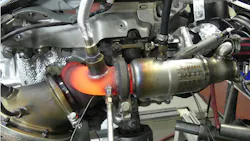
FARMINGTON HILLS, Michigan—Bosch Power Solutions’ new Rapid Catalyst Heating (RCH) decreases emissions and could potentially improve fuel efficiency, all without major engine modifications. This “add-on solution,” designed as a system for light- and medium-duty gasoline engines, could be a lower-cost solution to OEMs’ current emissions requirements set by state and federal governments in the U.S. and across the globe.
Bosch’s team in Germany began the project roughly four years ago to help vehicle OEMs meet European emissions standards. Eventually, the project migrated to the U.S., Dr. Ryan O’Donnell, technical lead for the RCH at Bosch Power Solutions division, told FleetOwner.
Here’s how the system works.
Bosch’s Rapid Catalyst Heating solution
To understand Bosch’s new solution, it’s helpful to understand the function of catalytic converters. These devices are part of a vehicle’s exhaust system and help control the emissions a vehicle produces by “converting hazardous combustion gases into less harmful substances, like water vapor and carbon dioxide,” according to the Universal Technical Institute. This conversion takes place via a chemical reaction. However, catalytic converters require extremely high heat (from 750 to 1,470 degrees F) to produce this chemical reaction, and they’re powered by the vehicle’s engine.
Yes, catalytic converters are “converting pollutants, but their blind spot is the amount of time it takes for them to come to activation temperature,” Mohammad Fatouraie, director of systems engineering for Bosch Power Solutions division, said to a group of automotive and fleet media here at Bosch’s U.S. headquarters.
It takes about 20 to 30 seconds for the catalytic converter to meet activation temperature, Fatouraie said, and within those first few seconds is when the vehicle’s tailpipe emissions are the most harmful.
That’s where the Rapid Catalyst Heating comes in.
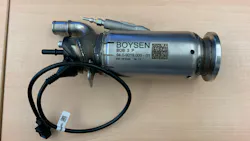
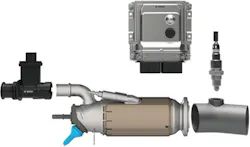
The RCH system, which includes a tube-like chamber, an air pump, and other components, is installed upstream of the catalyst package. The RCH provides roughly 25 kW of thermal power to the exhaust stream to “rapidly elevate catalyst temperatures and activate the kinetic reactions as quickly as possible,” O’Donnell said. “That all manifests as a reduction in tailpipe emissions.”
The system pumps a specified amount of fuel and air inside the RCH chambers, with the amount of each metered by the vehicle’s electronic control unit (ECU). Inside, a glow-plug ignition heats up the chamber before igniting the engine. While this requires the operator to wait 4 to 10 seconds before engine startup (much like waiting for the glow plug light to illuminate before starting a diesel engine), the trade-off is an engine start that emits fewer pollutants.
While the RCH uses fuel for rapid heat, according to O’Donnell, that doesn’t generate a higher overall fuel burn. In fact, Bosch’s expectation is that the system should be “fuel-use neutral,” or even potentially increase fuel efficiency.
“If I’m heating a catalyst during a cold start event, I’m doing it with my engine,” O’Donnell explained. “When I run my engine in that manner, it’s actually very inefficient. It gives me heat, but I’m using a lot of fuel to generate that heat.” The RCH, on the other hand, “has something close to 99.9% combustion efficiency, which means it’s a very efficient way of burning fuel and generating heat.”
 kenworth electric T680
How the Bosch RCH helps decrease emissions
O’Donnell provided examples of the RCH system’s effect on a pickup truck. His team recorded emissions from the vehicle before the RCH and then after the RCH. This test was performed multiple times. The test findings are shown in the graphic below.
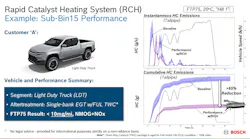
The blue line indicates the baseline, and the purple line indicates the vehicle’s emission output with the RCH. The graphic on the top indicates instantaneous emissions, and the bottom graph shows cumulative emissions.
The same test was performed on an SUV, both with and without the RCH. Where the RCH showed a 65% reduction in emissions at engine start for the pickup, the SUV experienced a 50% reduction with the RCH.
But the RCH system isn’t designed only for light-duty vehicles.
“We have seen similar, maybe even higher, reduction levels in medium-duty applications because of the size of the catalyst and thermal mass that it needs,” Fatouraie said.
The Bosch RCH is built for light- and medium-duty gasoline or hybrid vehicles
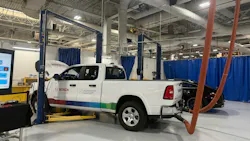
Because the RCH is designed for multiple vehicles, it must be easily integrated with multiple vehicles. So while the design of the RCH chamber remains the same in every vehicle, Bosch has developed different designs for the component that connects the exhaust from the RCH back to the vehicle’s exhaust stream. Bosch calls this component the “Mixing Geometry.”
At the event, Bosch displayed a 2025 Ram 1500 pickup truck with the RCH add-on. In this example, two RCH chambers were installed in the engine bay. This required a Mixing Geometry with a more complex design because of the lack of space under the hood.
“We’ve taken a portion of the inlet cone of the catalyst, we’ve produced a 3D-printed part that allows us to couple the burner, and introduced, in an intentional manner, a mixing flow that provides very good distribution of the burner outflow, both from a mass flow and temperature perspective,” O’Donnell said.
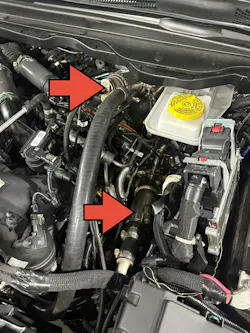
In scenarios that provide more space, such as if the RCH were installed under the floor in a medium-duty vehicle, Bosch’s Mixing Geometry would look differently as its purpose is to support the RCH “in a manner that would be consistent with the layout,” according to O’Donnell.
In a hybrid, Fatouraie explained that there’s more predictability when the engine needs to start. This is because the vehicle is powered by its battery until using the engine becomes a necessity. This means the RCH can begin working in a more efficient manner.
What’s more, the whole system runs on a 12V electrical system, negating the need for OEMs to develop an entirely new electric architecture.
Overall, Fatouraie and O’Donnell say the RCH system could potentially reduce the monetary burden OEMs face when designing new systems to meet emissions standards that are increasingly becoming stricter.
About the Author
 Jade Brasher
Jade Brasher
Executive Editor Jade Brasher has covered vocational trucking and fleets since 2018. A graduate of The University of Alabama with a degree in journalism, Jade enjoys telling stories about the people behind the wheel and the intricate processes of the ever-evolving trucking industry.