Decarbonization still messy but manageable, NACFE real-world data proves
Key takeaways
- The future is a mixed fleet: There is no single "silver bullet" for Class 8 decarbonization. Fleets must embrace the "Messy Middle" by utilizing a portfolio of diesel, natural gas, battery-electric, and hydrogen powertrains.
- Diesel efficiency is peaking: Modern diesel operations are achieving unprecedented fuel economy—up to 11.8 mpg in real-world freight operations—proving there are still massive near-term emission and cost reductions to be found in the baseline technology.
- BEVs are pushing boundaries: Battery-electric vehicles are officially expanding beyond regional routes, with NACFE data validating that heavy-duty BEVs can successfully operate 350 to 500-plus miles daily when properly matched to terrain and infrastructure.
- RNG provides a mature bridge: Renewable natural gas (RNG) combined with modern 15-liter engines offers a highly capable, immediate pathway for demanding duty cycles, enabling some fleets to achieve carbon-negative operations today.
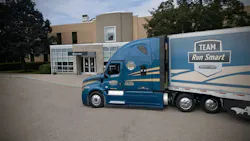
The transition to zero-emission commercial vehicles remains complicated, even as diesel continues to gain efficiency. The trucking industry is firmly entrenched in a multi-decade transitional era where diesel, natural gas, battery-electric, and hydrogen powertrains will have to coexist in this “Messy Middle.”
That was the central finding of the North American Council for Freight Efficiency’s (NACFE) latest study, Run on Less—Messy Middle. Last September, NACFE tracked 14 Class 8 tractors across 13 fleets. Over 18 days, those vehicles logged 73,000 miles in real-world freight operations. Those tractors spanned the spectrum of power technologies—from optimized diesel to early hydrogen powertrains.
"The Messy Middle isn't about finding one winning fuel; it's about finding the winning technology for every specific route," Dean Bushey, NACFE's director of programs and lead author of the report, said. "Our data shows that when the powertrain matches the duty cycle, the transition to sustainability becomes both operational and profitable."
How Run on Less was conducted
The Run on Less—Messy Middle demonstration was conducted over 18 days in September 2025. The North American Council for Freight Efficiency (NACFE) tracked 14 Class 8 tractors across 13 fleets operating in active revenue freight service on real customer routes. Collectively, the participating trucks logged more than 73,000 validated miles across the U.S. and Canada.
To capture accurate real-world performance, NACFE equipped each tractor with a Geotab telematics system that recorded continuous, high-resolution duty-cycle data at standardized 10-second intervals. This quantitative data was integrated with GPS elevation models and combined with qualitative insights gathered through driver interviews and fleet manager consultations.
The 2025 iteration of Run on Less focused on long-haul trucking because, while that segment represents less than 10% of trucks on the road, it burns well over half of the diesel fuel that commercial vehicles consume nationwide. This was the fifth Run on Less demonstration since 2017. Past iterations focused on diesel efficiency, regional operations, electric truck routes, and depot-based electric truck operations. The Messy Middle demonstration’s focus was more spread out among long-haul and heavy-duty regional linehaul, distribution, and port drayage operations.
“If you're going to impact emissions and fuel burn and costs ... you got to work on the long haul, heavy-duty, long-distance stuff," Mike Roeth, NACFE executive director, said during American Trucking Associations’ Technology & Maintenance Council conference in March.
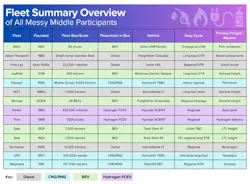
Participating fleets by powertrain
Diesel/renewable diesel
Albert Transport
Frito-Lay
Mesilla Valley Transportation (MVT)
Schneider
Compressed/renewable natural gas (CNG/RNG)
Kleysen Group
UPS
Wegmans
Battery-electric vehicle (BEV)
4Gen Logistics
JoyRide
Nevoya
Saia (operated two trucks)
Hydrogen fuel cell
Penske
Pilot
Messy Middle takeaways for fleets
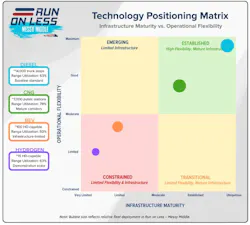
As its name implies, there is no simple commercial freight decarbonization answer for fleets in the Messy Middle, according to the NACFE research. The council suggests fleets pivot toward portfolio thinking—operating multiple powertrain technologies simultaneously while matching each to the application that makes the most operational and economic sense.
As the Run on Less study authors note, technology determines where a fleet can operate, but operations determine how well it performs there. For fleets navigating the Messy Middle, utilizing real-world, validated operational data—rather than relying solely on OEM specifications—could make the difference between a failed pilot program and a successful, scalable deployment.
Here’s a breakdown of how four major powertrain technologies performed in the real world, according to NACFE researchers, and what fleet executives need to know to plan out future operations.
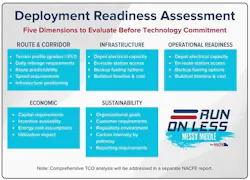
Factors for fleet decision-making
Run on Less–Messy Middle produced 11 findings relevant to fleet technology decisions.
- Diesel remains the operational benchmark.
- Terrain is the most significant performance variable.
- CNG/RNG serves specific duty cycles well.
- BEV technology is expanding beyond regional applications.
- Hydrogen fuel cells demonstrated operational characteristics but face significant barriers.
- Real-world operational data complements specifications.
- Daily productivity matters as much as efficiency.
- Infrastructure availability shapes deployment options.
- Human factors influence outcomes across all technologies.
- Fleet strategy benefits from portfolio thinking.
- Organizational culture influences technology success.
Diesel baseline: Pushing the envelope
Diesel fuel remains the undeniable benchmark for operational flexibility, daily productivity, and infrastructure independence. The four diesel fleets in the Messy Middle study—Albert Transportation, Frito-Lay, Mesilla Valley Transportation (MVT), and Schneider—achieved fuel economy ranging from 9 to an astonishing 11.8 mpg.
The national average for diesel tractors has improved from 6 to 7 mpg over the past 15 years, Roeth noted. “We don’t have a lot of the EGR (Exhaust Gas Recirculation) trucks that were bad for fuel economy—they’re now out of the system,” he said.
While the diesel baseline is improving, the Run on Less study shows there is still massive potential for optimization. “Two of these four trucks did 11.5,” he emphasized, pointing out that “we have a lot of fuel economy we can still get out of them” by continuing to work with drivers and adopt new technologies.
Another important point is that the renewable diesel used by these fleets helps decarbonize operations, resulting in a 50% to 80% reduction in carbon intensity without operational changes.
 electric vehicle charging station
 Fleets need to prepare for fuel volatility like a squirrel prepares for winter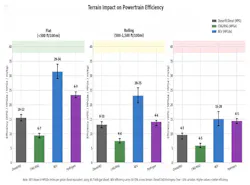
CNG/RNG: The mature bridge
Compressed natural gas (CNG) and renewable natural gas (RNG) proved to be a highly capable pathway for demanding trucking applications. Three fleets—Kleysen Group, UPS, and Wegmans—operated 15-liter natural gas powertrains, putting the Cummins X15N engine to the test.
The natural gas trucks achieved 4.5 to 6.7 mpge (miles per gallon equivalent), running 400 to 700 miles per day. Fleets using RNG sourced from organic waste can achieve carbon-negative operations. Roeth highlighted this environmental benefit as a significant win for the industry.
“Renewable natural gas is really a thing,” he said, noting that a majority of the natural gas powering trucks today is RNG. “When you grab methane that’s leaving landfills, dairy farms, etc., and use that in the truck, that’s a really good thing.”
Battery electric: Expanding beyond regional
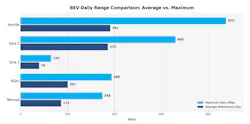
Battery-electric vehicles (BEVs) are pushing beyond their regional boundaries. The four BEV deployments—Joyride Logistics, Nevoya, Saia, and 4Gen Logistics—in the 2025 Run on Less were equipped with battery capacities ranging from 438 kWh to more than 900 kWh.
The results were eye-opening for NACFE researchers: BEVs achieved 350 to 500-plus miles daily. JoyRide Logistics pushed the envelope even further, achieving a validated maximum of 875 miles in one day using a Windrose Technologies sleeper.
Despite current bottlenecks in the charging infrastructure, NACFE remains optimistic about the technology's trajectory. “The battery-electric trucks are getting better and coming quickly, in our opinion,” Roeth said. However, fleets must still proceed cautiously with routing, as terrain dictates BEV suitability and efficiency swings translate directly into range volatility.
Hydrogen fuel cell: High potential, high barriers
Hydrogen fuel cell vehicles (FCEVs) demonstrate distinct operational promise. Penske and Pilot operated Hyundai Xcient fuel cell tractors, achieving a stable efficiency of 7.7 to 7.8 miles per kilogram, operating 120 to 430 miles daily. FCEVs boast a clear weight advantage and faster fueling times than BEVs, whose heavier batteries take longer to recharge than hydrogen tanks.
Despite the improved technical capabilities, infrastructure remains a prohibitive bottleneck. NACFE’s near-term hydrogen viability remains guarded.
“I’ll be really blunt. Hydrogen is the fuel of the future—no matter where you are, whether it's 50 years ago or 50 years from now,” Roeth noted. “It seems really challenging … the promise of hydrogen, I would say, still eludes us.”
Until hydrogen fueling station density increases and fuel costs normalize, NACFE expects hydrogen to remain at the demonstration stage.
About the Author
 Josh Fisher
Josh Fisher
Editor-in-Chief
Editor-in-Chief Josh Fisher has been with FleetOwner since 2017. He covers everything from modern fleet management to operational efficiency, artificial intelligence, autonomous trucking, alternative fuels and powertrains, regulations, and emerging transportation technology. Based in Maryland, he writes the Lane Shift Ahead column about the changing North American transportation landscape.