Top 10 Fleets Explained articles of 2025
With its debut in May 2024, the Fleets Explained series covers a wide variety of industry topics such as truck parking, regulations, fuel, freight rates, and more. The goal of the series has been and continues to be to educate new entrants to the industry; the trucking industry is complex and constantly evolving, so this series has been a source of knowledge for veterans as well as newbies.
In 2025, the Fleets Explained series expanded in both topics and mediums. This year’s coverage includes quizzes, media galleries, and even a podcast. We covered topics from distracted driving to the U.S. Interstate System.
What can you expect from this series in 2026? The FleetOwner team has big plans. But first, let’s take a look at the top Fleets Explained articles in 2025.

10. Fleets Explained: How do trucking labor unions impact the freight industries?
Labor Day was created to honor the American Labor Movement and the past and continuing contributions of laborers to the U.S. In honor of this year’s Labor Day (September 1, 2025), we took a look back at the history of unions in the trucking industry and the industry’s union status today.
Since 1901, unions have represented drivers’ interests within the transportation industry, long before semitrucks became the most efficient way to move freight. While often at odds with carrier management and other business leaders, these organized labor groups have played a significant role in shaping the modern trucking industry. Read more…
9. Fleets Explained: What is a tank truck?
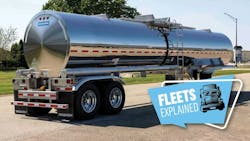
A tank truck, also known as a tanker truck or simply a tanker, is a motor vehicle designed to transport liquid or gas cargo in bulk. Like all trucks and trailers, these tank trailers can come in different sizes and are made of durable materials like stainless steel, aluminum, or fiberglass-reinforced plastic.
What separates them from other tractor-trailers and trucks is that tankers can safely carry cargo such as liquids, gases, and dry bulk across various terrains. This FleetOwner Fleets Explained entry details how tank trucks operate, how they are regulated, how much and what they can haul, and what future tank truck technology is being developed. Read more…

8. Fleets Explained: What is distracted driving?
Distracted driving kills thousands of people on U.S. highways annually. In 2022, 3,308 people were killed in motor vehicle crashes involving distracted drivers, according to the latest data from the National Highway Traffic Safety Administration. When drivers engage in any activity that diverts their attention, it can create problems for them and anyone they share the road with.
While distracted driving is a problem for everyone on the road, truck drivers are even more affected than the typical passenger car driver: By nature of their job, professional truck drivers are on the road for longer periods; truck drivers are more often in danger of being in an accident caused by another distracted driver; tractor-trailers can weigh 80,000 lb. and take a longer distance to stop than lighter vehicles; and truck drivers themselves have more chances to be distracted while driving. Read more…

7. Fleets Explained: Cross-border operations
Ports across the lower U.S. experience thousands of truckload crossings daily. Recent months have seen record cross-border freight activity, largely due to the effects of nearshoring. This uptick in northbound freight presents opportunities for fleets—and those opportunities are growing.
“The average daily northbound full truckload (crossing) in Laredo is 8,640,” and those crossings are projected to grow between 5 and 7% over the next five years, Jerry Maldonado, director of Laredo and Mexico operations at Warren Transport, said during a recent industry event. Read more…

6. Fleets Explained: How the U.S. Interstate System grew the nation and trucking industry
Before the First World War, rail was the quickest way to move freight—or anything else—across the vast United States. Few trucks had cargo capacities greater than two tons, and most roads between cities were unpaved and challenging to traverse.
But war changed all that. More than a century later, nearly 50,000 miles comprise the U.S. Interstate System, a network of controlled-access highways that pass through—or around—all 50 states (and one territory). Read more…
 fleetsexplained
 Fleets Explained: What are the segments of the trucking industry?
5. Fleets Explained: What actually affects fuel efficiency?
Increased fuel efficiency is something OEMs and fleets are always chasing. Manufacturers have spent millions of dollars in research to improve fuel efficiency, and so has the federal government. The hundreds of millions of dollars spent on the Department of Energy’s SuperTruck initiatives alone are enough to showcase the industry’s focus on increasing fuel economy.
One might think amounts of money this large would be enough to solve the fuel efficiency problem, but as it turns out, multiple factors affect fuel efficiency, and what might work in theory faces a plethora of challenges in reality.
This Fleets Explained entry tackles some of the factors that impact fuel efficiency. Read more…

4. Fleets Explained: How much money do truck drivers make, and how are they paid?
To many, a life on the road is appealing. Who wouldn’t want to get paid to travel the U.S.? In the media, movies, books, and even job postings, the life of a truck driver can be romanticized. But reality, aka money, trumps fantasy for most. This begs the question: How much money do truck drivers really make?
The answer to this question isn’t easily discoverable with a Google search, as it is complicated. Not only do you have to consider the different driver jobs available but also the expenses of an average truck driver. And like many other jobs out there, history hasn’t been kind to truck driver salaries. Read more…

3. Fleets Explained: Fuel prices
The price of fuel is one of the largest expenses for commercial carriers—and one of the most volatile. Diesel is by far the primary fuel type for heavy-duty vehicles, powering 97% of Class 8 trucks in 2022, according to research by the Engine Technology Forum.
The price of fuel, particularly diesel, is subject to a complex and ever-changing supply chain. Diesel prices jumped up and down by 20% over a few months in 2023 alone, thanks to innumerable shifts in supply and demand. Read more…

2. Fleets Explained: Iconic truck makers of the 20th century
Just as there are too many electric vehicle startups to count, so too were there many vehicle—and truck—startups that soared into existence and faded into obscurity in the 20th century.
While many consumer vehicle brands began their journey in the early 1900s, the realization that bigger vehicles would be more suited to bigger jobs didn’t fully arrive until the 1910s. Many manufacturers on this list began shortly before, during, or shortly after the first World War. Unfortunately, it was the Great Depression that prevented many young truck manufacturers from making this list or even this list of the seven major truck manufacturers of today.
This list of defunct truck OEMs only includes those that made it through the Great Depression and the post-war era. Read more…

1. Fleets Explained: The history of truck stops
From the Wild West to the aftermath of World War II to today, truck stops have grown from small watering holes to corporate networks that keep the men and women who move America's goods fueled, fed, rested, and more.
Today’s travel centers provide parking, fueling, food, and other amenities, but this wasn’t always the case. Truck stops have evolved alongside the trucking industry and the Interstate Highway System. This Fleets Explained entry will walk through the history of truck stops and how these oases for truck drivers have changed and improved over the years. Read more…
Along with these articles, FleetOwner publishes several popular annual features that garner attention throughout the trucking and transportation industries. These include our annual looks at the largest commercial transportation systems in the U.S., the FleetOwner 500: For-Hire and FleetOwner 500: Private Fleets.
Our annual profiles of women in the industry, Women in Transportation 2025, were published this spring. Each year, FleetOwner recognizes the transportation operations of private fleets with the FleetOwner Private Fleet of the Year award. This fall, we expanded and rebranded our annual New Models into the 2025 FleetOwner vehicle guide, our largest-ever look at the next generation of heavy-duty, medium-duty, light-duty, and alternative-powered trucks and vans.
We put a bow on the year with the 2025 Trucking By the Numbers feature, an info-graphical look at the facts and figures that make up the trucking and transportation industries.
To view what's ahead for FleetOwner in the new year, please check out our 2026 Media Kit.
About the Author
 Jenna Hume
Jenna Hume
Digital Editor
Digital Content Specialist Jenna Hume joined FleetOwner in November 2023 and previously worked as a writer in the gaming industry. She has a Bachelor of Fine Arts degree in creative writing from Truman State University and a master of Fine Arts degree in writing from Lindenwood University. She is currently based in Missouri.