Fleets Explained: What are nuclear verdicts?
Key takeaways
- Nuclear verdicts over $10M are rising fast in trucking, driving higher insurance premiums and financial risk for fleets of all sizes.
- Plaintiff tactics like reptile theory, emotional appeals, and negligent hiring claims are key drivers behind growing jury awards.
- Fleets can reduce risk through ongoing driver training, safety tech adoption, accident response planning, and early legal involvement.
Nuclear verdicts come from lawsuits that result in fleets being ordered to pay more than $10 million in damages to plaintiffs, according to the Marsh McLennan Agency. In the trucking industry, nuclear verdicts mostly arise from on-road accidents. These strict judgments typically stem from injuries or deaths resulting from a crash. According to Pearl Insurance, alleged negligence by trucking companies also contributes to these massive verdicts.
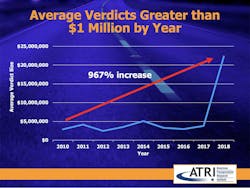
Nuclear verdict payouts have been rising since 2010. According to the American Transportation Research Institute (ATRI), the average size ballooned from $2,305,736 to $22,288,000—a 967% increase—between 2010 and 2018.
And the numbers just keep rising. A more recent study from the U.S. Chamber of Commerce Institute for Legal Reform showed that between June 2020 and April 2023, the average jury award was $27.5 million.
Factors driving rising nuclear verdicts in trucking
There isn’t one clear reason why nuclear verdicts have grown so much in recent years. More than likely, multiple factors have created this perfect litigation storm. But here are a few potential factors:
Litigation advertising
According to ATRI, part of the problem could be the 1977 Supreme Court case that re-allowed litigation advertising. “The median dollar value of trucking litigation awards from 1985 to 1989 was slightly more than $100,000. And in the next five years, the average award increased by 90% to $190,000.”
The infamous McDonald’s coffee lawsuit
In 1994, a woman who sued McDonald’s after suffering burns from spilling the company’s coffee on herself was awarded in excess of $2.8 million. This isn’t a trucking case, but some argue that it raised the litigation bar in the minds of attorneys and juries.
Increased third-party funding
Litigation financing is becoming increasingly problematic worldwide, but the U.S. is getting hit the hardest. Third-party litigation funding is when third parties, such as bankers, financiers, etc., help fund a plaintiff’s lawsuit. The third party then gets a cut of the payout when the lawsuit is successful.
According to ATRI, the use of litigation finance by U.S. law firms has grown 745% between 2015 and 2019, though some states are suffering more growth than others. With this rapid growth, there is some legislation on third-party funding, but legislators can’t seem to keep up.
Strategies plaintiffs use in high-dollar trucking lawsuits
To help protect your fleet, it’s important to know the techniques used in nuclear verdicts.
Reptile Theory
According to National Interstate Insurance, the Reptile Theory was created in the 1960s by neuroscientist Paul MacLean. The theory “seeks to render all of these basic facts irrelevant and instead appeal to the jury’s primitive, 'Reptilian Brain.’”
Plaintiffs in trucking lawsuits use the Reptile Theory to convince the jury that the motor carrier and/or driver in question is a danger to society. Attorneys will often point to safety rules that the driver or carrier allegedly broke to convince the jury of the threat they pose.
Negligent hiring and/or training
Plaintiff attorneys may also try to convince the jury that the carrier in question knowingly hired a driver with a poor driving record. According to Captive Resources, attorneys may try to prove that the driver in question was not adequately trained or supervised on safety.
Emotional appeals
According to the PrePass Safety Alliance, attorneys may also focus on the emotional aspect of the case, especially if there have been any injuries or deaths as a result of the accident. Emotional appeals can be used to increase the payouts in nuclear verdicts.
 Top 10 Fleets Explained articles of 2025
 White semi-truck hauling a red shipping container on highway with “Fleets Explained” graphic overlay, symbolizing trucking industry and fleet management.
Financial, reputational, and operational impacts on fleets
When a trucking company loses in a nuclear verdict, they lose more than just money. Fleets also face rising insurance costs and worsening reputations, in addition to budget challenges.
Rising insurance costs
According to ATRI, insurers are raising premiums to account for the possibility of nuclear verdicts. In 2023, premiums rose 12.5% primarily due to nuclear verdicts. For many fleets, especially smaller carriers, these rising costs aren’t sustainable.
Worsening reputations
In and out of the trucking industry, nuclear verdicts are big news because of their high impact and memorable payouts. So in the aftermath of a nuclear verdict, trucking companies have to worry about their tarnished reputations in addition to financial issues.
According to Pearl Insurance, nuclear verdicts can hurt customer relationships and employee morale. Companies may also experience increased regulatory scrutiny.
Driver stress
With nuclear verdicts, there is one factor that cannot be overlooked: the impact they have on truck drivers, who are the ones on the road facing the possibility of a serious accident
Whether a nuclear verdict happens in a driver’s company or is just featured in the news, drivers can feel the stress of an accident, according to PrePass Safety Alliance. Drivers already deal with numerous stressors on the road—lack of truck parking, hours of service, extreme weather, etc.—and too much stress can take a toll not only on drivers’ health but also on their focus and working to the best of their ability.
Financial challenges
Most obviously, nuclear verdicts can lead to financial issues for trucking companies. According to Pearl Insurance, “when an insurer pays beyond policy limits or a verdict exceeds coverage, the trucking company’s own assets are at stake, potentially leading to bankruptcy or major restructuring.” Smaller carriers, especially, are at risk when nuclear verdicts occur.
Fleet strategies to mitigate risk and prevent massive verdicts
With payouts on the rise, there are multiple ways fleets can prepare for and prevent nuclear verdicts.
Focus on driver safety training
According to SambaSafety, drivers forget up to 90% of what they learn within a single week. This means you can’t stop safety training after the initial driver onboarding. Ongoing training and personalized coaching are needed to reinforce safety behaviors and knowledge of safety requirements.
Invest in safety technology
In addition to driver training, there are multiple technology options fleets can use to help drivers stay safe and serve as evidence that a driver isn’t responsible in the event of a crash. The available technologies include dashcams, automatic emergency braking, lane departure warnings, collision mitigation systems, blind-spot monitoring, and more.
Dashcams can help identify who was responsible for an accident, while the other technology features above can help ensure driver safety and provide opportunities for coaching.
Have a plan for accidents
At the Truckload Carriers Association’s 2025 Safety & Security Meeting in June 2025, a panel discussed what to do and what not to do when a driver reports an accident.
They emphasized the importance of having a plan in place for when an accident occurs. According to the panel, this plan should include confirming the safety of the driver and anyone else involved, contacting emergency services, securing the scene, notifying company leadership and legal services, collecting evidence, and beyond.
While no fleet wants to deal with a crash, it's important to be ready if an accident happens.
Be prepared legally
After an accident occurs, it’s important to immediately begin working with legal counsel before memories fade, according to Pearl Insurance. Legal experts will assist with accident reconstruction, evidence collection, and communication with investigators. The earlier you contact legal counsel, the more time they have to prepare a defense.
Review insurance options
In the face of nuclear verdicts, fleets still have some control over their insurance options. According to Pearl Insurance, “many fleets have raised their liability coverage limits (e.g., carrying $5 million or $10 million primary policies instead of the statutory $750,000 minimum) or purchase umbrella policies to provide a larger cushion if a big verdict strikes. Some large carriers have turned to captive insurance arrangements or self-insurance for more control over claims and costs.”
About the Author
 Jenna Hume
Jenna Hume
Digital Editor
Digital Content Specialist Jenna Hume joined FleetOwner in November 2023 and previously worked as a writer in the gaming industry. She has a Bachelor of Fine Arts degree in creative writing from Truman State University and a master of Fine Arts degree in writing from Lindenwood University. She is currently based in Missouri.