Fleets Explained: How cybersecurity threats impact trucking operations
Key takeaways
- Cyberattacks on transportation are on the rise, putting fleet systems, data, and operations at increasing risk.
- Ransomware, phishing, and DDoS attacks can halt dispatch, delay freight, and drive costly downtime.
- MFA, system updates, training, and response plans help fleets reduce cyber risk and protect operations.
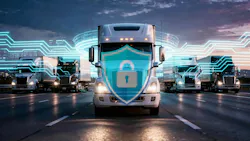
As technology has advanced and permeated more and more of our personal and professional lives, cybersecurity has become an increasing concern. Cybercrimes have more than doubled since 2018, according to the Federal Bureau of Investigation (FBI). From 2018 to 2024, the FBI received 5 million cyberattack complaints, with reported losses totaling $56.7 billion. The recent rise of artificial intelligence (AI) has only further complicated cybercrime.
For the trucking industry, cybercrime is an ever-growing problem, especially as more and more technology finds its way into truck cabs. Closely connected to cargo theft, cybersecurity in trucking has its own quirks and challenges. But before we get to those, let’s discuss the basics of what cybersecurity is, inside and outside of the trucking industry.
Cybersecurity basics for fleets
Cyberattacks are “any kind of malicious activity that attempts to collect, disrupt, deny, degrade, or destroy information system resources or the information itself,” according to the National Institute of Standards and Technology’s (NIST) Computer Security Resource Center.
Common types of cybercrime include phishing, ransomware, malware, data breaches, and more. The most common goal of digital criminals when targeting businesses is financial gain, though espionage and sabotage are other motivations.
Cybersecurity, therefore, is the “practice of protecting people, systems, and data from cyberattacks by using various technologies, processes, and policies,” according to IBM.
Some of the business sectors most affected by cybercrime are health care, manufacturing, financial services, small businesses, and transportation.
Why cybersecurity is critical for fleet operations and uptime
Trucking and the supply chain today are more digital than ever, with technologies such as telematics, electronic logging devices (ELDs), electronic bills of lading (eBOL), artificial intelligence (AI), autonomous vehicles (AVs), and more. Fleets can now operate more safely and efficiently with greater visibility thanks to this new technology.
But this advanced technology comes at a cost. In this new digital age, industries like trucking have become targets of digital criminals. The transportation sector saw an 186% increase in cyberattacks from June 2020 to June 2021, according to a 2021 study. Transportation ranked ninth among the top 10 most commonly targeted industries in 2025.
And when cybercrime occurs, it doesn’t just affect the industry; its effects trickle down the supply chain, eventually impacting the public and consumers. This is because cybersecurity incidents often cause unexpected downtime and delays, especially when telematics and routing technology are affected. In addition to impacting freight delivery, this results in lost revenue and tarnished reputations for trucking companies.
 Rising congestion forces fleets to shift to real-time routing and data-driven planning
 load board fleets explained
Top cyber threats targeting fleets and supply chains
Like cargo theft, digital criminals are constantly adapting existing cybercrimes and creating new methods. Here are the details on the most common cybercrimes affecting trucking:
Ransomware
Ransomware is a type of malware that holds a victim’s data or devices hostage until a ransom is paid, according to IBM. Ransomware is one of the most common types of cybercrime, and it has evolved into subcategories such as double- and triple-extortion.
Double extortion is when cybercriminals threaten to leak a victim’s data online. Triple extortion involves threatening to use the stolen data to attack an organization’s customers or business partners.
Phishing
A phishing attack occurs when a cybercriminal sends an email that appears familiar but is an attempt to steal personal information, such as passwords, the National Motor Freight Traffic Association (NMFTA) states. These emails typically look like an email address for an individual or organization, with one letter, number, or punctuation mark that looks different.
DoS and DDoS attacks
Two similar cybercrime methods are Denial of Service (DoS) and Directed Denial of Service (DDoS). According to NMFTA, both types of attacks overload a system with requests and prevent access. The system shuts down when overloaded with too many requests.
When a system like this shuts down, the organization or individual cannot use it. In trucking, this could halt an entire fleet and its drivers, resulting in delays, lost revenue, spoiled products, and more, not to mention the stress this situation puts on drivers, dispatchers, managers, and others.
The difference between the two types of attacks is that DoS is system-to-system, whereas DDoS is multiple systems against one system, Fortinet states.
MITM attack
A man-in-the-middle (MITM) attack occurs when a hacker intercepts communication between two parties and modifies information.
NMFTA provides the following example of an MITM attack: “Imagine a company sends a client a message that requests they wire payment to the company’s bank account. A hacker could receive this message, replace the company’s bank account with their own, and then potentially walk away with tens of thousands of dollars.”
Brute-force attack
A brute-force attack is a type of data breach that tries every possible combination of letters, numbers, and symbols to guess the correct password eventually. This, in turn, allows a hacker to access an organization’s system.
How fleets can strengthen cybersecurity and reduce risk exposure
With so many cybercrime methods, there are also plenty of ways trucking companies can protect themselves. For every niche method of cybercrime out there, there’s a niche method of cybersecurity. But here are some broad ways fleets can protect themselves with cybersecurity.
Conduct regular audits
Conducting regular audits can help fleets identify weaknesses in their security systems before hackers find them, according to Keystone Technology Consultants. This can be done with a fleet’s IT professionals or outside cybersecurity consultants.
Use rigid authentication measures
Multifactor authentication (MFA) is another measure to protect fleet technology systems. According to Isaac Instruments, MFA requires individuals to provide more than one form of identification to log in to email or other company systems. MFA can include passwords, fingerprints, authenticator apps, email codes, etc.
Keep tech updated
When fleets fail to update their technology, they leave themselves vulnerable to new cyber threats. Promptly updating technology, and even enabling automatic updates, further protects fleet data. NMFTA found that one-third of data breaches are from vulnerabilities that technology updates would have prevented.
Train employees on cybersecurity
It may seem cliché, but proper cybersecurity awareness and training are a major way fleets can protect themselves. These training sessions shouldn’t just teach staff how to identify phishing and other scams; they should also focus on procedures for when cybercrimes do occur.
NMFTA recommends that every employee at a trucking company receive cybersecurity training, from not sending sensitive information by email to creating strong passwords.
Make cybercrime incident plans
As with cargo theft, fleets can’t just focus on prevention; they need plans in place for when cybercrimes occur. NMFTA suggests the following steps that fleets might implement as part of these plans:
- Notifying management
- Not negotiating with hackers
- Changing passwords
- Unplugging servers
- Uploading backups
About the Author
 Jenna Hume
Jenna Hume
Digital Editor
Digital Content Specialist Jenna Hume joined FleetOwner in November 2023 and previously worked as a writer in the gaming industry. She has a Bachelor of Fine Arts degree in creative writing from Truman State University and a master of Fine Arts degree in writing from Lindenwood University. She is currently based in Missouri.