Fleets Explained: How heavy-duty trucking differs around the world
Key takeaways
- Global truck designs reflect regional needs, from U.S. long-haul comfort to European urban efficiency.
- HOS rules, emissions policies, and driver pay vary worldwide, shaping fleet operations and compliance.
- China leads autonomous trucking progress, while fleet technology adoption differs across global markets.

One of the first things I learned about the trucking industry is what makes American trucking stand out: Engines, cab shape, and trailers. While the equipment looks different outside North America, trucking is still a vital part of global supply chains—even if other countries do trucking a little differently.
This Fleets Explained article focuses on how trucking differs around the world, from equipment, technology, operations, and more.
Commercial vehicle design differences by region
If you put an American Class 8 tractor next to a European or Asian one, anyone could point out a few differences. But there are more unique features to each than what meets the eye.
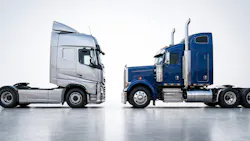
The most notable difference is the cab. Most American trucks have a long, protruding nose, while trucks in other countries have a flat front. This is due to a few reasons, such as the engine position.
Cabover vs. conventional truck engine layouts
American trucks position the engine in the front of the truck before the cabin. Due to smaller roads and regulations regarding vehicle length, European and Asian trucks favor a cabover design, in which the cab is positioned over the engine. While U.S. truck manufacturers once produced more cabover semitrucks, cabover semitrucks were largely phased out of the Class 8 market in the 1980s.
Cab sizes in global trucking
In terms of geography, American trucking focuses more on long-haul than other countries. To give drivers more comfort on long routes, cabin sizes average 6 to 9 feet in length, depending on whether it’s a day cab or a sleeper model. European and Asian trucks are built with efficiency and shorter, often urban trips in mind, so the cabins average 6 to 7 feet in length.
Commercial vehicle length regulations worldwide
Regulations on truck and trailer sizes vary from country to country. In the U.S., the average length of a truck and trailer is 72 feet. In Europe, the average length is approximately 54 feet. In Asian countries, the average is around 53 feet. The shorter truck and trailer lengths allow for easier maneuverability on narrow streets.
How regional trucking needs shape truck design
Overall, trucks in different countries are designed and built with different purposes in mind. In the U.S., trucking is often viewed as a lifestyle in addition to a job, with a focus on longer routes and driver comfort. This means U.S. trucks are big, with spacious cabins and larger engines.
In other countries, semi-truck designs are more focused on aerodynamics with smaller engines, making them better suited for shorter routes, urban environments, and stricter emission regulations.
Leading commercial truck OEMs by region
Favored original equipment manufacturers (OEMs) vary country by country. And many OEMs have global footprints, with parent companies owning multiple brands worldwide. In America, the main OEM brands include:
- Freightliner
- International
- Kenworth
- Mack
- Peterbilt
- Volvo
In Europe, the main OEMs are:
- Daimler Truck AG
- Volvo Group
- DAF
- Traton
In Asian countries, the main OEMs are:
- Isuzu
- Hino
- FAW Jiefang
- Sinotruk
- Foton Motor
- Scania
In South America, the main OEMs are:
- Mercedes-Benz
- Scania
- IVECO
- Volvo Trucks
Global fleet technology trends
Overall, fleet technology is pretty consistent globally, but different countries are more innovative and focused on some types of technology than others.
Autonomous trucking adoption by region
Autonomous trucking is an emerging technology globally, but China in particular has made the most progress so far. This has been possible for China largely due to government support and its large geography. Chinese companies like Inceptio and Pony.ai have logged millions of self-driving miles, far more than any European or American AV start-ups. Inceptio specifically is aiming to fully commercialize in 2028. The U.S. also has a growing AV sector, mostly centered in the Sun Belt, but most driver-out operations take place on private roads.
Driver monitoring technology around the world
In the U.S., driver-facing dashcams are becoming a new safety standard. The cameras can help identify risky driver behavior, prevent distracted or drowsy driving, and assist in exonerating drivers when accidents occur.
Driver monitoring software exists in Europe, but privacy regulations complicate its usage. The U.K. is handling these regulations, but countries like Germany and Italy are approaching the situation with more caution.
Global trucking emissions and sustainability
One area where the U.S. is lagging behind the rest of the trucking world is sustainability. In the U.S., emission regulations change with every new governmental administration. Before the current Trump administration, fleets faced stricter requirements from CARB, new GHG3 rules, Advanced Clean Fleets, and more. These regulations were gutted or rescinded entirely after he retook office.
This doesn’t mean that progress in electric vehicles (EVs), alternative fuels and powertrains, and regulations in the U.S. has stopped. But reduced federal incentives have pushed many EV-makers and infrastructure providers to find commercially viable paths to adoption.
In contrast, Europe and Asia operate under stricter emissions regulations. Europe is enforcing a hastened timeline for reducing CO2 emissions, from 45% by 2030 to 90% by 2040.

 cross border operations explained
 fleetsexplained_8
Asian countries are seeing increased EV adoption in and outside of trucking. China leads the world in EVs. Renewed focus began in 2025 to go beyond light-duty vehicles and electrify trucking.
Most Asian countries are regulating emissions through Euro IV standards. Some countries, such as China, Japan, and India, have additional regulations on fuel consumption and fuel economy.
Global trucking operations and regulations
Hours-of-service (HOS) rules around the world
In the U.S., the HOS regulations are as follows:
- 11-hour driving limit: May drive a maximum of 11 hours after 10 consecutive hours off duty.
- 14-hour limit: May not drive beyond the 14th consecutive hour after coming on duty, following 10 consecutive hours off duty. Off-duty time does not extend the 14-hour period.
- 30-minute driving break: Drivers must take a 30-minute break after 8 cumulative hours of driving without at least a 30-minute interruption. The break may be satisfied by any non-driving period of 30 consecutive minutes (i.e., on-duty not driving, off-duty, sleeper berth, or any combination of these taken consecutively).
- 60/70-hour limit: May not drive after 60/70 hours on duty in 7/8 consecutive days. A driver may restart a 7/8 consecutive day period after taking 34 or more consecutive hours off duty.
In Europe, the HOS rules are stricter and force drivers to rest more:
- Daily driving period shall not exceed 9 hours, with an exemption of twice a week, when it may be extended to 10 hours.
- Total weekly driving time may not exceed 56 hours, and the total fortnightly driving time may not exceed 90 hours.
- Daily rest period shall be at least 11 hours, with an exception of going down to 9 hours maximum three times a week. Daily rest can be split into 3 hours rest followed by 9 hours of rest, for a total of 12 hours.
- Breaks of at least 45 minutes (separable into 15 minutes followed by 30 minutes) should be taken after 4 ½ hours at the latest.
- Weekly rest is 45 continuous hours, which can be reduced every second week to 24 hours. Compensation arrangements apply for reduced weekly rest period. Weekly rest is to be taken after six days of working, except for coach drivers engaged in a single occasional service of international transport of passengers, who may postpone their weekly rest period after 12 days in order to facilitate coach holidays.
- Daily and/or weekly driving times may be exceeded in exceptional circumstances by up to one hour to enable the driver to reach his/her place of residence or the employer’s operational center in order to take a weekly rest period. Exceeding the daily and/or weekly driving times by up to two hours is also allowed to enable the driver to reach his/her place of residence or the employer’s operational center in order to take a regular weekly rest period.
HOS rules in Asia vary country by country. China is making strides to reduce fatigued driving and thus has the following rule:
- A driver will be deemed fatigued if any of the following conditions are met: driving continuously for more than 4 hours without stopping, or resting for less than 20 minutes; for passenger transport drivers, driving continuously for more than 2 hours between 10 p.m. and 6 a.m. without required rest; or accumulating more than 8 hours of driving time within a 24-hour window.
In Vietnam, commercial drivers have a daily 10-hour limit, a weekly 48-hour limit, and cannot drive for more than 4 hours continuously. And in Japan, truck drivers are limited to 960 hours of overtime per year since 2024.
Truck driver pay by region
Truck drivers in the U.S. earn an average salary of $57,778. Driver pay is nuanced, though, and depends on many factors, including region and driver type. Here is how ATA broke down driver pay with 2023 numbers:
- Median annual earnings for truckload drivers: $76,420
- Median annual earnings for linehaul LTL drivers: $94,525
- Median annual earnings for local LTL drivers: $80,680
- Median annual earnings for private carrier drivers: $95,114
- Median annual earnings for leased-on independent contractors for truckload carriers: $186,016
While owner-operators may earn more than company drivers, they have more out-of-pocket expenses, such as insurance and equipment costs. You can read more about truck driver pay in the U.S. in this Fleets Explained article.
In Europe, monthly driver pay ranges from €1,500 to €5,000+ ($1,710 to $5,700). When added up, this amounts to a gross yearly salary of $20,520 to $68,400. This is less than what U.S. drivers typically make.
Asian truck drivers make even less, though exact pay varies by country. The steadiest pay ranges are seen in Japan (average pay $30,583) and South Korea (average pay $27,801).
About the Author
 Jenna Hume
Jenna Hume
Digital Editor
Digital Content Specialist Jenna Hume joined FleetOwner in November 2023 and previously worked as a writer in the gaming industry. She has a Bachelor of Fine Arts degree in creative writing from Truman State University and a master of Fine Arts degree in writing from Lindenwood University. She is currently based in Missouri.