ATA leadership touts advocacy efforts, emphasizes need for discipline in lingering downturn
Key takeaways
- ATA’s leadership transition comes as carriers face weak freight demand, rising costs, and regulatory uncertainty.
- ATA highlights advocacy progress on CDL integrity, truck parking, emissions rules, and cargo theft prevention.
- Incoming CEO Mark Colson plans to prioritize member trust, industry advocacy, and value for carriers.
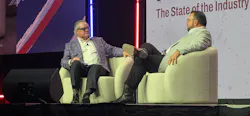
CHARLOTTE, North Carolina—As the trucking industry continues to work through an extended economic recovery, the American Trucking Associations (ATA) is working on its own strategic transition.
In a candid executive dialogue at the ATA Management Conference & Exhibition, outgoing ATA Chairman Greg Hodgen and incoming Chairman Derek Leathers reflected on recent legislative and regulatory victories, outlined core operational tenets for carriers, and formally introduced Mark Colson as ATA’s new president and CEO. The overarching message for industry executives is clear: Trucking must pivot from surviving the recent downturn to actively shaping the future marketplace.
“ATA's strength has never depended on a particular economic cycle or a political party, or any individual leader for that matter,” Leathers, CEO of Werner Enterprises, said. “That's the point of the federation. It comes from a durable purpose, and a federation that brings the industry together to solve problems that nobody alone is going to be in a position to solve.
“The transition is not simply something just to manage, but it's an opportunity to sharpen the focus. It's an opportunity to raise our expectations and to build a strong foundation for the future.”
Amid soft freight demand, lagging volumes, and escalating operating costs, Hodgen, CEO of Groendyke Transport Inc., noted that responsible fleets have endured severe market pressures without compromising safety, maintenance, or workforce development.
“It's not a moment for celebration, but it's also I don't think a moment for anxiety,” Hodgen said. “I think it is a moment for confidence, discipline, and some urgency.”
Leathers emphasized that ATA’s primary role is fostering a fair, level playing field that rewards operators who invest in safety and play by the rules, while actively curbing bad actors who undermine industry standards. He reassured members that throughout the board's disciplined CEO search, ATA’s advocacy agenda never paused, keeping the organization firmly focused on representing fleets of all sizes.
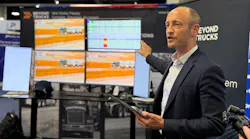
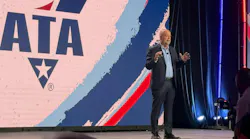 bob_costello_ata_angle
Policy wins, strategic advocacy
Unified advocacy across federal agencies, Congress, and state associations yielded tangible results over the past year, as the chairmen outlined:
- CDL integrity and highway safety: After intense ATA advocacy, federal authorities launched a nationwide crackdown on non-compliant training programs, removing nearly 10,000 non-compliant CDL schools from the federal registry—including 550 identified as fraudulent—and taking thousands of unqualified drivers out of service. More than $217 million has been invested in CDL integrity initiatives across more than 20 states.
- Regulatory rollback: ATA secured the final repeal of the U.S. Environmental Protection Agency's (EPA) Phase 3 greenhouse gas standards in February and led engagement on low NOx regulations, ensuring environmental rules preserve equipment reliability and reduce unnecessary capital burdens.
- Infrastructure and parking: Following a landmark $200 million federal appropriation dedicated to truck parking, the U.S. Department of Transportation (DOT) began releasing funds, including $61.7 million for expansion projects across five states.
- Labor and independent contractors: ATA supported confirming Keith Sonderling at the U.S. Department of Labor, helping advance a final rule protecting the independent contractor model to the White House for final release.
- Cargo theft mitigation: To combat supply chain theft, ATA built bipartisan support for the Combating Organized Retail Crime Act (CORCA) and filed it as an amendment to the must-pass National Defense Authorization Act (NDAA).
Hodgen highlighted this pragmatic strategy—attaching key industry priorities to mandatory legislative vehicles—as essential for achieving results in a divided Washington.
Three pillars of value
Looking ahead, Leathers outlined ATA’s value proposition for fleet executives around three core legs of the stool:
- Legislative influence: Developing bipartisan strategy to convert industry priorities into binding policy.
- Regulatory connectivity: Bringing real-world shop-floor and highway realities into agency rulemaking before mandates are finalized.
- Financial stewardship: Managing member dollars with strict business discipline, directing resources toward high-impact initiatives, and demanding measurable returns.
On labor dynamics, leadership clarified that the industry's primary challenge is not a shortage of CDL holders, but ensuring rigorous vetting, proper initial training, and overcoming broader national demographic headwinds as fewer workers enter the trades.
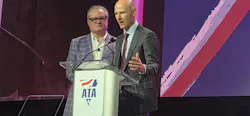
New leadership: Colson takes the wheel
Closing the session, incoming President and CEO Mark Colson shared his vision for leading ATA. Raised in a family-owned tire shop in Alabama, Colson has served as president and CEO of the Alabama Trucking Association since 2019. He shared his personal philosophy, rooted in faith, family, teamwork, and grit.
Expressing deep empathy for motor carriers navigating difficult economic conditions, Colson pledged an executive leadership style centered on active listening, trust-building, and maximum value delivery for carriers.
"I believe the professionals in our industry matter most," Colson said, issuing a direct call to earn the trust of members across the federation. "Guided by empathy and respect for the trucking professional—simply put, I love truckers."
About the Author
 Kevin Jones
Editor
Kevin has served as editor-in-chief of Trailer/Body Builders magazine since 2017—just the third editor in the magazine’s 60 years. He is also editorial director for Endeavor Business Media’s Commercial Vehicle group, which includes FleetOwner, Bulk Transporter, Refrigerated Transporter, American Trucker, and Fleet Maintenance magazines and websites.
Working from Beaufort, S.C., Kevin has covered trucking and manufacturing for nearly 20 years. His writing and commentary about the trucking industry and, previously, business and government, has been recognized with numerous state, regional, and national journalism awards.