Key takeaways
- Knight-Swift is pushing 10%+ truckload rate hikes as capacity tightens and shippers prioritize securing freight coverage.
- Mini-bids and rejected contracts are rising as pricing shifts upward.
- Capacity attrition and seasonal shocks could drive stronger spot rates, pointing to a potential freight market upcycle.
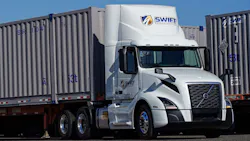
Knight-Swift Transportation is pursuing contract rate hikes of 10% or more for truckload business this spring and typically securing mid-single digit increases on less-than-truckload work, CEO Adam Miller said April 23 after the company reported its first-quarter results.
Miller said Phoenix-based Knight-Swift, ranked No. 3 overall on the 2026 FleetOwner 500 list of for-hire carriers and the largest truckload carrier in North America, is working its way through “a busy and rapidly evolving bid environment” in which many shippers are prioritizing securing capacity over favorable rates because a stricter regulatory environment has removed excess capacity. That dynamic, he added, has also whittled down discounts in the spot market.
“This is on top of a trend of shippers favoring asset-based relationships that have formed late last year in response to the regulatory enforcement efforts,” Miller said. “Whether for these reasons or because of expectations of improving demand, we have already had a number of shippers initiate discussions about peak-season demand support, which is not typical this early in the year.”
Knight-Swift executives said last week that first-quarter profits would miss analysts' expectations due to several factors, including disruptions from severe winter weather and the recent spike in fuel prices. At the time, Miller also said that those trends were hastening the rationalization of freight capacity.



Following the release of Knight-Swift’s Q1 numbers—a small net loss and adjusted operating income of $49.8 million on $1.64 billion in revenue excluding fuel surcharges—Miller said Knight-Swift teams are seeing more mini-bids from shippers as well as the rejection of awarded bids by some carriers because prices have moved up since January.
Those comments reinforce statements made last week by fellow FO500 executives at J.B. Hunt that the freight market appears to be in an upcycle. J.B. Hunt’s Spencer Frazier also told analysts and investors that more shippers were putting out mini-bids and looking to consolidate their business with fewer carriers. Analysts at Stifel agree that the tide appears to be turning and told clients April 23 that several events could reinforce the evolving dynamics.
“Supply attrition—both organic and regulation-induced—seems to be accelerating, and we think episodic capacity shocks like produce season (underway), DOT road check week (May), and the spring freight peak could make spot rates more susceptible to outsized moves,” the team led by Bruce Chan wrote. “Meanwhile, demand has started to materialize off the bottom, which we believe would be very helpful in driving a cycle inflection if sustained.”
Shares of Knight-Swift (Ticker: KNX) rose nearly 3% to $65.77 on April 23. Over the past six months, they have now climbed about 50%, a move that has grown the company’s market capitalization to nearly $10.7 billion.
About the Author

Geert De Lombaerde
Senior Editor
A native of Belgium, Geert De Lombaerde has more than two decades of experience in business journalism. Since 2021, he has written about markets and economic trends for Endeavor Business Media publications FleetOwner, Healthcare Innovation, IndustryWeek, Oil & Gas Journal, and T&D World.
With a degree in journalism from the University of Missouri, he began his reporting career at the Business Courier in Cincinnati. He later was managing editor and editor of the Nashville Business Journal. Most recently, he oversaw the online and print products of the Nashville Post and reported primarily on Middle Tennessee’s finance sector and many of its publicly traded companies.