Knight-Swift ‘feeling a bit better about our ability to push rates’ in ‘26

Freight market shows signs of a turn, according to Q4 earnings: Knight-Swift confident it can push for rate increases this bid season. But trucking is still fraught with risk, as shown by Landstar's nuclear verdict hit.
Jan. 23, 2026
4 min read

Key Takeaways

  • Rate-hike push: Knight-Swift is "feeling a bit better" and will regularly push for contract rate hikes of around 5% during the 2026 bid season.
  • Cost management: Knight-Swift expects cost savings, including a 5% trim of non-driver head count, to drive margin expansion as 2026 progresses.
  • Claims spike: Landstar's Q4 results include $56 million in "highly elevated insurance and claims costs," notably from a recent, unfavorable $23 million nuclear verdict ruling in Texas.
  • Profit drop: Due to these expenses, Landstar’s Q4 profits are likely to fall more than 40% compared to late 2024, despite revenues slipping just 3%.
  • Supply-driven lift: Landstar noted a late Q4 supply-driven pricing boost, with truck revenue per load rising roughly 6% from October to December.

Saying his team has become “a bit more constructive” on how supply and demand dynamics have improved this month, Knight-Swift Transportation CEO Adam Miller this week said the No. 3 company on the FleetOwner 500 list of for-hire carriers expects to make some price moves early this year that should begin to show come spring.

Speaking after Phoenix-based Knight-Swift reported its 2025 fourth-quarter results, Miller told analysts that the company, like many of its peers, generally saw activity fall off late after a projected surge of sorts fizzled out in November. But 2026 and its bid season have started with “far more constructive conversations with customers,” Miller said, adding that Knight-Swift will regularly push for contract rate hikes around 5%.

“We’re feeling a bit better about our ability to push rates in the bid season and maybe find some ways to even get some […] premium spot opportunities early in the first quarter,” Miller said, adding that it “has been some time since we’ve been able to do that.”

Those increases will take a little time to translate into a healthier bottom line for Knight-Swift, Miller noted, saying that this quarter is likely to be “a period where we feel better than we look in terms of the results.” But executives are growing more confident that margins will improve as 2026 progresses.

Miller’s comments about market conditions and Knight-Swift’s pricing ambitions were a bit bolder than those of Shelley Simpson, his peer at J.B. Hunt Transport Services, who said her team will be “prudent” in trying to push price increases. The comments from both CEOs were directionally very similar: Neither called a major market inflection, and both focused on costs, but Miller is more bullish on bid season.

On the cost side, CFO Andrew Hess said Knight-Swift, the largest trucking general freight operation in the U.S., has trimmed the non-driver head count of its truckload group—which brings in roughly two-thirds of revenues—by 5% and expects to save more money by merging the operations and brand of Abilene Motor Express, which the company bought eight years ago, into Swift Transportation.

ID 104377851 © Sockoro | Dreamstime.com
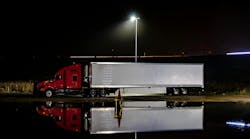
truck in a parking lot alone
ID 158693145 © Teeradej Srikijvilaikul & ID 49976340 © Vitpho | Dreamstime.com
fleet lead brainwaves concept

“Price, obviously, is going to be very much market-dependent and to some degree, the miles,” Hess said. “But we expect cost alone should drive margin expansion in 2026.”

Knight-Swift posted a net loss of nearly $7 million during Q4 on revenue excluding fuel surcharges of nearly $1.67 billion. The bottom line slipped into the red primarily due to nearly $53 million in charges related to the Abilene integration; adjusted operating income in Q4 was nearly $101 million, versus about $106 million in late 2024.

Shares of the company (Ticker: KNX) rose nearly 3% to $59.44 on January 22, the day after the earnings release and conference call. Over the past six months, they have now climbed more than 30%, growing the company’s market capitalization to nearly $10 billion.

Landstar warns of claims spike and notes a Q4 supply-driven pricing lift

Landstar System executives said Jan. 21 that the asset-light company’s Q4 earnings will be marred by “highly elevated insurance and claims costs of $56 million” that include nearly $6 million in new exposure due to a recent Texas court ruling.

Leaders of Jacksonville-based Landstar, which ranks ninth on the FleetOwner 500: For-Hire list, say they plan to “vigorously” appeal the recent ruling on the case of a fatal 2021 accident in Texas. The court’s judgment earlier this month held Landstar fully liable for nearly $23 million in damages awarded in the case, which involved a separate carrier carrying a shipment that Landstar had brokered. The ruling superseded a jury determination from last summer that the company was liable for 15% of the $23 million.

Executives also detailed $11 million in insurance and claims costs stemming from two crashes in the last three months of 2025, as well as more than $5 million in claim reserves “primarily due to the impact of an increase in the anticipated loss exposure for claims above $1 million.”

Those expenses mean Landstar’s Q4 profits are likely to fall more than 40% from those of late 2024, even though revenues are expected to slip just 3% to about $1.17 billion. The news isn’t all grim, though: President and CEO Frank Lonegro and his team said truck revenue per load was up about 1% year over year in the quarter but rose roughly 6% from October to December as supply tightened.

Landstar shares (Ticker: LSTR) rose 0.5% on Jan. 22 to nearly $158. They are up about 15% over the past six months, and the company’s market value is now roughly $5.5 billion.

About the Author

Geert De Lombaerde

Senior Editor

A native of Belgium, Geert De Lombaerde has more than two decades of experience in business journalism. Since 2021, he has written about markets and economic trends for Endeavor Business Media publications FleetOwner, Healthcare Innovation, IndustryWeek, Oil & Gas Journal, and T&D World. 

With a degree in journalism from the University of Missouri, he began his reporting career at the Business Courier in Cincinnati. He later was managing editor and editor of the Nashville Business Journal. Most recently, he oversaw the online and print products of the Nashville Post and reported primarily on Middle Tennessee’s finance sector and many of its publicly traded companies.

Sign up for our eNewsletters
Get the latest news and updates

Voice Your Opinion!

To join the conversation, and become an exclusive member of FleetOwner, create an account today!