Heller: Don't turn back the ELD clock
Key takeaways
- The debate over paper logs versus ELDs continues, but Heller advocates for improving existing electronic systems rather than reverting to outdated methods.
- FMCSA continues revising its vetting process for ELDs to improve compliance and prevent fraudulent logging.
- ELDs are primarily compliance tools, with safety benefits being a secondary consideration; the rules themselves bring the safety benefits.
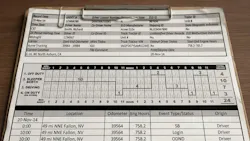
Our industry sometimes seems to be time-traveling, not necessarily in a “Back to the Future” or “Avengers: Endgame” kind of way, but because some issues do not seem to dissipate or reach any kind of conclusion. I frequently hear discussions about how an industry news article from 20 years ago is likely to be a topic of conversation still today.
I am referring to the recent exemption request published in February by the Federal Motor Carrier Safety Administration (FMCSA) regarding the Electronic Logging Device Rule, seeking the right to use manual paper logs rather than the digital platform currently regulated. I understand the recent news has not been kind to ELDs regarding compliance issues.
This rule was written to ensure that a driver’s hours of service were accurately recorded without any impropriety. In fact, FMCSA has increasingly made it the norm, rather than the exception, to remove devices from its list of registered products, with over 300 devices now on the list and ending up in FMCSA’s version of the land of misfit toys.
Revisiting this exemption request only stands to muddy the waters even further, since there is a reason that the need for ELDs grew to where we are today. Fraudulent logging was not rare but commonplace, necessitating the electronic recording of a driver’s hours of service. ELDs are commonly misconceived as safety improvement devices, when in reality they are compliance improvement devices, and just about everyone knows there is a difference between compliance and safety. The safety aspect of the hours-of-service regulations lies in the regulations themselves, not the tool used to track compliance with them.
FMCSA is in the midst of revisiting these rules and exploring two pilot programs to assess the safety benefits of increasing the flexibility in those regulations. My point is that the agency is being very progressive in examining the rules the ELD is responsible for tracking, and they should be, because that device can now accurately record compliance with a driver’s on-duty clock if it has been designed in accordance with the agency’s prescribed specifications.
Which leads us back to the device itself. Devices that failed to meet prescribed criteria have led to an increased revocation of compliance tools. At the same time, our friends north of the border had insisted on third-party certifications, which have had a tremendous impact due to the differences in “certified” devices between the two. As a result, the agencies’ enforcement actions have had to take place after the fact.
Now, the agency itself has announced that it is revamping its vetting process altogether, which certainly coincides with the industry’s increased enforcement actions. Recently, the agency announced a new vetting process to demonstrate compliance with these devices, a change that the industry certainly welcomes. The system of self-certification, as prescribed in the original rule, made it easy to issue noncompliant devices, leading drivers to invest in devices that failed to meet the expectations the rules specified.
With the new process, drivers and carriers can be assured they have invested in equipment that will actually work as intended by the agency. While the details of FMCSA’s complete overhaul of the vetting process remain confidential, the agency promises that it will include an initial review, fraud detection, and an application categorization process that will determine whether a device is in compliance or needs further work. All of this can certainly be attributed to a recommendation by the National Transportation Safety Board (NTSB) for the FMCSA to tighten its ELD requirements to prevent drivers from creating fake logs.
In reality, we are at a point today where the agency is taking action that would always benefit our industry. Taking a step backward does not solve the problem and puts us back into the time machine I mentioned earlier. The answer is not allowing paper logs to track our compliance but improving upon a rule that the industry has embraced and grown accustomed to. We once again applaud the agency for its increased enforcement actions against those in the industry who choose to be noncompliant.


About the Author

David Heller
David Heller is the senior vice president of safety and government affairs for the Truckload Carriers Association. Heller has worked for TCA since 2005, initially as director of safety, and most recently as the VP of government affairs. Before that, he spent seven years as manager of safety programs for American Trucking Associations.