The state of fleet management directly from the fleets
Key takeaways
- Over half of fleet leaders cite rising costs and regulatory compliance as top concerns impacting operations.
- Despite high adoption of fleet maintenance software, manual data entry remains prevalent, increasing administrative workload.
- AI adoption remains cautious, with most fleets researching or piloting the technology due to trust and reliability concerns.
- Maintenance is often a hybrid approach, with fleets outsourcing some services while managing others in-house.
- The transition to electric and hybrid vehicles is slow, with most fleets in evaluation mode due to infrastructure costs and technician shortages.

To benchmark how fleets are managing operations in these trying times, fleet management platform Fleetio recently surveyed the industry’s operational leaders. The results offer insight into how fleet companies are navigating industry challenges, such as the economy, the rise of artificial intelligence (AI), and whether alternative-fueled vehicles remain on their radar.
Fleetio surveyed more than 600 fleet leaders, both customers and non-customers, to find out where the industry stands.
Here’s what’s happening in the industry, according to fleet leaders
Top fleet management concerns
What keeps fleet leaders up at night? Unsurprisingly, costs are at the top of the list, with other concerns such as regulations and technician shortages also taking top spots. Here’s a rundown of fleet leaders’ top five concerns:
- 54.4% of respondents cite rising costs as a top concern
- 46.1% of fleet leaders are concerned about regulations and emissions mandates
- 35.1% of respondents cite the EV transition and infrastructure challenges as a concern
- 32.5% see the technician shortage as a concern
- 28.9% are concerned about parts and vehicle availability
One fleet manager in the rental and leasing industry said that the pressure from optimizing operations and maintaining consistency has become a challenge:
“As fleets grow and operations become more decentralized, keeping everything aligned, especially across locations and teams, becomes a real challenge. There’s also increasing pressure to optimize turnaround time and minimize downtime, while still maintaining high service standards. If the right tools and systems aren’t used effectively or consistently, that gap only grows wider.”
A closer look at fleet maintenance
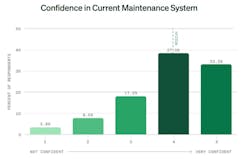
More than 61% of fleet leaders surveyed are concerned about fleet maintenance due to the technician shortage and parts/vehicle availability, and Fleetio describes the overall sentiment on fleet maintenance as “not failing, but not fully in control.” What contributes to that?
According to fleet leaders, only 9.7% believe they are “great at performing maintenance on time.” Barely a quarter of fleet leaders (25.6%) believe they are “good at performing maintenance on time.” Nearly half of fleet leaders (44.3%) see their maintenance performance as doing a “decent job, room for improvement.” Additionally, nearly half of the respondents cited their maintenance needs as “half-scheduled/half-unscheduled.”
How is industry-wide fleet maintenance tech adoption?
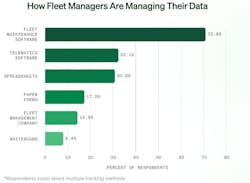
A big win for transportation tech companies is that more than 70% of fleet leaders use fleet maintenance software, and more than 30% use telematics software. But, according to survey data, it is rare for a fleet to be 100% digital in its admin operations, leaving a hefty load of paperwork to someone on the team.
More than 30% of respondents still rely on spreadsheets, and more than 17% rely on paper forms. The Fleetio survey allowed respondents to select multiple data management options, indicating that many fleets use multiple data management methods.
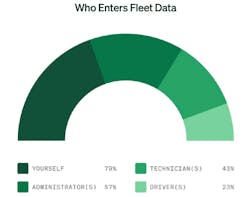
This multi-method data management increases the administrative workload. Instead of using a system that automatically inputs fleet data into telematics and fleet maintenance systems, a whopping 80% of fleet leaders indicate that they manually input this data themselves.
The time it takes to input this data manually depends on the fleet, yet thankfully, the largest share of respondents (25.9%) believe it takes only one to two hours of their workweek. Others (24.1%) believe this data entry takes two to four hours of their workweek, 21.3% believe it adds four to eight hours to their workweek, and 13.8% indicate that manual data entry takes up 16 or more hours of their workweek.
Do fleets outsource or perform their own maintenance?
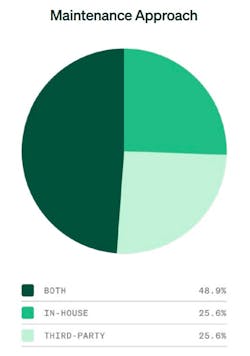
Fleet leaders who took Fleetio’s survey indicate that most maintenance is performed in a hybrid fashion, with fleets performing some tasks and outsourcing others. About half (48.9%) of respondents said they maintain their vehicles with in-house and third-party maintenance services, 25.6% said they perform maintenance fully in-house, and 25.6% said a third-party provider performs all their maintenance.
The top services outsourced to third-party maintenance providers include unscheduled repairs (39.4%), preventive maintenance (29.1%), specialty assets (27.5%), and overflow relief (25.8%).
 tim denoyer ACT Research
 mechanic with computer
The rise of AI among fleet operations
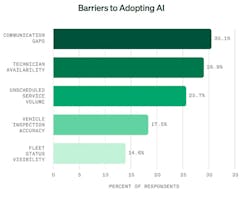
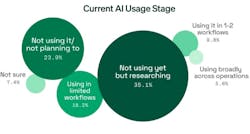
Artificial intelligence has become synonymous with transportation technology providers, yet very few Fleetio survey respondents (5.6%) indicate they’re using the rapidly growing technology in their operations today. Instead, many are going the cautious route, with 35.1% indicating they are “researching” AI and 18.2% piloting AI within their operations. One reason for the slow adoption of AI could be trust, as only 1.5% of respondents said they “completely trust AI recommendations without review,” the report states.
Here are fleet leaders’ top “trust and readiness” concerns with AI:
- 50.8% are concerned with AI’s accuracy and reliability
- 43.3% are concerned about trust and confidence with AI
- 37.7% believe that human oversight is still needed
- 35.2% are concerned about data quality concerns
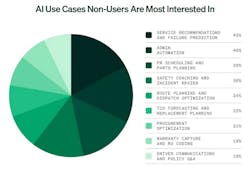
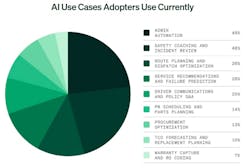
Fleetio’s report outlines fleet leaders’ perceptions of AI on multiple fronts and displays these in graphs. See these below.
One respondent working in the trucking, logistics, and shipping sector believes AI will only make servicing vehicles more complex in the future. They write: “It will be interesting to see how AI and automation affect the way we manage our fleets on a daily basis. There’s also concerns about having a qualified workforce as vehicles become more reliant on computer technology.”
Where do fleet leaders stand with alt fuels and emissions regulations?
While the “EV mandate” was removed last year, Fleetio’s survey found that some fleets still feel the regulatory pressure to convert to electric vehicles; however, most fleets are still in “evaluation mode.”
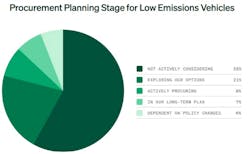
The survey found that 70% of fleets report owning no hybrid or alternatively powered vehicles. However, 18.3% of fleets report operating hybrids, and 11.6% report operating EVs. Citing reasons such as the high cost of infrastructure and the need to hire new technicians, 57.6% of fleet leaders indicate they are not actively considering purchasing alt-powered vehicles. Citing reasons such as adapting the fleet to future regulatory changes, 21.1% of fleet leaders are exploring alt-powered vehicles. Only 7.9% of fleet leaders indicate that they are actively procuring alt-fueled vehicles.
One fleet manager working in the arts, entertainment, and recreation sector had this to say: “Insurance hikes, parts availability, parts price increases: Electric/hybrid will make it necessary to hire a new tech with specific knowledge, new parts, charging stations, battery life and costs. Increased payroll costs despite staying competitive in client pricing.”
About the Author
 Jade Brasher
Jade Brasher
Executive Editor Jade Brasher has covered vocational trucking and fleets since 2018. A graduate of The University of Alabama with a degree in journalism, Jade enjoys telling stories about the people behind the wheel and the intricate processes of the ever-evolving trucking industry.