Inside Arka Express’ safety-first fleet strategy
Key takeaways
- Arka Express uses Samsara telematics and AI dashcams to improve safety and reduce risky driving behaviors.
- Trucker Path for Fleets cut low-clearance incidents 50% and improved routing, fuel savings, and efficiency.
- Standardized Freightliner equipment and coaching programs support cost control, safety, and driver retention.
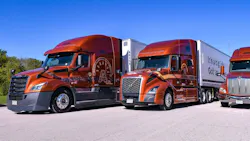
From technology to daily operations, nearly everything that takes place at Arka Express is focused on safety and efficiency. “Those are the core of our operation,” Igor Naumov, director of safety, emphasized. “Every decision we make, whether it’s about equipment, software, or drivers, has to support those two goals.”
Founded in 2007, the Markham, Illinois-based carrier provides truckload service primarily east of the Mississippi River. Today, Arka Express fields a fleet of more than 800 tractors and over 2,000 trailers.
Arka Express uses a mix of management and telematics systems to monitor performance and support safer operations. The fleet runs Samsara on-board solutions for telematics and is equipped with dash cameras in its trucks to help track behaviors such as speeding, seat belt usage, distracted driving, and fatigue indicators.
Safety tech drives real-time coaching and driver behavior improvement
In September 2025, the carrier launched a major safety initiative by creating a new division within its safety department. “We began coaching drivers to help them understand unsafe behaviors,” Naumov related. “Our team works directly with drivers based on what AI recognizes from our dash cameras and telematics data.
“With in-cab technology that alerts drivers immediately, and the coaching team following up while the incident is still fresh, we’ve had immediate and impressive results,” he continued. “There’s been a significant reduction in speeding and distracted driving, and fewer policy violations for cell phone and seat belt use.”
One of Arka’s most significant safety improvements came through its adoption of Trucker Path for Fleets. Rapid expansion had placed drivers in unfamiliar areas, often with low-clearance bridges, weight restrictions, and truck-prohibited roads. Navigation tools that lacked truck-specific routing created costly consequences.
 sustainable fleets 2026
“At one point, we were seeing up to seven trailers damaged per year due to low-clearance incidents, and two to three trailers totaled annually,” Naumov said. “Each incident meant thousands of dollars in repairs, weeks of downtime, and added risk from cargo damage and delivery delays.”
After evaluating other routing tools, Arka selected Trucker Path for Fleets and piloted it with 25 drivers. Many were already familiar with the app and trusted it. The app now provides truck-friendly routes with turn-by-turn navigation through a link to the carrier’s 10 Speed Transportation Management System. The integration syncs load assignments with the navigation solution to automatically populate routes.
Since implementing Trucker Path for Fleets, according to Naumov, Arka Express has seen a 50% reduction in low-clearance incidents, fewer route-related delays, reduced out-of-route miles, and fuel savings of as much as 3% through route and fueling optimization.
Moreover, Naumov believes that Trucker Path for Fleets is helping improve driver retention. “The app simplifies workflows for drivers by integrating truck-specific navigation with our TMS, fueling system, and Samsara electronic logging devices, including syncing hours-of-service data so drivers can see remaining drive time in the app,” he explained.
“Finding drivers hasn’t been our challenge, but retention requires an ongoing effort,” Naumov continued. “Part of our approach has been to solicit feedback at key points in a driver’s tenure, including after 90 days, after one year, and when drivers leave the company. We want to understand where we dropped the ball and identify issues we can address.”
Routing optimization and fleet standardization reduce cost and damage
Compensation has been a concern, for example, though Arka Express pays for leave time and offers wage increases. “It’s hard to pay more in a tight freight market with slim margins,” Naumov said, “but when the market improves, compensation will reflect that.”
Cost control through standardization is also central to the equipment strategy at Arka Express. The company’s trailer fleet consists of 53-ft. dry vans, primarily from Utility, along with some Hyundai, Stoughton, and Wabash models.
For the past three years, Naumov reported, the carrier has been transitioning to Freightliner tractors. “About 65% of the fleet is now Freightliner, and we plan to convert all equipment in the next few years,” he said. “Working with one manufacturer gives us more buying power and simplifies maintenance and parts inventory needs.”
Maintenance for the fleet is handled by an independent provider owned by Arka Express, which services equipment in Illinois and at facilities in Georgia. For road service and repairs, the company relies on Freightliner dealers and Love’s Travel Centers.
As Arka Express continues to grow, Naumov noted, smart choices for equipment, technology, and drivers will continue to reflect its guiding principles and its focus on safety and efficiency.
About the Author
 Seth Skydel
Seth Skydel
Seth Skydel, a veteran industry editor, has more than four decades of experience in fleet management, trucking, and transportation and logistics publications. Today, in editorial and marketing roles, he writes about fleet, service, and transportation management, vehicle and information technology, and industry trends and issues.