America 250: How colonial trails shaped modern freight corridors
Key takeaways
- The development of roads, canals, and railroads over centuries transformed freight movement, leading to the modern interstate system.
- Early trucks, introduced in the late 1800s, evolved alongside road improvements, eventually becoming the dominant freight transport method in the U.S. by the mid-20th century.
- The shift from rail to truck transportation post-World War II significantly increased freight efficiency, with trucks now hauling over 70% of U.S. freight, shaping the nation's economy.
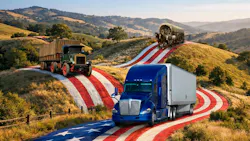
Have you ever looked at a map of U.S. interstate highways? East Coast interstates zig and zag across the map, creating an ocean of blue routes from east to west, north to south. Often, the areas with the most interstate interchanges on a map are coastal cities or those near large bodies of water, such as the Great Lakes. There’s a reason for that.
Interstates represent both a large population and a busy freight corridor. These freight corridors, while a 20th-century concept developed with the U.S. Interstate System, have their roots in pre-colonial tribal trade routes and colonial trade routes dating back to the 1600s and 1700s.
Freight corridors and cities have been built along waterways since time immemorial. Not only is water essential for life, but before trucks, water made it easier to move large quantities of goods from one population center to another.
The Thirteen Colonies were founded similarly. The British expansion into the Americas was driven by economic interests and the bolstering of England’s trade networks during the era of mercantilism, according to History.com. All of the British colonies settled on inland rivers and “tidewater regions,” which ensured ease of access for “ocean-navigating ships to bring supplies from the Atlantic directly to inland rivers,” Civics for Life states.

In the 1600s, inland routes connecting settlements and cities were also established for trade and mail. Three of the oldest of these routes are found in Connecticut, which connected Boston with New York. Today, Interstates 95, 91, and 84 follow these centuries-old routes. From 1650 to 1735, the King’s Highway—named in honor of King Charles II, who ordered its construction—connected Boston to Charleston. Much of the road is still in use today, though it has been modernized over the years.
Even with the formation of King’s Highway, many roads traveled in the 1700s were trails established by Native Americans that had simply been widened, according to historians from Colonial Williamsburg.
Though we would consider colonial roads trails today, they were heavily traveled on foot, on horseback, or in carriages. Yet, according to National Geographic, moving goods along these roads was expensive, leading farmers and artisans to primarily transport goods by water.
Goods transportation in the 1700s and 1800s: Roads, rail, and canal routes
In 1795, a privately constructed road in Pennsylvania, known as the Philadelphia and Lancaster Turnpike Road, opened. This is known as America’s first “hard-surfaced” road as well as its first toll road. The 62-mile-long and 20-ft.-wide road stretched from Philadelphia to Columbia, Pennsylvania.
Just 11 years later in 1806, the U.S. Congress approved the first federally funded road in the country. Construction began in 1811 in Maryland and was finally completed in Virginia in 1818. This road was called the National Road (today, known as U.S. Route 40). The road was eventually pushed out through Ohio and even into Illinois before construction halted for lack of funds, the National Park Service (NPS) states.
 ecm8331_featureimage
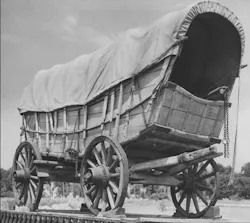
The National Road experienced heavy traffic. One type of wagon that drove the route, called the Conestoga, was “designed to carry heavy freight both east and west over the Allegheny Mountains,” according to NPS. One could consider these the tractor-trailers of the 1800s. It took a team of six horses to pull this wagon over 15 miles on an average day.
By 1892, the National Road was essentially killed off by the locomotive, as travelers opted to journey via rail instead of wagon and horseback.
The introduction of canals also aided in the transportation of goods. New York’s Erie Canal, completed in 1825, connected the Great Lakes to the Hudson River and out to the Atlantic Ocean. Shortly after, New York became the United States’ largest shipping and trade port. Chicago, resting on the banks of Lake Michigan, also grew rapidly, thanks to other Great Lakes canal projects.
By the mid-1800s, steam locomotives were the preferred method of goods movement, and along with canals, they allowed Americans to expand further into the Midwest, as they offered “an efficient and relatively inexpensive means to deliver their goods to market,” according to National Geographic.
In the 1870s, as populations grew and the bicycle became a popular mode of transportation, a group of cyclists championed the Good Roads Movement, an initiative to “build and improve the condition of U.S. roads,” according to Britannica. The group hoped to get farmers involved in their mission by publishing a “Letter to the American Farmer” in 1891, emphasizing that improved roads would help farmers get their goods to market. The call for better roads became more widespread.
Goods transportation gets back on the road
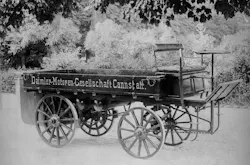
During this time in Germany, Gottlieb Daimler was busy working on the world’s first truck, which he introduced in 1896. The truck resembled a carriage with a 2-cyl. engine in the back, able to pump out 4 hp, according to Daimler Truck. Daimler’s innovation has continued for more than 120 years after his death through the company he helped build.
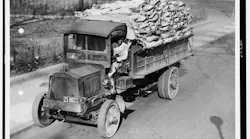
In the U.S., “the realization that bigger vehicles would be more suited to bigger jobs didn’t fully arrive until the 1910s,” according to a FleetOwner Fleets Explained article. “Many [truck] manufacturers … began shortly before, during, or shortly after the first World War.”
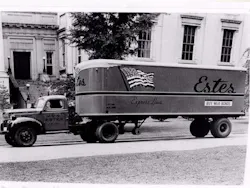
The more trucks that traversed the roads—which were primarily dirt and gravel—the more damage they inflicted. This prompted the first weight restriction for American trucking. In 1913, states began implementing truck weight restrictions, according to a history of trucking from Diligent Delivery Systems. This also prompted the idea to build roads with a “surface adequate for the heavy truck traffic,” which became asphalt and pavement.
With rail stretched “beyond its capacity” after America entered World War I, trucks became a more popular way to move goods and freight, according to the Federal Highway Administration (FHWA).
The rise of goods movement via interstate trucking
The economy boomed, and Americans became big consumers after World War I—yet rail remained the primary mode of goods transportation. In the early 1930s, trucks transported only about 2-3% of consumer goods, according to FHWA. Even when researching the development of an interregional highway system, the committee President Franklin Roosevelt tasked with exploring the idea in 1941 did not foresee much of a future for interstate trucking. Instead, it believed that trucking routes would become even shorter.
“[The] Committee does not suggest that there is need of special highway facilities for the accommodation or encouragement of long-distance trucking. All the evidence amassed by the highway-planning surveys points to the fact that the range of motortruck hauls is comparatively short. There is nothing to indicate the probability of an increasing range of such movements in the future,” the committee stated in its report, released in 1944. The eventual modernization of transportation “would seem to forecast a future shortening rather than a lengthening of average highway-freight hauls.”
However, by the 1950s, truck-hauled freight increased to 17% of all freight-ton miles, thanks to the post-World War II economic boom. This—along with an eye on national defense—led President Dwight D. Eisenhower to revisit a federal highway program; he tasked another committee with finding a way to fund a national interstate system. When Eisenhower presented this committee’s report to Congress, he stated:
“Our unity as a nation is sustained by free communication of thought and by easy transportation of people and goods. The ceaseless flow of information through the Republic is matched by individual and commercial movement over a vast system of interconnected highways crisscrossing the country and joining it at our national borders with friendly neighbors to the north and south.”
The Federal-Aid Highway Act was passed in 1956, and it funded the interstate system we travel today.
The Highway Cost Allocation Report, released in 1961, detailed the shift in goods transport from rail to truck after the construction of the national interstate system. Goods that shifted from rail to road transportation in large percentages included consumables, such as fruits and vegetables, petroleum products, and steel shipments to factories, according to the report.
Shipment of goods by truck has grown since then. Today, trucks haul more than 70% of America’s freight, according to the American Trucking Associations, and are the lifeblood of American life as we know it.
The road to America’s modern-day transportation system and logistics network is older than America itself, but analyzing the history of transportation makes it evident that goods transport played a large part in transportation advancement and the settlement of America’s rural heartland.
Timeline of American Trucking
1820 - 1840: The Conestoga wagon, designed in the 1700s, was heavily used to transport freight. This wagon was a common sight along the National Road, which completed construction in 1818. (image)
//
1896: Gottlieb Daimler developed the world’s first truck in Germany. (image)
//
1913: States begin implementing truck weight restrictions.
1917: The Federal Excise Tax (FET) places a tax on all new heavy-duty truck sales.
//
1937: Hours of Service rules were first established.
1956: Federal-Aid Highway Act passes, funding the Interstate Highway System that trucks travel today.
//
1980: While trucking’s “deregulation” period began in the 1970s, the Motor Carrier Act of 1980 increased competition and productivity within the industry by removing governmental red tape for entry into the industry.
1982: The Surface Transportation Assistance Act provided funding for infrastructure improvements and established a federal standard for truck length and weight.
1985: The EPA begins setting emissions standards for heavy-duty trucks with significant changes in 2007, 2010, and most recently 2027.
//
2010: Federal Motor Carrier Safety Administration launches Compliance Safety Accountability (CSA) program.
2015: Electronic logging devices are mandated.
2021: EPA establishes Clean Trucks Plan
2025: Autonomous trucks beginning running routes
About the Author
 Jade Brasher
Jade Brasher
Executive Editor Jade Brasher has covered vocational trucking and fleets since 2018. A graduate of The University of Alabama with a degree in journalism, Jade enjoys telling stories about the people behind the wheel and the intricate processes of the ever-evolving trucking industry.