Women in Transportation: Career-building lessons from leaders
Key takeaways
- Women from different backgrounds shared their journeys of stepping into leadership roles in transportation, emphasizing the importance of self-belief and taking risks.
- Key lessons include trusting oneself, learning from mistakes, and building confidence through problem-solving and solution-oriented thinking.
- Industry gaps such as lack of mentorship and visibility for women are still an issue in the industry. But women should actively seek networking opportunities and mentorship.
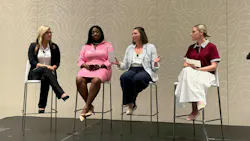
NASHVILLE—A little belief and determination can lead to great opportunities in transportation. At least, that’s been the experience of three women from different backgrounds, companies, and learning and leadership styles who all convened here in Music City at the Motive Vision user conference.
The three women—Jessica Lovell, associate director of safety at Lincare; Tyra Grayson, director of safety and compliance for Adroit and founder of The Tier Consulting Group; and Allison Finerfrock, VP of global logistics at Ferguson Enterprises—sat on a panel at Motive’s annual Driving Women Forward Breakfast, an educational panel made up of industry leaders who happen to be women.
Each career path looked drastically different for these women, but while each of them had reservations—even doubts—about the changes that would come if they stepped into a new role, they each made the conscious decision to take a leap. That leap turned into leadership.
Taking the leap: From the office to the field, real estate to sales, and employee to entrepreneur
Grayson, who once worked at a transportation company as the director of safety and compliance, appreciated the job security with her employer, “but I was just tired of waiting on that ticket of permission to say, ‘Hey, here’s your ticket to the next step, here’s your ticket to the next level.’ And so I bet on myself, and I started entrepreneurship, consulting.”
“That day came, and I said, ‘You know what, I’m not going to wait around for that ticket,’” Grayson said. “I want to be able to create and build the homes that I fought so hard to be in.”
Today, Grayson consults for fleet companies and has even consulted for retail giant Amazon.
Finerfrock knew she wanted to lead, but she initially felt uncomfortable about moving to another state where she had no support system. The opportunity was a general manager role at a facility that “needed a complete turnaround,” Finerfrock said.
“I knew what I was getting into, because I had been out there helping,” she continued. “So I made the decision, and obviously with my spouse, and said we’re going to pick up and move halfway across the country, where we have no support and no other family.”
Soon, Finerfrock built a community around her, and when it came time for her to take on a leadership role in another state, she no longer saw the lack of a support system as an obstacle.
Lovell came from a position in property management, but she wanted more. She interviewed for a sales position in health care, but was “terrified” of shifting from a stable income to a commission-based job.
“I was real nervous to have that secure income and then rely on myself,” Lovell said. Then, “I thought to myself, ‘I just need to trust me.’”
She accepted the job and took her facility from “down at the bottom” to the top respiratory facility on the West Coast. Eventually, she began leading more and more facilities, developed rapport with leadership, and was promoted to Lincare’s director of safety.
 Women in Transportation: By the Numbers
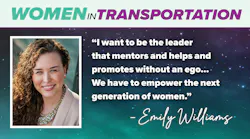 wit_images_emily
Leadership lessons learned along the way
Betting on and trusting yourself go hand in hand, and trusting her own decisions is a lesson Finerfrock has had to learn throughout her career.
“Mistakes are going to happen; it’s what you do with those mistakes,” Finerfrock said. “There’s nothing more empowering than going to your leader and being like, ‘Hey, I made a decision, it didn’t work out, but here’s what I’m going to do different next time.’ And then you actually build more trust in yourself and your leaders [build] more trust in you. You have that ability to take a chance, to make a mistake, and to move on.”
Lovell has learned to speak up and trust herself to solve problems. In her early days, she would present problems to her superiors without solutions. But once she began finding solutions on her own—solutions her superiors celebrated—she began to build her confidence. Today, she encourages her team to be solution-oriented.
“Things that I work on with my team are: ‘I understand you have a problem, but what are your ideas, what are your thoughts around how you’re going to solve it?’” she said. “I give them the opportunity, because it builds self-confidence in them as well.”
Overcoming her own self-doubt was one of Grayson’s biggest lessons learned. Previously, Grayson “internalized” her mistakes—even the small ones. Throughout her career, she’s had to learn to shift her mindset.
“A lot of it is mental,” she said. “I’m in a room, I’m in a position, the work spoke. That’s why I’m here. I don’t need to over-explain, I don’t need to over-share, I don’t need to continue to prove to you that I deserve to be here, because I’m here. You hired me, you see the work, you see the results.”
What does the industry still get wrong about developing women leaders?
The industry is still lacking in investing in women, according to Grayson. Women need mentorship, networking, and visibility.
“There’s still not a lot of effort being put behind women in that regard. … Actively seek that, if you can,” Grayson said, encouraging the women attendees in the room to find mentors, attend conferences, and join organizations within the industry.
Finerfrock is tired of folks in the industry making assumptions about what women want from their careers. Finerfrock started at the corporate headquarters, but she wanted to be working out in the field. And while she has a family with children, it doesn’t prevent her from traveling, as some in the industry have assumed in the past.
“Don’t ever assume that someone can or can’t do something, whether they’re a man, woman, whoever,” she said.
Finerfrock also values a well-thought-out decision—even if others look down on it.
“I think there’s a perception that women aren’t quick decision makers; that, ‘Oh, they have to go think about it.’ Well, guess what: that might not be a bad thing,” Finerfrock said. “I think there’s a thought in supply chain and logistics and trucking and all these different industries that we are in, that if you can’t make a decision immediately, you’re not a good leader, or you’re not a good decision maker. When it’s actually, I think, the opposite.”
Yet, at the end of the day, we’re all human, Lovell said, and we all have faults, insecurities, and different things we can work on.
“It’s not about men versus women,” Lovell explained. “We’re all human, all have our own struggles. It’s about how you're going to be a stronger leader and speak up and speak up for yourself and advocate for yourself.”
About the Author
 Jade Brasher
Jade Brasher
Executive Editor Jade Brasher has covered vocational trucking and fleets since 2018. A graduate of The University of Alabama with a degree in journalism, Jade enjoys telling stories about the people behind the wheel and the intricate processes of the ever-evolving trucking industry.