2026 Women in Transportation check-in
Key takeaways
- Mentorship is valued by women in trucking, with many seeking more opportunities for guidance and leadership development to enhance career growth.
- Perceptions of being welcomed vary; positive experiences include supportive leadership and diversity, while negative ones involve harassment and gender bias.
- Industry improvements suggested include stronger safety policies, increased women in leadership, and more targeted networking to foster inclusion and retention.

This article was featured in FleetOwner's annual Women in Transportation issue.
For over a decade, FleetOwner has looked at ways to shine a light on how women are shaping the transportation industry in the 21st century. This year, the team profiled six women from different parts of the industry, showcasing their accomplishments and how they have overcome. You can view all six profiles here.
Data tells one story, and perception tells another. Data provides factual information necessary to inform decisions and implement change. Perception is an opinion or an emotional tie to an organization’s operations. But perceptions alone can help drive change and be even more valuable than any raw data. After all, employees’ perceptions of their employers can be the difference between retention and churn.
With driver turnover and an aging workforce plaguing the trucking industry, companies that strive to pull in workers from the other 50% of the labor pool—women—might come out stronger. The best way to do that is to identify women’s perception of the industry and use their perspective to make improvements.
FleetOwner compiled responses from three industry surveys: American Trucking Associations’ Women In Motion (WIM) survey, which received responses from women in non-driving roles; Lance Surety Bonds’ survey, which surveyed women in driving roles; and FleetOwner’s own survey, which sought insight from both women and men on how their workplace treats women employees. The results highlight why women choose the industry, their expectations and concerns, and how industry leaders can make improvements.
Why do women choose to work in trucking?
Most individuals who work in the trucking industry either start out in the family business, like Ingrid Brown (read her profile here), or simply fall into it, like Paige Petroni (read her profile here). Regardless of how these women entered the industry, they each had different reasons for showing up. The charts below identify these reasons for both drivers and non-drivers.
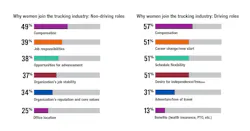
Once a woman decides to get into trucking, she often becomes a recruiter too. Lance Surety Bonds’ survey found that 85% of women drivers would recommend the job to other women or younger generations, and WIM’s survey found that 55% of women learn about their first jobs in trucking through a referral.
Trucking and equal pay
Both segments of non-driving and driving roles within the industry cite compensation as a top reason for joining. This is significant.
“Being a truck driver is one of the only industries in the world where there's equal pay,” Emily Williams, WIM chair and Geotab’s head of transportation business development, told FleetOwner.
While there are few statistics regarding equal pay for non-drivers, many trucking companies tout this reality to their drivers. Melton Truck Lines states on its website that its women driver salaries are equal to those of men, as the company pays its drivers “by cents on the mile,” regardless of who is driving. Further, the Truck Driver Institute listed unequal pay as the No. 1 busted myth on its website, stating:
“In reality, male and female truck drivers are paid equally. A trucker’s wages are usually determined by the miles they log each day, the hours they drive, and/or a percentage of the load pay, depending on the particular carrier. None of these factors has anything to do with the gender behind the wheel.”
However, Lance Surety Bonds’ data found that women drivers earn 20.5% less than men drivers, on average, with women’s average pay at $60,000 annually compared to men’s $73,000 average.
Does the industry provide mentorship opportunities?
At a time when uncertainty has dominated headlines, the Society for Human Resource Management found that organizations with mentorship programs might benefit from improved employee retention and greater stability. In-house mentorship programs keep employees engaged, which improves retention. Further, a 2022 Gallup poll found that employees in organizations with mentorship and sponsorship programs “are twice as likely to be engaged and 98% more likely to strongly agree that they would recommend their organization as a great place to work.”
But where does the trucking industry stand with mentorship? FleetOwner posed this question in its survey and found that roughly two-thirds (66%) of both women and men believe their organizations provide mentorship opportunities.
The Lance Surety Bonds survey reported that mentorship opportunities are a top desire for women truckers, with 26% citing this as something they’d like to see change in the industry. Further, 30% of LSB survey respondents said that having access to female or minority mentors would make their job feel more inclusive.
Similarly, 26% of respondents in the WIM survey found that women in the industry see the lack of mentorship as a barrier to career advancement.
Does the industry make women feel welcome?
This question is a perfect example of when learning perception is more important than reviewing data. Whether one feels welcome in a certain environment is a personal opinion, and because the industry should strive to ensure all women feel welcome in every facet of trucking, it’s important to ask women—and when applicable, men—how welcome they feel. FleetOwner’s survey did just that.
Some women report positive experiences within their company, citing the number of women in the office and the women in leadership roles.
Here’s why some women feel welcome in the industry:
- “I work in the corporate office, and it is mostly females. We are empowered to run the operations smoothly and efficiently.”
- “There are a number of women working here; women in positions of power.”
- “There are more women leaders in my current company than I ever had in the past.”
Yet, some women report negative experiences within their company, including harassment.
Here’s why some women feel unwelcome in the industry:
- “They treat women as incapable and usually assign tasks such as making the coffee, taking meeting minutes, etc.”
- “I've been sexually harassed by both customers and coworkers.”
Because allyship among men is vital for women’s acceptance in the trucking industry, FleetOwner surveyed men for this question, too.
Men in the industry believe:
- “My company just treats all drivers the same.”
- “Other than providing for the basic differences in a woman's needs, men and women are treated equally in our organization.”
- “We welcome women, gay, lesbian, and trans professionals into our team. Results matter most—if you perform at a high level, you're in.”
- “Women seem to be more responsible and in tune. They want to be professional. They typically hold onto the steering wheel with two hands. They wear boots or closed shoes, and they are on the floor and not on the dash. They use Bluetooth when on the phone, not one hand, with their eyes on the phone screen.”
 wit_images_shari
 driven by connection
Does the industry foster women’s growth?
Feeling welcome in the industry and being empowered within the industry are different concepts. FleetOwner’s survey sought to understand whether women feel their organizations foster growth. Again, the survey found mixed reviews.
Does your organization foster women’s growth? Here’s what women believe:
- “There are a ton of opportunities to move up. They support continuing education, seminars, and group outings.”
- “Depending on your role, I think there are growth opportunities. I've seen a lot of women who are hired on the store level leave very quickly, though.”
- “[My organization offers] diverse programs, which I don't feel really help because the culture is that women ‘know less.’”
FleetOwner posed the same question to men, whose responses were more positive. One respondent believes his organization fosters growth opportunities among women because it embraces them “with open arms.” Another believes that “quotas” help foster women’s growth.
Does your organization foster women’s growth? Here’s what men believe:
- “Putting them in touch with other women in the industry and mentoring younger women.”
- “No, but many women have come to drive here, and there seems to be low turnover.”
Where is there room for improvement?
While the industry has made progress in hiring, recruiting, and accepting women, the survey results show there’s room for improvement. But where do the industry’s women believe that effort should go?
According to women truckers, specifically, the LSB study found that most women (68%) want to see improvements in safety and implement stronger policies against harassment and discrimination.
Other safety concerns women have are outlined in the graphics below:
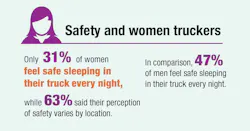
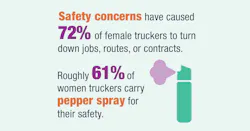
The LSB survey also found that 41% of women drivers want to see more women in leadership roles, and 35% want equal pay.
Respondents to FleetOwner’s survey want to see “more women-oriented networking” and to be treated “equally, not specially.”
The industry’s men showed support for women in the FleetOwner survey, citing the need for more “respect” toward women and “merit-based pay and promotion.” Another suggested to “have more of an outreach and give our women drivers some specific brochures to hand out to show we are welcoming.”
What’s your perception of women in trucking?
Those who work in trucking know the industry offers great opportunities to anyone with a hard work ethic and a good head on their shoulders. Making the industry a better workplace for half the population only enhances these great opportunities and makes it even better.
Whether you’re a woman working in trucking or a man who works alongside them, did reading these survey results inspire you? Did something resonate? Are women in your organization treated unfairly or with partiality? If you’re a fleet leader with women on your team, ask them these types of questions either face-to-face or in an anonymous survey. Feedback is crucial for industry improvement, and the lovely ladies in this industry will be happy to give it when you’re ready to listen.
Did these survey results inspire you or resonate with you? Get the conversation started at your workplace or online using the hashtag #FOWomenInTransportation.
Did these survey results inspire you or resonate with you? Get the conversation started at your workplace or online using the hashtag #FOWomenInTransportation.
About the Author
 Jade Brasher
Jade Brasher
Executive Editor Jade Brasher has covered vocational trucking and fleets since 2018. A graduate of The University of Alabama with a degree in journalism, Jade enjoys telling stories about the people behind the wheel and the intricate processes of the ever-evolving trucking industry.