Hazardous waste, flawless safety: Inside Ross Transportation's award-winning fleet
Key takeaways
- Award-winning safety: Ross Transportation Services earned the 2026 FleetOwner Small Private Fleet of the Year award by maintaining a flawless 0.0 DOT recordable accident rate while hauling hazardous waste.
- Unique routing strategy: The hazmat carrier utilizes a "backward" logistics model, dispatching empty trucks to retrieve specialized waste and returning it to their Grafton, Ohio, base for on-site processing.
- Industry-leading retention: By treating its 25 specialized drivers as frontline customer service ambassadors, the fleet maintains an average driver tenure of more than eight years.
- Transparent safety tech: The company successfully implements in-cab technology, such as cameras and ELDs, by focusing on constructive driver coaching rather than punitive discipline.
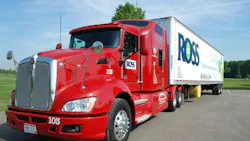
Moving freight from point A to point B requires careful execution, but moving hazardous waste leaves absolutely zero margin for error. For the team at Ross Transportation Services, the trucking arm of family-owned Ross Environmental Services, operating safely in a high-stakes segment isn’t just a regulatory baseline—it is a deeply ingrained operational philosophy.
That unyielding discipline is why the 25-driver private fleet won the 2026 FleetOwner Small Private Fleet of the Year award, sponsored by Descartes, after logging a flawless 0.0 DOT recordable accident rate over the past year.
“We have a firm belief in safety and compliance being our number one priority,” Chris Fada, VP of Ross Transportation Services, told FleetOwner. "We have this equilateral triangle that we talk about a lot, whether it’s with new hires or 40-year associates. It’s compliance and production, but it all sits on a bedrock of safety. That’s the third leg of the triangle: If we’re not safe, we don’t get to any of those other goals."
A 'backward' routing model for hazmat logistics
While most fleets specialize in outbound distribution or tight regional routing, Ross operates what Fada describes as a “backward model" compared to traditional trucking. The fleet’s core mission is to support its parent organization’s hazardous waste incinerator.
Ross Transportation Services: Facts & Figures
- Company heritage: Ross Environmental Services is celebrating its 75th anniversary as a family-owned enterprise supporting hazardous waste management and environmental solutions.
- Headquarters: Grafton, Ohio
- Fleet profile: 25 company drivers operating a highly diverse mix of dry vans, liquid bulk tankers, vacuum tankers, and roll-off units.
- Safety record: 0.0 DOT recordable accident rate over the past year; 100% compliance utilizing Smith System defensive driving training.
- Driver longevity: Average driver tenure exceeds eight years, with multiple drivers exceeding 20 years of service.
- Compensation strategy: Competitive hourly pay, robust health benefits, and a universal corporate profit-sharing program extended to every employee.
- Community footprint: Administered via the Ross Foundation, key initiatives include building the county fairgrounds event center and completely funding the Midview High School athletic complex expansion.
"We are essentially a truckload hauler making roughly one stop a day, but we operate backwards from most people," Fada explains. "We leave our base of operations empty, pick up a load of waste, and bring it back home where we manage it on-site."
A one-stop-per-day operation sounds simple on paper. But the variety of needed equipment creates logistical complexity. Depending on the day's duties, Ross drivers might pull standard dry vans loaded with containerized waste, specialized bulk-liquid tankers, vacuum-loaded tankers, or roll-off trailers carrying bulk solids.
Matching the right driver with the right equipment for the right job, while maintaining strict hours-of-service compliance, creates a daily multi-variable puzzle for the dispatch team. "Our drivers work a lot of hours, and managing that home time with their work time is something we constantly try to optimize," Fada says. "Our logistics department does a fantastic job of managing our customer needs while meeting our drivers’ personal requirements."
Implementing fleet safety technology with driver transparency
As a historical early adopter of in-cab technology, Ross began deploying electronic logging devices (ELDs) long before the federal mandate took effect a decade ago. That early experience taught the leadership team that introducing technology requires transparency rather than top-down enforcement.
When the fleet recently transitioned to onboard cameras, management used lessons learned from the ELD rollout to reduce friction. "With any new technology, there are going to be some curveballs thrown at you," Fada says. "We wanted to deal with those curveballs early to soften the concept of cameras in the trucks—explaining what we can see, when we can see it, and how we use it."
Instead of using telematics data as a punitive tool, Ross uses metrics such as harsh braking, idle time, and fuel efficiency to foster constructive coaching and open dialogue.
"One of the biggest benefits is that our drivers understand why we look at these things," Fada says. "They understand we aren’t looking to discipline people or beat heads. It’s all for the sake of safety, compliance, and efficiency. We don’t hide behind the books. We involve them in the decisions we make and explain what’s behind it all. It makes them better, which in turn helps the organization."
 Descartes transportation management platform helps FGL automate freight brokerage operations
Hazmat truck drivers as frontline customer service ambassadors
In the hazardous waste sector, the private fleet driver is the primary face-to-face contact a customer has with the parent company. Ross treats its drivers as critical customer service representatives who do far more than drop a trailer. Ross drivers are extensively trained to assist site managers with complex compliance tasks, such as completing shipping manifests and verifying compliance with strict labeling requirements imposed by the U.S. Environmental Protection Agency.
"Our external customers see that driver in the red shirt pull up with the red truck, and that’s their point of contact," Fada says. "When a driver is ready and willing to get out of the seat and do whatever they can to help a customer, they don’t lose sight of that. At the same time, our drivers are trained to know when to raise their hand and call back to our team if a question is beyond their capacity."
Driver retention strategies for specialized fleets
As demographic shifts and market pressures cause driver turnover to tick upward across the industry, Ross maintains stability through an intentional onboarding and retention strategy. The carrier’s overall transportation division consists of just 35 people, which creates a close-knit, direct-line environment.
"It is dysfunctional at times, but it’s a family, and we treat it that way," Fada says.
When onboarding new hires, Ross implements a highly intensive, month-long training program before a driver ever takes a truck out alone. A large portion of that time is spent paired with veteran driver mentors. According to Fada, the first 24 months are the critical threshold for long-term retention.
"We feel like if we can get them to Year Two, we’re in good shape with hanging onto them long term," Fada highlights. "Through checking in at 30, 60, and 90 days, we ask a lot of questions. We reach out to them at random times just to talk. Once they get past a year, they start becoming a part of that culture. When we see that turn happen, we know we're in a good position."
The proof is in the data: The average driver tenure at Ross is an impressive eight years, bolstered by a veteran core of four drivers who have been with the company for more than two decades.
Corporate philanthropy and community investment
Ross also takes pride in giving back to its local community of Grafton, Ohio. Operating through the philanthropic Ross Foundation, the company acts as a vital pillar for the rural township where it operates.
Over the years, the foundation and the Cromling family (now in its third generation of family leadership since it was founded 75 years ago) have poured substantial resources into local civic infrastructure. Recent efforts include funding and building a brand-new community event center at the local county fairgrounds to support agricultural programs, as well as a massive financial contribution to Midview High School to construct a fully modernized athletic facility.
"It’s just one of our core values as a company," Fada says of the community investments. "We want to take care of our associates and our customers, but it’s also our responsibility to take care of our neighbors and be a good community member. There is no quid pro quo. It is simply the right thing to do."
About the Author
 Josh Fisher
Josh Fisher
Editor-in-Chief
Editor-in-Chief Josh Fisher has been with FleetOwner since 2017. He covers everything from modern fleet management to operational efficiency, artificial intelligence, autonomous trucking, alternative fuels and powertrains, regulations, and emerging transportation technology. Based in Maryland, he writes the Lane Shift Ahead column about the changing North American transportation landscape.