Women in Transportation: This director’s leadership style is transforming her department
Key takeaways
- Super has increased employee engagement by 10% through open communication and actively seeking employee opinions.
- She maintains strict adherence to company rules and regulations while customizing her leadership approach to meet individual needs.
- Super is working to shift her team’s culture to embrace emerging technologies in transportation, keeping the workforce motivated and future-ready.
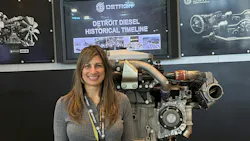
Christine Super has spent less than two years in her role as the director for Powertrain Test Center at Detroit Diesel’s manufacturing plant. She’s already renegotiated a union contract, restructured the supervisor model in her department, and is now focused on shifting the workplace culture to increase employee engagement—and it’s working. What’s her secret?
FleetOwner sat down with her at the Detroit Diesel engine manufacturing plant to pick her brain about her dynamic leadership skills and understand how she’s thriving as a leader in a male-dominated environment.
A no-compromise, yet customized, leadership approach
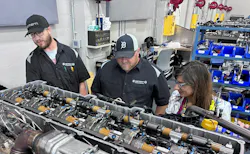
Super leads a workforce of 110 full-time employees and about 20 individuals in supplemental positions. She oversees both a nonunion and union workforce and uses a “mass customization” strategy in her leadership.
The “customization” within her leadership strategy is necessary because each employee needs something a little different to realize their full potential. Super deems this customization necessary because she desires that all her employees succeed.
“I’m very compassionate, and I want people to collaborate and feel seen as people,” Super told FleetOwner. “I want people to grow personally and professionally.”
So, what does Super’s mass customization leadership strategy look like? Essentially, Super’s leadership style and messaging change with individuals in a way that most helps them.
“I know I have to treat this person a little bit differently than I do this person to get them to their highest potential,” Super explained. “I tailor my message to those people to encourage them.”
Much of the conversation centered around the differences in leadership styles between men and women, but that also led to the different ways Super approaches the men on her team compared to the women.
“Women are going to be different—we're not going to necessarily look like our male counterparts, even from the way we do things, therefore I shouldn't expect the men and the women in my team to do things the same way, right?” she said. This leads to “keeping everything fair and all the rules the same, but maybe the conversations are a little different.”
But for Super, customization never means compromising on company rules or Detroit quality. As a union employer and manufacturer of heavily-regulated engines and components, Super maintains that the rules are the rules and they must be followed, regardless of the way the message is given.
“If there's a non-compliance topic, I'm still going to hold down that ‘This is the rule, and we must be strong on the rule,’” she said, reiterating that her leadership style “is not a lax in control or discipline, it's more of, ‘We can be people and just follow the rules,’ kind of thing. But if we don't, then we're going to talk about it. We're not just going to let it go. … I don't give anyone a pass. Everybody gets the same treatment of their performance potential and their performance standard.”
Increasing employee engagement, building union relationships, and building a company culture that welcomes challenges
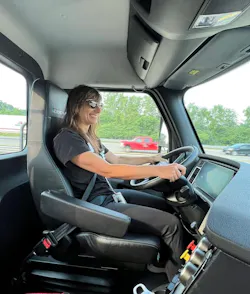
One of Super’s crowning achievements in her role as test center director has been the increase in employee engagement. Employee engagement is a metric Detroit Diesel measures via an employee survey to determine how “actively engaged” employees feel they are in their work, Super explained. Since Super took over in the test center lab, engagement has increased by 10%. Super believes her employee engagement scores have increased due to one simple reason: She simply talks to her employees.
“I learn about what they're doing, [and] I ask for their opinion,” Super said. “Better leaders ask people's opinions, and I feel like some people don't necessarily [ask].”
Super has also worked to build engagement and better relationships among union workers, as managing Detroit Diesel employees and union employees often have differences due to different operating procedures. That difference can sometimes “be a deterrent” for managers, Super said. However, Super has worked hard to build her relationship with the union, and she’s encouraging others to do the same.
“I think they're doing an amazing job, and I think that that's been positive for the union—it's been positive for the company, so [we’re] really excited about the future of that,” she said.
Welcoming challenges in a changing world
A challenge Super is working to overcome is shifting her group’s culture from one that solely fosters its current skill sets to one that embraces the changing landscape of transportation.
When legislation dictated that combustion engine technology could remain the standard a while longer, Super saw her employees slightly disengage from those emerging technologies. Yet she realizes that Daimler Truck, Detroit Diesel's parent company, and Detroit Diesel can’t ignore the alternative technologies that are making their way into the transportation industry.
One way Super is working to “reinvigorate” her team’s excitement about emerging powertrain technologies is by introducing some of those technologies into the combustion space—for testing purposes, of course. In fact, her goal is to generate more investment for combustion research and development over the next few years to keep that excitement within her team.
Leading by example, and leading with her gut
Overall, Super strives to build a workplace where people enjoy coming to work each day, just as she has for the past 22 years at Detroit Diesel. While she has had great role models and leaders throughout that time, she leads her team in her own special way by going with her gut.
The data has shown that, so far, her strategy is working.
“Christine has this rare ability to connect deep technical knowledge with strong strategic and organizational leadership,” Michael Doornbos, manager of engineering program management at DTNA, said of Super. “Her global background across multiple engineering roles gives her a perspective that's genuinely hard to find.
“She can navigate complex challenges of any kind while keeping teams aligned and moving in the same direction,” Doornbos continued. “What stands out most is that she listens and seeks to understand first, then creates clear direction and accountability without losing sight of developing the people around her. Working with her has fundamentally shaped how I think about leadership, execution, and long-term organizational improvement.”
What’s more, Super leads by example, as outlined by her colleague, Rianne Schoeffler, manager of HV battery cell technology and battery validation.
“Christine is the real deal—what you see is exactly who she is, and that’s something I really appreciate about her,” she said. “She’s easy to connect with, authentic, approachable, and always willing to listen, whether it’s for coaching, mentoring, or just a quick question. What stands out most to me is how passionate she is about her work and how intentional she is about keeping everyone aligned and included in achieving her goals.”
In less than two years in her position at Detroit Diesel’s Powertrain Testing Center, Super is thriving and ready to continue changing the culture for the better, improving employee engagement, and gathering more investment in programs that keep her team encouraged and excited for the future.
About the Author

Jade Brasher
Executive Editor Jade Brasher has covered vocational trucking and fleets since 2018. A graduate of The University of Alabama with a degree in journalism, Jade enjoys telling stories about the people behind the wheel and the intricate processes of the ever-evolving trucking industry.