How Lazer Logistics powers up yard performance
Key takeaways
- Lazer Logistics operates more than 150 electric terminal tractors across 21 states and Canada.
- The company's electric yard tractors have delivered more than 3 million miles with lower maintenance costs than diesel units.
- Lazer expects more than 100 additional electric units to enter deployment over the next 24 months.
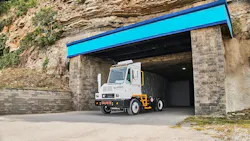
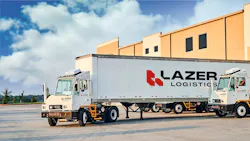
Lazer Logistics began in 1996 with a single terminal tractor and has grown into the largest provider of outsourced yard logistics in North America. Based in Alpharetta, Georgia, it now operates at more than 800 locations across the U.S. and Canada, with more than 3,000 power assets, along with drivers and maintenance.
A key strategic move has been electrification. The company now operates more than 150 Class 8 battery-electric terminal tractors, most supplied by Orange EV, across 21 states and Canada. This makes it the largest outsourced electric yard truck fleet in North America. It all started with three electric units in 2017.
“High-frequency, in-yard drop-and-hook trailer movements make terminal tractors an ideal candidate for electrification,” Chris Bennett, VP of EV, energy, and sustainability, said. “Yard tractors operate on predictable duty cycles with frequent stops, conditions that are well matched to battery-electric systems.”
A seamless EV integration
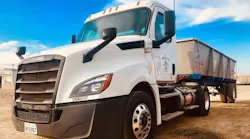
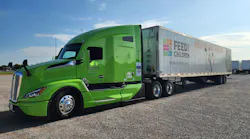
The company owns and operates both diesel and electric spotters, allowing it to control uptime, maintenance, and performance. Lazer also manages driver schedules to ensure continuous operations. Charging is seamlessly integrated into this workflow without sacrificing productivity.
“Charging infrastructure for yard tractors is far less complex than many think,” Bennett related. “With opportunity charging during breaks, meals, and shift changes, we can keep trucks in operation without requiring the larger charging systems typically associated with Class 8 electric trucks.”
Lazer has achieved a ratio of up to four trucks per charger with its standard EV and as high as a six-to-one ratio with its heaviest-duty model. Across more than 80 unique deployments, most EV sites have relied solely on existing facility power, avoiding expensive new utility upgrades.
Lazer’s decision to scale its electric fleet was based on data, not experimentation. The company accumulated more than 3 million electric miles and millions of yard moves in the first eight years of its EV program, giving it a deep operational dataset.
That data tells a compelling story, Bennett noted. “Electric terminal tractors are proving not only viable but advantageous across key performance metrics,” he said. “Maintenance costs, for example, are more than 50% lower per operating hour compared to diesel units in similar conditions. Uptime has improved as well, supported by the simplicity of electric drivetrains and a robust service network, including Orange EV’s mobile field service capabilities.
“Durability has also exceeded expectations,” Bennett continued. “We have one Orange EV electric yard tractor approaching seven years of service and nearing 40,000 operating hours, and several others soon surpassing 30,000 hours. Battery health and propulsion system performance have consistently outperformed initial engineering projections.”
One of Lazer’s key differentiators is its ability to offer electrification as a turnkey service. This includes detailed financial and sustainability analytics, such as electricity usage, carbon reduction, and asset utilization––data that customers can use for internal decision-making and regulatory compliance.
This approach is particularly attractive to Fortune 500 companies that rely on Lazer to manage complex distribution networks. Outsourcing yard operations gives businesses access to advanced electrification strategies without building in-house expertise or spending precious capital.
A reason to expand
Lazer also helps customers navigate compliance requirements and incentive programs. However, Bennett noted that the company has reached a point where grants are no longer essential to making electrification economically viable.
“We appreciate the role incentives have played, especially early on,” Bennett said. “But today, the total cost of ownership stands on its own. In many cases, we can show a return on investment for charging infrastructure in less than a year, and sometimes in just weeks at the largest sites.”
With electric spotters now representing roughly 7% of its spotter fleet, Lazer Logistics is continuing to expand its EV program aggressively. The company has more than 100 new electric units in its deployment pipeline over the next 24 months.
The partnership with Orange EV remains central to that growth. “Orange EV continues to lead the field,” Bennett said. “Their trucks and chargers, along with their in-house service network, help us deliver efficiency and uptime.”
“Lazer sees electrification as a competitive advantage and not just an environmental initiative,” Bennett added. “Electric spotters deliver superior operational performance and significantly lower costs while also helping our customers meet their Scope 3 sustainability goals.”
About the Author
 Seth Skydel
Seth Skydel
Seth Skydel, a veteran industry editor, has more than four decades of experience in fleet management, trucking, and transportation and logistics publications. Today, in editorial and marketing roles, he writes about fleet, service, and transportation management, vehicle and information technology, and industry trends and issues.